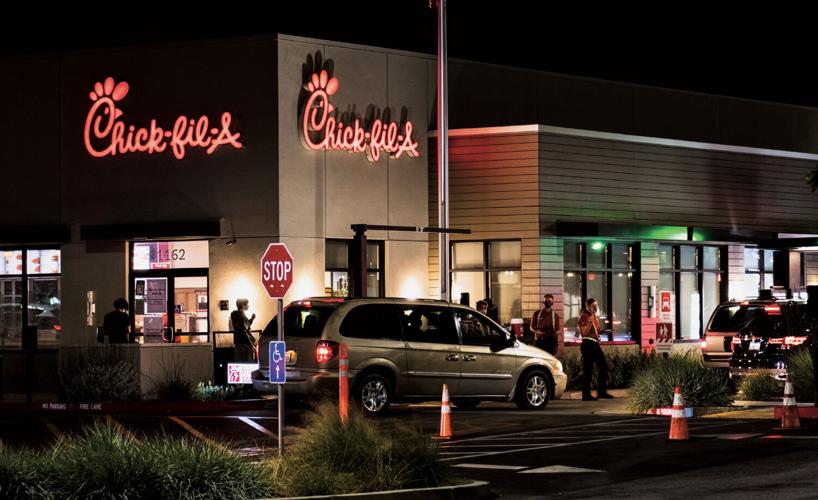




Chick-fil-A isn’t alone when it comes to dealing with long drive-thru lines.
When nearly every restaurant dining room shut down, businesses with drive-thru lanes were forced to manage an incredible surge in business. Even after shutdowns lifted and people could dine in again, drive-thru traffic continued to grow. While that’s somewhat of a nice problem to have, something must be done when your restaurant requires a traffic cop.
Across the top 10 brands in QSR, service times were slower and less accurate overall in 2021, according to an annual survey by mystery shopping and analytics firm SeeLevel HX. Customers spent 6.3 minutes in line, a 7 percent slowdown from 2020. Order accuracy fell to 85 percent from 87 percent.
Why? There are plenty of reasons. Drive-thru sales keep growing, up about 10 percent year over year through October 2021, according to research firm Black Box Intelligence. And even while traffic was down in 2021 compared to 2020—it dropped 6.4 percent, according to the firm—it’s still much higher than 2019. Plus, there’s the exceptionally difficult employment situation, with the hospitality industry overall 8.9 percent shy of full employment, according to November 2021 data from the U.S. Bureau of Labor Statistics.
But there are solutions. We asked three top franchise operations executives to share how they tackled the bittersweet problem of incredible drive-thru traffic.

Monica Rothgery, KFC’s chief operating officer.
KFC’s ‘nuts and bolts’ tactics
KFC Chief Operating Officer Monica Rothgery noted the surge in traffic when the pandemic hit, and because the company already had large meals as a core competency, some of those dinner lines got exceptionally long. They stretched further when the company launched its updated chicken sandwich.
During dining room shutdowns and through to today, she said correct staffing and communication was paramount.
“The focus went totally to the drive-thru; every person and every operation knew the drive-thru was the way we’d push through the pandemic. The use of headsets, we were using three to four headsets so everyone knew what was going on, and the use of a timer,” said Rothgery.
There were a lot of “nuts and bolts” changes, many done with resources franchisees already had on hand. Employees moved over from empty dining rooms and the spare headsets got some action. There was a bit of spirited competition in the mix, too, as those drive-thru timers connected to the cloud and back to a scoreboard in the restaurant.
“We have boards in our restaurants to compete with other restaurants across the country. Franchisees can compete nationally or within their organization,” said Rothgery. “Anytime you can make something a game and make it fun, it’s better. Everyone knows who they want to eat and who’s on top.”
She also sought to get customers out of the line as some restrictions lifted. KFC rolled out Quick Pick-up, a low-friction way to grab digital orders without waiting in line. She wants to compete with the brands getting 40 percent digital orders, which would “totally change the business model.”
While Rothgery is working on some updated digital menu boards and some predictive analytics tools to help plan ahead better, those are incremental on top of a simple operation. Her No. 1 solution to long lines? An uncomplicated menu.
“I think that’s a real key to speed and ease of ordering. The more simple we can make our menu, the easier it will be for the customer and the team member to navigate,” said Rothgery. “It has to start with the menu. A complex menu, even with technology, is still a complex menu.”

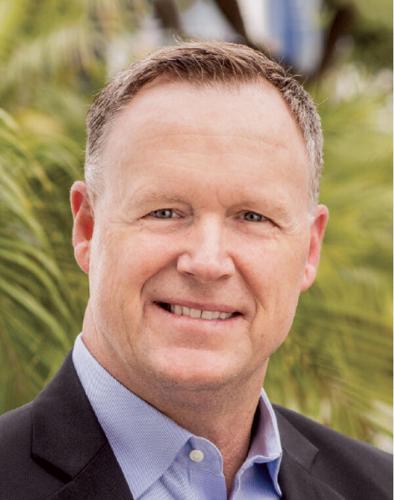
Tony Darden
Jack in the Box’s techy tricks
Jack in the Box COO Tony Darden took over the role in June 2021 and inherited a massive volume of drive-thru business. Today, the restaurants have settled at 90 percent of sales going out through a drive-thru window or in a delivery bag. Prior to the pandemic, it was 83 percent.
That’s not a sea change for the business, but it required some new thinking to handle. The brand also avoided slowing down its popular limited-time-offer calendar.
“One of the things we’re really proud of at Jack, and some of this was before I arrived, through the pandemic our menu team and ops team continued to push and stay on track with our LTO plan,” said Darden. “The menu variety and ability to order is a differentiator for us. For us, it’s not scaling back the menu, but how do we continue our innovation but also test, iterate and make sure the innovation we’re doing is executable in the restaurant.”
One of his first projects was to tackle the massive amount of third-party delivery orders from across the menu.
“As you went through the pandemic, those orders were just stacking up. It could be like a mosh pit sometimes in the early part of the pandemic,” said Darden. “September and October is when we started to test the technology and a dedicated screen and our operations teams to reduce complexity.”
That amounted to creation of a dedicated delivery area, personnel and a kitchen display system—essentially some light technology and some smart operations. He’s a big fan of higher-tech tools outside and in customers’ pockets.
“The outside order taker, having that ability is certainly one that has been great for us,” said Darden. “But through this time, we’ve upgraded our app platform so guests can order and pay through the app. That has been a great investment for us, the Jack loyalty program. We’ve grown that base of consumers 60 percent in the last 12 months.”
He said when customers can simply bypass the bottlenecks of a standard drive-thru experience, things go a lot faster and it becomes a kitchen operations puzzle, something the brand does well now. Its new prototype and equipment standardization will help in the longer term.
“If you rated those, No. 1 is the technology. We have to have the ability to provide a frictionless experience to our guest, so we have to have that foundation of technology,” said Darden.

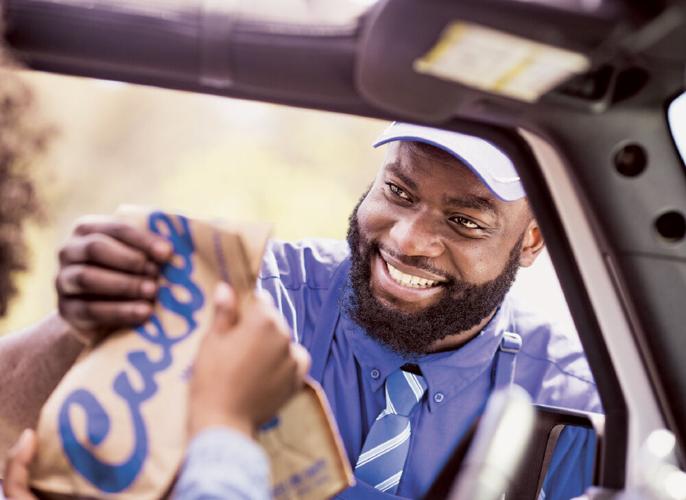
Culver’s found success grabbing drive-up orders and bringing food to customers’ cars.
Culver’s doubles up, adds channels
When Dale Ballweg took over as vice president of operations at Culver’s in February 2020 after 35 years at the company, he had little idea how much the business would shift from the brand’s popular dining room to the drive-thru.
“I’d say we’re longer by, on average, 10 to 12 seconds per order. That’s the measured time,” said Ballweg. “In just sheer volume, we went from, at the end of 2019, 48 percent of business in the drive-thru” to 66 percent by the end of 2021.
Unlike Jack in the Box, one of the first things the brand did was pause the LTO schedule so operators could focus on executing the perfect Butter Burger.
“We stopped limited-time offering rollouts, we did reduce testing of new items really because we didn’t want to put additional strain on the restaurants,” said Ballweg. “As you know, staffing and supply chain is very challenging. We didn’t want to add those additional headaches.”

Dale Ballweg
Ballweg said his No. 1 line-busting tactic when things got really bad was to change the guest perspective. He’s very careful to distinguish between measured time and perceived time. When a guest is greeted in the drive-thru line by a smiling Culver’s employee with a tablet (or a walkie talkie in the initial shutdowns), their order is quickly taken and they move to a waiting area. Even if the food’s arrival takes longer than a competitor up the street, the line to order keeps moving.
“If the line is at a standstill, that is a deterrent. But if it’s seven, eight, 10 cars deep, as long as they get through in a reasonable amount of time and they get a good product, they’re willing to wait,” said Ballweg. “That’s the guest perception. All those touchpoints, and especially face-to-face, helps with the guest perception of speed.”
The brand is working through a double-drive-thru rollout to eventually bring those team members back inside, while reopened dining rooms have had a major impact in the last six to eight months. Those will help in the long term even if drive-thru business sustains at this level.
“During the peak when dining rooms were closed, it was meeting guest demands,” said Ballweg. “At that point it became additional ways to take orders. So, I’d say some of the simplification on LTOs came after, but the immediate needs and most impactful things were additional order points and how we could accommodate those guests.”