Planet Bleach
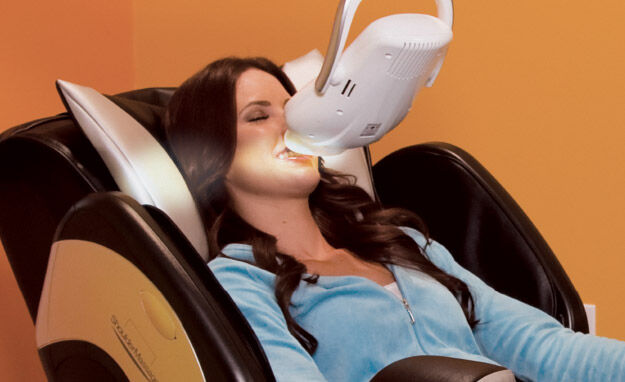
At Planet Beach, do-it-yourself teeth-whitening is one of the popular services.
Some of the fastest-growing franchised health club and spa salon chains employ minimal to no staff, provide 24/7 member access and market more to retiring and affluent baby boomers.
In an industry as competitive, fragmented and repetitive as the quick-serve side of the restaurant industry, Anytime Fitness, Snap Fitness and the Planet Beach spa salons are the market leaders in workout and salon franchising.
But unlike some challenged segments of the restaurant business, specialty niche gym and spa operators are booming, thanks to computerized key cards that allow gym members to come and go any time of the day, and in some cases self-operated tanning, teeth-whitening, massage machines and other services.
Gym rats enjoy lower membership fees and franchisees enjoy lower labor costs, the chains claim.
Anytime Fitness, a leader in the around-the-clock sector with 2,100 units in 15 countries, is working to have the best of both worlds.
Late last year, the Hastings, Minnesota-based chain bought a six-unit spa chain called Waxing the City, a salon that specializes in hair removal. The franchisor will open a "handful" of the units before the end of the year.
Later this spring, company execs expect to begin franchising aggressively to new and existing Anytime Fitness franchisees, "dozens of whom have already expressed an interest," says Mark Daly, national media director. The company is looking to open 100 to 300 Waxing the City franchises within the next three to five years.
Although Anytime Fitness is best known for its self-utilized gyms in predominantly suburban and rural markets, it intends to expand Waxing the City as an urban vehicle, says Daly, who adds the concept does have a staff and will not operate 24/7. The company is intent on franchising the concept nationwide, and eventually globally.
Daly claims Anytime Fitness’s bare-bones operations, limited staff and 4,000-square-foot footprints have allowed the chain to grow at a rate faster than McDonald’s historical average.
"It took Anytime Fitness only 10 years to reach 2,000 locations," he says. "It took McDonald’s 32 years to reach that same number of franchises." Daly reports systemwide sales are expected to jump to $630 million in 2013, a 30 percent increase.
As its name implies, members access the typical unit any time they want with a computerized key card. The units are "partially staffed" about 10 hours a day. Monthly membership is about $40 a month.
Key to the company’s future growth is catering to retiring baby boomers, who are shaping up to be the wealthiest generation of Americans to ever retire and who see fitness as a way to ward off disease and other negatives of aging. Daly says membership among older people has been growing, not only for fitness or to lose weight, but also to remain flexible and mobile.
Spas and health clubs are part of a segment the International Franchise Association calls the "personal services" industry, which also includes beauty salons, senior healthcare and educational services. Segment sales are expected to jump 3 percent this year, to $87.9 billion.
In its 2012 annual report, the International Health, Racquet & Sportsclub Association in Boston—which represents 29,960 individual fitness and spa locations, including yoga studios—reported its members’ aggregate revenue jumped 5 percent to $21.4 billion, for the year ended 2011.
Gold mine of growth
To the health club and spa franchised industries, health-conscious 40-somethings and the 76 million retiring baby boomers represent a gold mine of growth as fitness and wellness becomes a more serious lifestyle pursuit for people who have the motivation to exercise and relax to a good life.

Karmen Nenahlo will soon be a 10-unit Anytime Fitness franchisee.
"I really think this industry is recession-proof," says Karmen Nenahlo, 31, a nine-unit Anytime Fitness franchisee based in Appleton, Wisconsin. She is a few months away from opening her 10th unit.
"Even in a recession, people still have disposable income and Anytime Fitness membership fees are an affordable lifestyle expenditure they don’t want to sacrifice," Nenahlo says. "Plus, some health insurance companies and employers are practically paying their clients or employees to work out consistently."
Segment rival Snap Fitness, which bills itself as "the world’s fastest-growing franchisor of 24/7 express fitness centers," is snapping at Anytime Fitness’s heels and is also eyeing an older gym rat. For several years, Snap Fitness has been one of Medicare’s Silver Sneakers participants.
Silver Sneakers is the brand name of the health club benefit Medicare recipients are eligible for in certain parts of the country. The gym membership fees are included in the Medicare deduction taken from monthly Social Security checks. About 16,000 gyms nationwide participate.
With 1,300 units worldwide, the Chanhassen, Minnesota-based franchisor rolled out at the beginning of the year a new concept called Rolling Strong. The start-up, to be located at Pilot Flying J travel plazas nationwide, is intended to cater to long-distance truck drivers and motorists who drive for vacation or business, by offering them quick, convenient gyms to maintain their workouts and fitness levels while on the road.
Rolling Strong, like Snap Fitness, will be fully staffed with top-of-the-line fitness equipment and 24/7 operations.
At Planet Beach, an all franchised, 250-unit automated spa salon chain in eight countries, members have access to a menu of nearly a dozen different personal treatments and comforts they can access around the clock in privacy to soothe their souls, refresh their skin, relax their muscles and nerves, and manage their weight.
Based in suburban New Orleans, a typical Planet Beach unit allows guests to administer without an attendant high-tech teeth whitening, facials, tanning, skin care, water massages and other relaxation therapies. Each unit also stocks a broad mix of products members can buy to use at the spa or home.
The chain generated $54.2 million in revenue in 2012. It costs about $310,000 to open a typical unit—about 20 percent of that amount the franchisor finances—and much of that investment covers the installation of the high-tech massage equipment, particularly the water massage machines, says David Mesa, senior vice president.
Planet Beach hires "consultants" and not licensed professionals whom the company trains and certifies to operate the machines, answer guests’ questions and assist them if necessary. Membership fees range from $79 to $99 a month and the typical unit can accommodate about 14 members at one time.
Mesa admits the teeth-whitening service is not on par with the treatments one gets in a dentist’s office, but nonetheless it is one of the chain’s more popular services, accounting for 10 to 15 percent of average unit volume.
Expanding to Florida
Ted Unseth, 35, who is both a Planet Beach area developer and a four-unit franchisee in Houston, says he has been involved in health club membership sales his entire working career. But Planet Beach is his most fulfilling and rewarding career experience, he says—so rewarding he is looking to expand to Florida with a fashion model as his partner.
"I actually own the No. 1 and 2 franchise units in the whole system," Unseth says, with business partner Richard Morton.
Women in the 30 to 60 year-old age range, are Unseth’s main target group.
"We help our clients reach their goals," he says. "It’s a membership business and I can’t think of anything more fulfilling than knowing you are in a business that helps people improve their lives."

