
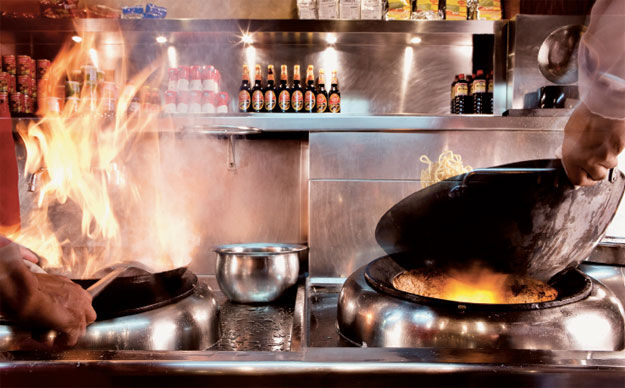
| You can’t use gas woks in Russia, one of many hurdles for Noodle House as it expands. |
When the owner of your holding company is Sheikh Mohammed, constitutional monarch of Dubai, your world view is different from someone who works for a regular Joe. Phil Broad takes it in stride.
You could say Phil Broad, managing director of Jumeirah Restaurants, is used to being around royalty. Before joining Jumeirah, Broad ran operations for Starbucks in Ireland and the U.K., and soaked up strategies about expansion that CEO Howard Schultz dispensed from his vantage point as king of coffee.
Sheikh Mohammed bin Rashid Al Maktoum owns almost all of Dubai Holding, which in turn owns Jumeirah Group and four other companies, and he cuts a colorful figure according to press accounts. The prime minister of the United Arab Emirates, he composes poetry in Nabati, a colloquial form of Arabic, and is known for his avid interest in horse and camel racing. Forbes puts his family’s wealth at $79.5 billion.
Dubai Holding was launched in October 2004 to consolidate several large-scale infrastructure and investment projects in Dubai. By April 2012, it had racked up liabilities greater than $2.5 billion at Dubai International Capital, its private equity investment arm, and had hammered out an agreement with creditors to complete a massive restructuring.
Broad says he doesn’t give much thought to the exotic trappings, but rather stays focused on the complex task of expanding The Noodle House franchise operation worldwide, along with other casual dining restaurant concepts. We asked him to detail his moves.
Broad: Jumeirah Restaurants LLC was formed just under three years ago, to develop, create and expand brands all around the world. So we have not only The Noodle House, but we have embryonic brands we’re starting such as Rice and Spice, Flaming Revolutions and the Caprice brands out of London.
FT: What are your goals for Noodle House, and why did you join this effort?
Broad: We have a target that we’d like to have 150 in development agreements at the end of this year, but I think we could have 500 or higher down the road.
The opportunity to move into a global role was exciting. Dubai had gone through some amazing growth. In terms of being on the scene where things are happening, Dubai was one of those locations. They do everything in a fairly spectacular way. It’s easy to get into and out of. It’s only been here 10 years, the majority of the area, so infrastructure is fairly new and everything works.
FT: It’s unusual to have a sheikh at the top of your organizational chart.
Broad: Sheikh Mohammed is a visionary who worked to create so many important infrastructure and other iconic projects in the region. But other than that it’s not so very different. I’ve worked for many different organizations.
FT: Detail your expansion plan.
Broad: Initially The Noodle House was a Dubai-based business that we started to grow, and then as we started to expand we opened right around us, to places that we could get to very quickly to support the partners, to make sure our systems worked and the supply chains could be supported. We then opened in Cyprus, to test again three or four hours away, and slowly we’ve developed out of Dubai to look at the wider region.
We opened in Pakistan four months ago, which was an absolute success. We opened in India, and there it’s called Tasty Tangles. We had to change the name there, because we haven’t been franchising for a particularly long time and someone went to register our name before us. We still operate exactly the same restaurant, branding and everything else, but not with the original name. I hope one day we’ll get it back.
FT: How difficult has this expansion been?
Broad: We now know it works in some very challenging areas to open up, whether it’s the training or the supply chain or some other difficulty. One of the things we’ve found, in Dubai we have 110 different nationalities, and we also employ a very diverse group, so even today opening up in the Russian market for us there could be language challenges, but we can usually find someone who can help with the particular issues in each location.
Sometimes those are equipment issues. For example, in Russia you can’t use gas, but a big part of our brand is the flair that comes out of the kitchen, with flames from the gas wok. So we’ve now developed with our wok supplier in China an electric wok in addition to the gas.
FT: What’s the significance of the deal you signed in the United Kingdom?
Broad: We have recently signed the U.K. market for 27 stores. We couldn’t go straight to the U.S. market; we needed a stepping stone market. It’s a matter of time. We fly regularly to the U.S. to go to franchise shows, and to get to Miami it’s a 23-hour journey from Dubai. To be closer to the openings for us is important. We’ll end up with a team in Europe, which makes a trek to Boston or wherever it is so much easier.
At the end of last year we went to a franchise show in Washington, and got to understand the market. We then went to Miami, Chicago and New York, so we’re really putting in the effort to raise awareness. In terms of identifying partners in the U.S., we’ve already had two companies fly into Dubai. For us it’s about getting one restaurant open, so if we get one opened by the end of the year, that might be too soon. I think it will be Q1 or Q2 next year.
FT: What did you learn at Starbucks that you’re applying at Noodle House?
Broad: You can expand very quickly, but sometimes you actually have to stop and consider what you’ve done. We say one cup at a time at Starbucks, and we say one meal at a time now. And you have to think locally about what you do as you go globally.
You look at what Howard Schultz has done and about how far the organization could go, but they really have picked their territory carefully. So it’s about making sure you’re following the strategy, and you have a team behind you, and the dream you’re trying to create. You do have to look at the rearview mirror while you’re going forward.
In 2008 the world changed quite dramatically with the financial crisis and the spend even on a cup of coffee became an expense that you did have to think about, so we did slow down to make sure what we were doing was right, we made sure the stores were right for the communities.
We have to do the same thing when we open up a Noodle House in Pakistan or India or wherever—we have to make sure we understand each community. Some people eat with their hands, some with chopsticks, some with a fork, and we have to respect all those cultures.
Interview by Beth Ewen

