
As Walmart faces corruption charges related to its expansion into Mexico, other retailers fear they may be next to be scrutinized. Violating the Foreign Corrupt Practices Act brings consequences all the way to jail.
Hearing that bribes to government officials are an easy way to fast-track a building permit or approval process in a foreign country probably won’t come as a surprise to most franchisors. But that "easy" route can land franchisors in big trouble.
Walmart made headlines earlier this spring when allegations surfaced that its Mexican subsidiary bribed officials to pave the way for its expansion into that country—charges the retailer is fighting. The case shines a spotlight on the Foreign Corrupt Practices Act (FCPA), which prohibits paying bribes to foreign officials. Companies caught up in that practice quickly learn that crossing the line can lead to serious—and costly—consequences.
As franchisors continue to accelerate their international expansion, the FCPA is an increasingly important topic. This is not just an obscure law on the books. The enforcement agencies, both the Department of Justice and the Securities and Exchange Commission, have made the law a top priority.
"The Justice Department has said that the FCPA is the number two priority it has around the world second only to anti-terrorism," said Philip Zeidman, a partner at DLA Piper in Washington, D.C. Other countries around the world are adopting similar anti-corruption laws as well. For example, the U.K. introduced a Bribery Act that is even broader than the FCPA, noted Zeidman.
The Walmart investigation has broader implications for the retail industry. Once the enforcement agencies start investigating a particular incident, it often kicks off a larger probe of that entire industry. That has been the case in the past with industries such as financial services, pharmaceuticals and oil.
"I am not aware that that has happened as of yet in the retail industry, but I would not be surprised if that does happen in the wake of Walmart," noted Brian Mich, managing director at New York-based BDO Consulting and co-head of the firm’s Anti-Corruption Compliance and Investigations Practice. The Department of Justice and SEC may scrutinize international retailers, or they may focus on those retailers that are active in what they view as "high-risk" countries, he added.
Stiff penalties
Companies caught breaking corruption laws face steep financial penalties and even potential jail time for individuals involved. The collateral damage for a company that values its brand and reputation can be huge.
"The biggest concern for companies is that even just being implicated threatens your reputation instantly," said Kiera Gans, of counsel at DLA Piper in New York.
The penalties for violations of the FCPA can be "draconian," added Mich. Recent settlements with some big-name companies have resulted in large corporate penalties. In 2008, Siemens faced a record fine that amounted to $1.6 billion in penalties and disgorgement of profits that was paid to both the United States government and the firm’s home country of Germany. The company was charged with violating the FCPA in Latin America and the Middle East related to paying bribes in order to win contracts in those regions.
Companies also face added expenses, such as conducting their own internal investigation, and paying the fees if a consultant or law firm has to monitor a company’s compliance over a certain period of time. "All of these things can be very costly. So it is not a slap on the wrist at all," said Mich. On the individual level, there is the possibility of jail sentences.
Some countries have earned a reputation for corrupt business practices. Transparency International, a global watchdog that produces a Corruption Perceptions Index, scores countries based on perceptions of illicit business practices occurring in the public sector in those countries. (See chart, next page.) Few countries are squeaky clean. The United States, for example, ranked 24th out of the 182 countries rated.
However, the same countries where companies are seeing the greatest potential for expansion—China, India, Russia and Brazil—are also challenging from a compliance standpoint. "Some of the most attractive markets are also some of the most problematic," said Zeidman.
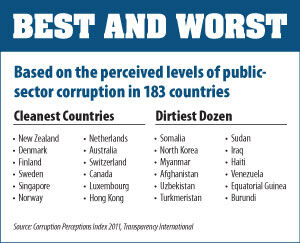
best and worst countries corruption
What franchisors can do
Franchisors need to take multiple steps to limit their risks and remain in compliance with the FCPA and other anti-corruption laws that are in place in other countries. Foremost, companies need to set a high standard of business ethics that is woven into the fabric of the company. "There can’t be any winks and, ‘OK, this is fine because we are operating in your environment,’" said Gans.
One of the best protections is to put procedures in place for dealing with incidents, such as bribery, should they arise. "If there are good compliance procedures in place, even if there are incidents of corruption, the government is not likely to prosecute the company," said Mich. If a company can show it has made a substantial effort to prevent and detect such behavior, then the enforcement agencies may decide to prosecute the individual rather than holding the entire company accountable.
Executives need to create a simple policy that is easy to understand, and then effectively communicate that policy to staff, management, directors, franchisees and other third parties who will be working on behalf of the company. In many instances, partners don’t understand the U.S. laws, or they don’t believe their actions will result in liability for the U.S.-based parent company.
Another important step is to conduct thorough due diligence on franchise partners, especially those operating outside the U.S. Particularly in high-risk countries, people with wealth and expertise may have obtained it by illicit means. If they have a reputation for misdeeds, that will put a company in the cross-hairs for regulators on future deals, noted Gans.
Franchisors need to ask tough questions about how those individuals or companies have been able to be successful in their challenging environment, and what business practices they have utilized in order to get ahead.
Franchisors have an obligation to look at business partners and know who they are. "It is not going to help you to stick your head in the sand and not ask those questions," said Gans. "Because if there are questions that you should have asked, and you don’t, you are going to be held culpable under this law."

