
Who better to serve coffee and donuts to Dallas than two of the biggest sports names in town—Hall-of-Fame Quarterback Troy Aikman and Cowboys owner Jerry Jones. The two legends have joined forces for a 50-store deal. How’d Dunkin’ score it?
Former Cowboys Quarterback Troy Aikman stood behind the Dunkin’ Donuts counter, a practiced smile on his handsome face. Aikman wasn’t there to greet customers or serve coffee, even though the store is one he and his business partner, Jerry Jones, the Dallas Cowboys’ owner and general manager, own. Before his cover shoot for Franchise Times, he posed with the grinning employees as cameras flashed from several sources.
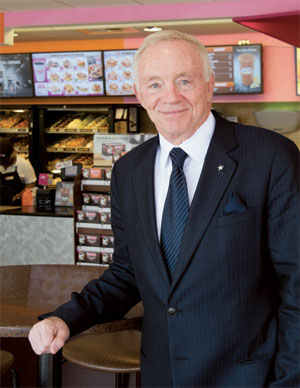
"We take more risks than anyone in sports," says Cowboys owner Jerry Jones. Photos by Jim Woods
At the same moment, Jones, a billionaire who made his money in gas and oil, real estate and football, was in the driver’s seat of his sporty car taking one last phone call before stepping out of the Dallas heat into the air-conditioned restaurant.
Celebrity franchisees aren’t new, but they’re always news. A visit from the franchisee/owner generally creates a ration of best behavior on the part of employees, but when the owners hanging around are famous sports figures, the level of excitement is akin to a football stadium doing the wave.
Jones and Aikman, who made history together when the Cowboys won three Super Bowls in Jones’ first seven years of ownership, are teaming up once again to bring 50 new Dunkin’ Donuts to the Dallas-Ft. Worth area in the next five years. The Canton, Massachusetts-based chain already has 19 restaurants in North Texas. Under the limited-partnership agreement, the Jones Family and Aikman will share ownership of 11 of the 19 currently company-owned restaurants as well as the newly built ones.
The Jones Family named in the deal include Jerry Jones’ grown children, Stephen, Charlotte and Jerry Jr., and son-in-law, Shy Anderson. The second generation works for the Cowboys as well as other businesses under their father’s umbrella.
Even celebrities like Jones and Aikman, who have multiple business dealings, don’t just get a pass when it comes to a franchisor performing its due diligence. But like most things in business, who you know places you at the front of the line.
Jones completed a sponsorship deal with Nigel Travis, CEO of Dunkin’ Brands, when Travis was at Papa John’s, so he already was in play-making mode, as was Aikman. Dunkin’ became a preferred vendor at Cowboys Stadium in 2009.
Jon Luther, the former CEO who is now chairman of Dunkin’ Brands, sits on the Wingstop board with Aikman. Luther was invited to join the board when Roark Capital bought the chain, and Aikman joined after being the spokesman for Wingstop, a relationship that was forged because Aikman and teammates used to eat at Wingstop and he liked the food.
It was at a board meeting when Luther and Aikman were talking about business that "he said, ‘I really like Dunkin’’ and that started the conversation," Luther says.
Luther filled him in on the Dallas market—Dunkin’ has company-owned stores there and was looking for a franchisee to build it out—and Aikman told him he was interested but wanted to partner with the Jones family. But even then, the two didn’t get a pass.
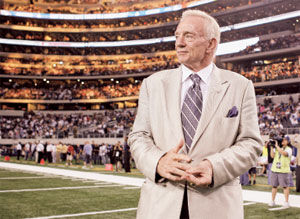
Oh, what a past for Jerry Jones: three Super Bowl championships in his first few years of ownership and ‘America’s team’ moniker. Photo by James Smith/Dallas Cowboys
"As a celebrity athlete, you’re not a celebrity owner," Luther cautions. "We talked about those nuances of skill sets." Having celebrities involved can "give you a bit of a halo," Luther admits. But if the celebrity turns out to be the next O.J. Simpson or (insert fallen hero here), the halo quickly turns into a choke chain. Which is why no one should be a franchisee based on income or name alone.
Earlier in his career, Luther worked for a chain that signed a deal with a prominent athlete and executives thought it would be a slam-dunk. Instead, the athlete ran the store for a short period of time and then called up Luther, expecting to be bought out. "It doesn’t work that way," Luther says. "But in this deal, we’re solid."
Aikman and Jones have the kind of relationship that’s legendary—literally. "I was his first (draft) pick," the former quarterback says. "We came in together….Our best years were together."
"You know how to be successful in the NFL?" Jones asks. "Have the No. 1 pick and have Troy Aikman sitting there."
The two have continued a friendship off the gridiron, which Jones admits is not always the case between an owner/general manager and a retired quarterback.
Jones’ grandchildren and Aikman’s two daughters attend the same school. And they both have a common interest in business. Jones gives solid business advice, Aikman says.
Aikman has moved from being in the game to talking about the game as a color commentator for Fox Network’s football coverage. "I never wanted to be that guy that constantly dwelled on the past," he says.
But, oh, what a past: three Super Bowl championships—’93, ’94 and ‘96—earning the Cowboys the moniker, "America’s team." The Dallas Cowboy cheerleaders, which is a franchise in and of itself, and an owner who fought the league to allow in more sponsorships ensure the Cowboys’ place in history.
"We came along at the right time," Aikman says about the winning teams. "I don’t know if we all appreciate what we had at the time." Why did it work? "Talented players who were hungry," he says. "Everyone checked their egos at the door."
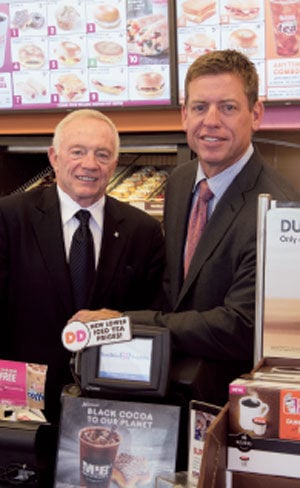
"We came in together. Our best years were together," says Troy Aikman, right, about his playing days with Jerry Jones.
Some have accused Jones of not checking his ego, but the billionaire knows that as both the owner and general manager, he’s never going to please all of the people all of the time.
"When I bought the team, (I decided) I’m going to be in it from socks to jocks," he says. "I didn’t buy it for an investment." Note: Dunkin’ Donuts was bought for an investment. Neither he nor Aikman see themselves taking the time to make the donuts or check the coffee temperature. But they will be involved in the strategic planning and marketing. Dunkin’ will be responsible for operations.
Employing what Jones calls "The Cowboys factor" should only help sell coffee.
Keeping up with the Joneses
Jones comes by his love of football firsthand. He was a star running back in high school and attended the University of Arkansas on a scholarship. In 1964, the team of which he was co-captain went 11-0 and won the Cotton Bowl. He didn’t go on to play pro ball, instead earning an MBA in 1970. He made money in oil and gas exploration in Oklahoma. He’s still married to his college sweetheart, Gene, a former beauty queen.
He likes to talk business, but he likes to talk football more. That tendency worried his father, who once told a reporter he shared his flask with on a cold day during a political ceremony that he was concerned about his 22-year-old son’s future. "Every time I try to pin him down, all he wants to do is talk about football," Jones says, quoting his father. "I don’t think he’s going to amount to s—t." Jones was working in his father’s insurance business at the time.
Jones laughs when he tells the story, because he’s now the owner of a team that is ranked as one of the most valuable franchises in the international sports industry.
When Jones bought the Cowboys in 1989 for $140 million, he says his dad called and said: "Son, I’ve never seen anything so visible. I don’t care if you have to do it with smoke and mirrors, you better make this work."
In an article in Forbes magazine last May, Jones said that at 25 he began his move toward team ownership. He flew from Missouri, where he was selling insurance for his father, to Houston where he had discovered the American Football League owners met regularly at a hotel. He introduced himself to as many owners as he could until he found a sympathetic supporter. At the time the San Diego Chargers were up for sale for $5.8 million, and Jones told them he could raise the money. All he needed to get into serious talks was a $1 million letter of credit, which he secured in a day.
Finding the money has never been an obstacle for Jones. Partly, he says, it’s his ability to share his passion for a project with the money people. "If it’s something you’re not passionate about, it’s not worth doing," he contends. Passion, plus the ability to convince people they can count on you to pay them back, has allowed Jones to parlay his sales ability into billions. People want to believe that when times get hard, you’ll be resourceful, he points out.
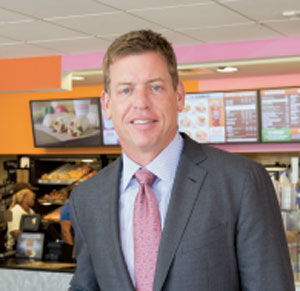
Dunkin’s chairman describes Aikman as thoughtful: "He doesn’t rush into these things without a lot of due diligence."
The deal with the Chargers never did materialize, but when he later had the opportunity to buy the Dallas Cowboys, he jumped at the chance. And even though the price tag was almost $134 million more than the Chargers’ deal, he once again had no problem coming up with the money. "I danced with the devil, the financial devil, when I bought the Cowboys," he says. He was back dancing with that same devil, he adds, when he was trying to fund what was a state-of-the-art stadium, with the largest flat-screen television screen known to sports. (Charlotte Motor Speedway’s 80-by-200-foot HD screen broke Jones’ record by 30 percent in 2011.)
At the time of the sale, the Dallas area was distressed. "I didn’t get into the NFL to make money," he repeats. "(But) I was afraid I’d be the fool who lost all his money. I didn’t realize 23 years ago, the NFL would evolve like it did."
When he’s cut open for his autopsy, he jokes, "you’ll see there will be scars from talking people into investing. But the painful scars are from paying it back."
His father was right. Ownership of the Cowboys put his business skills out there for everyone to see and comment on. He was criticized for firing legendary coach Tom Landry after 29 seasons and hiring Jimmy Johnson. The same year Financial World magazine recognized Jones as the owner of the most valuable sports franchise in the world, the NFL sued Jones for signing two sponsorship deals with Nike and Pepsi that were not league-approved. American Airlines was the only approved sponsor. Jones turned around and sued the league and won.
He had learned about the value of sponsorships, he said, from the Busch family of St. Louis Cardinals fame.
"We take more risks than anyone in sports," he says of the Cowboys. And his performance reviews are broadcast every Sunday and debated in newspapers and magazines, not to mention on fan blogs and at sports bars. "Our fans are passionate," he says of the criticism. "That’s good. That’s where you get involvement."
The Dallas Cowboys were given the tagline, America’s Team, after a TV crew broadcasting games noticed every time the Cowboys played in another team’s stadium, there was a significant amount of blue-and-silver competing with the home team’s colors, according to Wikipedia. The title was both a blessing and a curse. It increased their fan base, but it also meant the team lining up against them came to knock them off their pedestal.
Football may be fun, but it’s also a business. Jones recounts something the president and general manager said to him when he first bought the team: "This would be a hell of a business if you didn’t have to play those football games."
About 90 percent of the game is getting knocked down, Jones contends. "A small percentage is success." As pundit and columnist George Will describes it: "Football incorporates the two worst elements of American society: violence punctuated with committee meetings."
The Dallas Cowboys Cheerleaders has blossomed into the gold standard for cheerleaders. The women must have a "real" job in addition to their role on the sidelines and abide by a long list of rules. They participate in myriad of charity events and received the Bob Hope award, named for the late comedian whose name became synonymous with USO shows for military troops overseas. Jones’ daughter Charlotte is the "CEO of the cheerleaders."
Due to his busy schedule, the only professional football games Jones watches involve the Cowboys. But his favorite games are the ones his grandsons now play. When his sons were younger, he’d fly home from business meetings to watch them practice and then fly back to the meeting. And those were practices for a 9 year old, his son-in-law Shy Anderson points out.
Jones relocated his office when his son and future son-in-law played football so he could stand at his window and watch them practice. "I thought I was doing it for the kids, but it was for me," he says.
Would he do anything differently?
"There’s no one who looks in a mirror that doesn’t wish they had something they’d like to change," he says. "Business is challenging. With the visibility today, you have no secrets."
As Dunkin’ Donuts expands west from its stronghold in the East, it will seek more multi-unit deals, such as the one with Aikman and Jones, rather than single-unit deals. They’re looking for individuals or groups with a QSR background who can commit to five to 15 units in a five to seven year build out, says Grant Benson, vice president of development for Dunkin’ Brands.
"Deals that size help us develop," he says. "It’s the old cliche: How many baskets do you want to carry your eggs in?"
The down side with having one large group handle a market, he adds: "if there’s a hiccup for whatever reason, then the whole market grinds to a stop." He doesn’t see the Jones/Aikman deal in that category. "The Jones family didn’t get to that place by working with groups that don’t perform," he says.
All expect the brand’s newest celebrity owners to generate excitement, and a caffeine buzz from all the coffee they’ll be selling.

