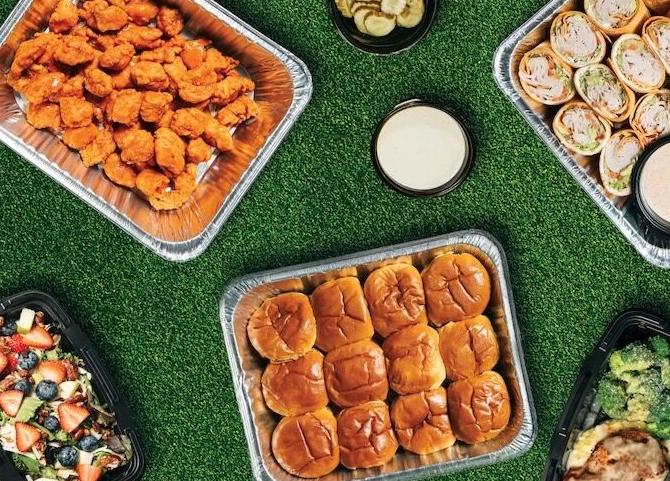


Walk-On’s Sports Bistreaux is entering a new phase of off-premises growth.
The Louisiana-born sports bar brand launched the first formal catering and boxed lunch program in its 22-year history.
“We didn’t just roll this out in November,” said John Hagen, director of culinary at Walk-On’s Sports Bistreaux. “There was extensive testing that went on behind the scenes.”
The brand was founded by Brandon Landry and Jack Warner, former Louisiana State University basketball walk-ons, as a local sports bar near Tiger Stadium in Baton Rouge in 2003. It’s since grown to nearly 80 locations.
“We’re kind of your favorite local sports bar, but we have a family-food environment — something for everybody on the menu. We have some Cajun options, but we also have hamburgers, bone-in wings, lemon butter chicken, pasta Alfredo, wraps, and even alligator on the menu,” said Hagen.
Why catering, and why now?
Off-premises makes up about 16 percent of total sales, mainly driven by takeout and third-party delivery. Hagen noted only 1 percent of that is catering sales right now.
In the past, one-off catering orders only happened if a customer called a restaurant. That’s where Walk-On’s identified an opportunity.
“We’re seeing catering grow in the industry, and we definitely wanted to launch to take advantage of that,” said Hagen.
The new program taps into a centralized digital catering platform powered by Olo.
“It speeds things up by increasing access to data,” Hagen said. “It enables us to make more database-driven decisions, so we can understand ordering behavior… It supports better communication, scheduling, marketing, efficiency, and operational execution, making sure it’s as frictionless as possible.”
The catering program includes both large-format trays and individually portioned boxed lunches.
“We designed the box lunch program to fit the gap for offices, pharmaceutical reps, schools — people who are given a budget, whether it’s X amount of dollars per head,” Hagen said.
For the catering menu, how well items travel was taken into consideration. Some dine-in favorites were excluded altogether.
“We do not offer our waffle fries on the catering menu,” Hagen said. “They just don’t travel well.”
“We wanted to have a little bit of seafood, a little bit of chicken, a little bit of beef, salads, and some vegetarian options as well—something for everybody,” he said.
Instead of a systemwide program launch, Walk-On’s took a staged approach focused on training and integration.
“We started in our corporate restaurants doing ticket-only catering in July,” Hagen said. “There was a lot of lift on our training team and our technology team to make sure this was right. We didn’t try to reinvent the wheel. We looked at what people are doing successfully and applied that to our brand.”
Related: More Catering Demand Means Ample Opportunity for Franchise Restaurants
Brands with established catering programs have a clear advantage, according to data from online catering marketplace ezCater. The company’s 2025 Feeding the Workplace report found restaurants with catering programs experienced a 5.1 percent increase in overall revenue from 2023 to 2024, outpacing the 3.3 percent average revenue growth rate for restaurants and bars reported by market researcher Technomic.
A version of this story first appeared in Food On Demand, a sibling publication to Franchise Times. Bernadette Heier is the managing editor of FOD.