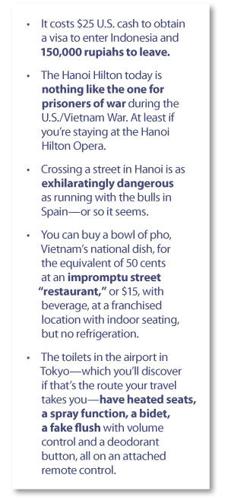

There are superfluous things you’ll learn on a trade mission to Vietnam and Indonesia that are side notes—the fun facts that make international travel so fascinating. But the true value of a U.S.
Commercial Service-sponsored trip comes from the business matchmaking, the contacts with high-ranking officials in the countries visited and the invaluable information delivered by local industry experts. And don’t discount the camaraderie and best-practices collected from the other trade mission participants.
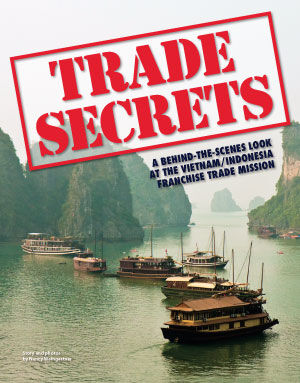
After attending a similar trade mission to India earlier in the year, Franchise Times signed on to sponsor the trade mission to Vietnam and Indonesia in early December, along with the International Franchise Association. The official name of the trip was the Franchise Times/IFA/U.S. Commercial Service Trade Mission to Vietnam and Indonesia, but sometimes the sponsors’ names shifted position—depending on which of us was talking about it, of course.
The majority of participants from the India trade mission returned, plus some new blood, such as Crestcom, a leadership training franchise and the Global Franchise Group’s food brands, Great American Cookies, MaggieMoo’s, Marble Slab Creamery and Pretzelmaker. William Edwards of Edwards Global Services (EGS) represented five companies: Denny’s; Rita’s Italian Ice; The Melting Pot; The Vitamin Shoppe; and Round Table Pizza.
Beth Solomon, IFA’s vice president, strategic initiatives and industry relations, handled the media relations and Brent Omdahl, a commercial officer out of the U.S. Commercial Service’s Atlanta, Georgia, office, headed up the mission from conception to execution. Omdahl had been stationed in Vietnam and was hoping some day to return. In addition, he had the dubious task of ensuring all 17 of the Americans made it on the two connecting flights, to group dinners, on shopping center tours and to meetings. The term "herding cats" has been annoyingly overused, but that was Omdahl’s charge for the mission. And we didn’t make it easy: Especially on the shopping center tours—where we were like kids in a candy store.
The beauty of a trade mission is it gives international developers a chance to see, touch, eat and feel the country, before signing on partners. At the first mall in Hanoi, Phil Crimmins, president of Applebee’s international division, and John Peddar, the chain’s executive director of international business, sampled KFC chicken at a modern food court location. Several others followed suit. The general prognosis was that the chicken was a bit drier than in the U.S. and spiced a little differently.
Sarah Kemp, the commercial counselor from the American Embassy, who led the Hanoi segment of the trip, looked at us disapprovingly and declared the chicken very good. Obviously she was protective of her turf, and its leading import from the U.S. For the Asian market, KFC could easily change its name to "King of Fried Chicken." The first restaurant in Vietnam was opened in 1997, and there are now around 1,000 units. While Americans think of fast food on the lower end of the restaurant ladder, in Asia it’s seen as a luxury.
"During the bird flu epidemic," Kemp explained, "many people chose to get their chicken at KFC because of the best practices associated with U.S. brands."

In a presentation by Ralf Matthaes of TNS Global, a company that conducts consumer research, 31 percent of Vietnamese surveyed rate KFC as the No. 1 restaurant brand. To put that into context, 9 percent ranked Pizza Hut as their favorite and 4 percent preferred Domino’s Pizza. In a 2011 poll, 49 percent of respondents preferred Western food to their own cuisine, and 95 percent eat out weekly.
But that doesn’t mean that opening a franchised food concept in Vietnam is an automatic success.
"You have to understand the size of the Vietnamese wallet," Matthaes cautioned.
"Two-thirds of Vietnam’s population is still eking out a day-to-day existence, while 5 percent are as affluent as the Western world," another consultant, Sean Ngo, the Vietnamese associate for EGS, told the group.
But the economy is gaining traction. "Tastes, behaviors and incomes are changing rapidly," Matthaes said. The two main cities, Hanoi in the north and Ho Chi Minh City (also known as Saigon) in the south are the focal points for expansion. In these two cities, 65 percent can afford fast food, which is a market of 8 million people, he said.
One thing to remember about Vietnam is that it’s a long narrow country, which has different personalities in the north and south. At one time, as many Americans of a certain age remember all too well, the country was divided along these same geographical lines. The north was under Communist rule, and the U.S. chose South Vietnam to defend. The U.S. lost the war, but "Vietnam won as a country," Kemp said.
Perhaps surprisingly, the Vietnamese people don’t resent Americans, either as tourists or business partners. "The U.S. didn’t come to colonize (as the French and Chinese did), we just picked the ‘wrong’ horse (in the battle)," she says. "Vets are welcomed back. That’s history, that’s the past."
Before the present worldwide economic problems, Vietnam was the country large companies were looking at for expansion, Kemp said. The Communist government understands the country needs to keep up with its neighbors.
One neighbor, Singapore, was lauded as the trend starter for the region. People from all over Asia go to Singapore regularly, and if they see it there, they want it in their country.
"This area of the world is so dynamic," said Kemp, who was stationed in China before her Vietnam rotation. "You see people take what they learn here and take it home...I’m thrilled to bring U.S. concepts here."
Shopping in heavy traffic
While there is certainly more square-footage along the roadways, the real estate experts in both Vietnamese cities steered franchisors to the modern malls. Most of the retail action is in the two cities, one of the real estate experts said, but the government is trying to move some of the population out to the suburbs to shop to reduce the amount of traffic in the cities. Because of this, landlords are willing to offer incentives to brands that can attract people away from the city centers.
Street-side real estate in Hanoi consists of tiny storefronts with limited parking. Many of the street corners are commandeered by make-shift restaurants where the proprietor camps out with his small grill, a cooler and plastic chairs usually spotted in preschool classes. They don’t pay rent, but they do pay a bribe for officials to look the other way. The vendors aren’t run out of town, we were told, because the government believes they add local color for tourists.
The motorbikes that make up the majority of the traffic in the cities drive right up on the sidewalks to park or through narrow alleys to hidden neighborhoods off the street.
The traffic is chaotic—it’s like a choreographed dance, where the motorbikes, cars and trucks all merge together from various directions without colliding, for the most part. Le Anh, who has been with the U.S. Commercial Service in Ho Chi Minh City for 14 years, said there have been studies on how the traffic affects the psyche. He claims it explains the Vietnamese personality of "always looking for the opening."
All wear helmets, and the majority have masks over their nose and mouth. In true entrepreneurial spirit, the masks have become a fashion accessory, as many younger riders wore plaid, flowered or designer masks.
Another perk of being on a bike is that motorbike riders can make their purchases at the street-side shops without getting off their bikes.
The more traditional "wet" markets we visited in Hanoi are a nod to the past when Vietnamese shopped daily for food. Many still do, but the surveys by TNS revealed people have started to shop less often, but buy more. Booths were crammed with colorful plastic sandals and clothes or fruits and vegetables picked that morning and brought in from the farms outside Hanoi.
Chickens and cows had already been slaughtered and the meat was heaped on tables under large umbrellas as the only visible means of refrigeration. Fish of all varieties were housed in tubs of water in neighboring stalls.
Some of the stalls were tables and shelves overflowing with merchandise, others were pushcarts bursting with a multitude of items.
The indoor markets were a cluster of separate stalls with vendors heaping their wares into small spots. The aisles were narrow; all the better for shopkeepers to grab your arm as you go by.
Bargaining is a way of life. And to buy something without bartering is to be a fool.
In Ho Chi Minh City, I accompanied Omdahl and Hair Parra of Wing Zone to one of the popular markets. On the street, we bought "Ralph Lauren" polo shirts for $3, only to find the woman farther down the street would sell them to us for $2 each.
We looked at a shop with "designer" purses that were excellent copies of Louis Vuitton’s $1,500-plus versions, at a much, much lower price. In one shop I found a version of the unmistakable Burberry plaid scarf for $10. When I heard the price in dong—200,000—it sounded too rich for my blood. The woman asked how much I would pay, and with Omdahl’s counsel, I replied 100,000. The shopkeeper looked insulted and turned her back. I left feeling badly, only to be pursued down the aisle. After waving away her higher offers as I tried to escape, the woman thrust the scarf in my hands and held out her hand for my money.
All my other purchases were made inside shops with fixed prices.
Malls Unlike America’s
The malls were new, sophisticated structures. Missing was the ubiquitous Starbucks of the states. In its place was The Coffee Bean & Tea Leaf in the prime locations, and at one mall Gloria Jean’s Gourmet Coffee and Tea was right next door.
Since we visited a few weeks before Christmas, the malls were decorated for a holiday that seemed out of place in a Buddhist-dominated country. (Even stranger was to see over-the-top Christmas decorations in Indonesia, where the vast majority of the population is Muslim.)
We were told the reason for the decorations was to encourage more gift buying at the end of the year. One of the older malls by our hotel in Hanoi was painted a bright blue with glittery decorations added to the walls, as well as a series of oversized characters, such as penguins in jaunty stocking caps, lined up along the sidewalk. Mothers gently pushed their dressed-up children in front of the displays for pictures that would no doubt end up in frames in their homes.
The main floor of the malls appeared to be a department store, but at closer inspection it was made up of a series of individual offerings, much like the cosmetic counters that dominate American department stores. Typical leases are three years for retail and five years for food and beverage. (Landlords of street locations have been known to abruptly end leases with little notice—another reason not to spend for the expensive, street-side real estate.)
These modern malls in Asia are destination locations. They provide not only a venue for shopping, but also for entertaining the entire family. We toured the malls in the middle of the week, and for the most part they were empty. But we were reassured on evenings and weekends, they were packed. The KFC we visited at 11 a.m. was empty, but someone remarked that a significant amount of chicken had been fried and stacked in bins, which most likely meant they did a fair amount of lunch trade.
Scott Chorna of Focus Brands pointed to a sign in front of the KFC advertising a soft-serve ice cream cone for around 50 cents. The product at that price, he commented, would be a loss-leader, and make it difficult for a concept like Carvel Ice Cream to compete on price. A brand like Häagen-Dazs, on the other hand, would have a better chance since it was a hard-packed product—different enough to justify paying more, he added.
At one mall we discovered "Australian cake," a sweet, gooey strawberry/mango bread that comes from China, not Australia, according to our guides. There’s even an ice cream store with Australian in its name—again, no connection.
By law, prices posted on menu boards have to be in dong, not U.S. dollars.
One local fast-food chain had chicken fingers and deep-fried cheese sticks listed under desserts on the menu board. Another food booth had liver paté—which one of us mistook it for cinnamon—in a breadstick.
The soda fountain at the Carl’s Jr. was a welcome sight for the Americans on the tour, but Vietnamese prefer their soft drinks and water out of bottles that are sealed.
The parts of Saigon we toured were significantly more sophisticated than Hanoi. The eating style of the two cities is different, as well. Because the north is colder, people tend to eat more protein. "Pho," a broth soup with noodles and meat, is often modified for all three meals in the north. In the south, people prefer sweeter dishes and more spice or heat. And in Saigon, all three meals are different.
Coffee is another favorite among the Vietnamese and 6 percent surveyed by TNS last year report their favorite activity is going to coffee shops. Gloria Jean’s already has waded into the coffee market, and we were told coffee should be included as an option at all restaurants.
Game centers are also popular at malls, and many of the new ones under construction include movie theaters. Singers and other acts are booked on the weekends. Franchisors were warned their offering needed some type of experience attached to it, such as the live music for the Hard Rock Cafe or singing waiters at Johnny Rockets.
An even more surprising no-show than Starbucks in Vietnam was McDonald’s. "What do they know that we don’t," one of the trade mission participants said under his breath.
While being first in a market is often preferable, a company going into a country like Vietnam has to be patient and willing to wait years to make a profit. The first ones in often have to educate the market, and wait for consumers’ incomes to catch up to the franchise brand’s prices.
Glad to meet
While seeing the lay of the land is important, so is meeting the prospective business partners in private meetings. Ask any franchisor what the most important thing to consider when going international is and the answer will always be—your partner.
Obviously, partners are important on your home turf, but when you’re half a world away, in an unfamiliar culture, it’s even more so.
That’s where the U.S. Commercial Service shines. They are charged with the responsibility of finding qualified partners. Frank Joseph, commercial officer for the U.S. Consulate in Ho Chi Minh City, took the process up a notch. Staff placed ads, but also held seminars to explain what franchising is and what it could do for the identified companies.
Vietnam is a cash-society, and it’s harder to know a company or person’s wealth. Plus, as an entrepreneurial society, people have more than one way they make money.
Some downsides to the market:
• Labor may be cheap, but often the young workers have not been trained. Training, therefore, has to be a well-thought-out component. And as one franchisee of an American children’s education concept said, "Paying a higher salary doesn’t mean you’re getting the best."
• There will be times when the local banks will run out of U.S. dollars to pay the franchisors’ royalties. The advice: "Consider other kinds of foreign currency or smaller, more frequent payments. Or wait a week."
• Land is owned by the government, and rents are high. Electricity can be a significant percentage of overhead.
• The supply chain is not as established in Vietnam as it is in other countries, such as India or Indonesia.
• Often during negotiations, a Vietnamese businessperson will say "yes," but mean "no." (As opposed to China, where "no" means "no," Kemp said.)
• The ideal is always to partner with someone with both money and experience, but that will be a harder combination to find in Vietnam, a local franchise expert said.
Indonesia: The last stop, but not the least
Indonesia, our third stop on the trip, has 400 franchise companies, compared to Vietnam’s 70. It’s also the fourth most-populous country in the world, with 237 million people—17 percent of whom are considered middle-class. But keep in mind, middle-class in other parts of the world is defined as having a certain amount of discretionary income. In this case, the equivalent of $3,000 a year.
From the bus windows on our ride from the airport to our hotel in Jakarta, we saw a much more modern city. Shopping is considered recreation here, and centers stay open until midnight or 2 a.m. so patrons can avoid traffic jams on their way home. Indonesia has 350 shopping malls and 113 of them are in the Jakarta area.
Concepts with bars won’t do as well here, since only 2 percent of Indonesians visit pubs or bars. The high concentration of Muslim population also means halal compliance in food preparation is extremely important.
McDonald’s is present in Indonesia, and one of the items it serves is bone-in fried chicken.
Indonesians like to shorten brand names, one of the candidates told me. So McDonald’s is referred to as McD; Starbucks as SBucks; and the new Johnny Rockets being built in Bali, most likely will be known as JRocks, he said, grinning.
Another example of American brands having power came from the woman who was our trade coordinator, Pepsi Maryarini. She said her father had studied at George Washington University in the states where he tasted his first Pepsi. Years later, he named his first child after the drink—over his wife’s objections.
Free Wi-Fi should be provided, since patrons will ask about it before they buy their coffee or food.
Leases are five years at the mall, the real estate experts told us, unless you’re not doing well. A shop without customers is not good for the mall, he said.
Adapting the food to the local taste is important. Customers may get bored with burgers after awhile, but they can still go to McDonald’s for chicken and rice.
A downside, we were informed, is that the population, for the most part, is unskilled. Wages may be cheaper, but it will take hiring more people to get the same productivity as workers in other countries.
A highlight of the trip was meeting the ambassadors, the local politicians and heads of business at receptions. And not just because they’re interesting people. Being able to tell a prospect you talked with these dignitaries is a plus. And having dinner at the assistant ambassador’s home is an unforgettable experience.
Traffic consists of more cars than motorbikes in Jakarta, but it was still at a standstill. Predictions are that gridlock will threaten Jakarta by 2014. To ensure we made our meetings on time, the U.S. Commercial Service staff had arranged for a police escort. With sirens blazing and lights flashing, traffic parted like the Red Sea for us.
The first meeting was with a group of young entrepreneurs and the chamber of commerce. Each brand’s rep gave his elevator pitch, and then the audience asked pointed questions, varying from "tell us about grilled chicken, we’re not familiar with that concept" to ROI. Not surprisingly, the finance questions were never answered to the prospects’ satisfaction. Franchisors were selling passion, they wanted to know the bottom line.
Indonesia is on a lot of people’s radar. While staying at the Shangri-la in Jakarta, CNN broadcast a report on Bali’s garbage problem; television show, "The Great Race," was a race through Indonesia; and Forbes Asia’s cover story was on the top 40 wealthiest Indonesians.
Security is palpable. At one shopping mall, we had to go through a metal detector. IFA’s Scott Lehr pointed to a sign at one of the hamburger chains that was pushing rice in their promotions. "That means they’re not doing well," he remarked, "because their core product’s not in demand."
That’s the problem with international expansion. It’s a gamble—an expensive gamble. But it can also be extremely worthwhile. Just ask KFC if they’d rather close their U.S. operations or their Asian.
An All-star Global General
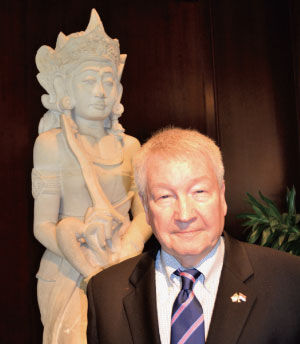
It wasn’t an easy sell. Dan Benton knew when he retired from the Army as a three-star general, he didn’t want to go the usual route of his small group of peers and become a defense contractor. He had spent a majority of his career overseas, his last position as Chief of Staff for Europe—a territory that extended from Norway to North Africa. While researching international companies, he attended a meeting in Atlanta where the German-born president of the Athlete’s Foot spoke. Benton introduced himself in German, and asked for a job in their international business. "He wasn’t sure what to do with a three-star general," Benton says. So he said he would bring Benton on for a six-month trial. "That was 10 years ago," Benton says.
As the director of international development for the Global Franchise Group, the parent company of a number of brands including Athlete’s Foot, Benton utilizes his MBA , as well as his West Point education and love of languages. His three criteria for his retirement job were: It had to be different from the military; it needed to be associated with international travel; and it had to be fun. Going into the private sector after being a general was difficult at first, he confesses. "Early on it was frustrating," he says. "We’d have a meeting at 9 a.m., and at 9 o’clock I’d be the only one in the room. I’ve adapted."
Thoughts for food
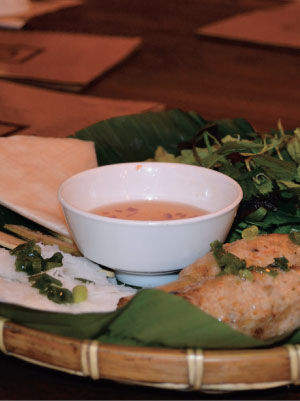
"Vietnamese love food," Ralf Matthaes of TNS Global’s Vietnam office said, which is why they don’t eat while driving and why they like restaurant seating that faces out toward the street so they can people-watch as they savor their meal. "Food is the highlight of their day."
Matthaes, an Aussie-turned-Vietnamese consumer expert, ran some statistics past the group: 89 percent of Vietnamese worry about health more than previous generations; 95 percent worry about food safety; and 72 percent prefer to drink beverages from the container, which makes soda dispensers a less attractive option than buying drinks in the bottle. Here are some of our observations:
1. Paper napkins were hard to find. Most of the time we received "wet wipes."
2. In one upscale restaurant, cigarettes were an item on the menu, right next to the beer list.
3. Vietnamese love coffee. The traditional way is to serve it is with condensed milk.
4. French baguettes are the bread of choice for sandwiches, according to one of our sources. This could be a problem for concepts like Subway that serve a soft roll. Plus Vietnamese like sauces, so sandwiches shouldn’t be dry.
The Quality of Partners
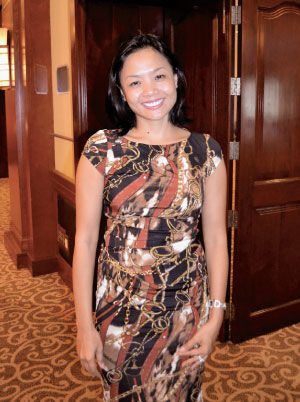
Do Thi Bich Hue was one of the candidates who had signed on in Ho Chi Minh City to meet with two of the food concepts. Under her company, New World Capital, she runs several companies, including a franchise, Bud’s Ice Cream, which has 50 units.
"Vietnamese love ice cream," she says, adding that Bud’s "for me, too sweet. I don’t like."
Hue is one of the many examples of young Vietnamese women who have gone to school in the United States—she has an MBA from Columbia University—and then returned home to help build their country.
One of her companies is a bakery that supplies long, skinny loaves of French bread to street vendors who add pate and place the bread on a small, coal grill to make toasted sandwiches. The cost is 8,000 dong, less than $1. Hue takes back any inventory vendors can’t sell at the end of the day, and in turn they pay her a small percentage of their sales. "My concept helps poor people," she says. Hue currently supplies 60 locations—all done on a cash basis, with no upfront costs for the vendors.
Hue is interested in Pollo Tropical. She likes the fact that it’s healthier than other fast food, something Vietnamese are now concerned with—now that many aren’t just eating to survive.
Behind the Sales
The value of a trade mission may be the trade secrets, but it’s also getting to know the people who travel the world selling. It’s nice after a day of meeting with strangers to go out to dinner or for a glass of wine and decompress. That’s where you learn things about the people on a trade mission. Such as:
• Jeff Sinelli, founder of Which Wich, doesn’t like to talk about the weather, believing the ice breaker is a waste of time, now that iPhones can give weather reports quickly for the entire world. He also doesn’t like mundane conversations, such as "I like your lilac shirt," which is why corporate employees wear "uniforms": jeans, polo shirts and yellow-and-black tennis shoes he furnishes. "That way people can talk about what’s important," he said.
• Consultant Bill Edwards used to work for Shell Oil Company in Turkey where they occasionally would use their equipment to drill water wells for the local communities. He also has a tie to Indonesia since his older daughter was adopted there.
• Strategist Fred LeFranc’s son is a playwright with an off-Broadway play and his daughter is a TV writer, whose latest project was "Chuck."
• IFA’s Beth Solomon’s mother was a journalist at a time when women didn’t work. Her independence and drive were passed on to her daughter.

