Publisher Mary Jo Larson takes Paris by storm. Here's her account of Franchise Expo Paris and how it differs from what she's used to seeing in her own back yard.
I admit it, I arrived with a preconceived notion: Franchise Expo Paris would be similar to expos I've attended over the years here in the United States. What I hadn't counted on was that in Paris, France, aesthetics were everything.
The expo was held March 14 to 17 at the Paris Expo Center, and hosted about 450 exhibitors from around the world. Franchise Times has not attended many international franchise expos, but in our efforts to build international coverage and presence, this particular show was recommended by friend and international franchising guru Bill Edwards of Edwards Global Services. "For Europe, this is the show to attend," he said.
My first clue that this show would be different should have been the beautiful, huge vases of flowers placed strategically about, and that was just in the registration area. It was a preview of what was to come.
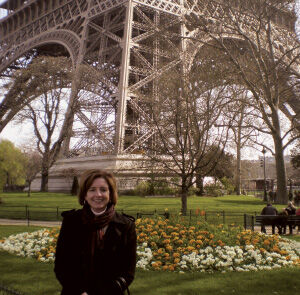
FT Publisher Mary Jo Larson didn't just check out the sights while in France, she learned of some of the differences between franchise expos in Europe and the United States. The biggest: More clothes, less food.
As I entered the show, the first franchise exhibit was a gelato business. I wondered what the "booth" had cost this company. I use the term "booth" loosely—this was not a booth. It looked like an actual store built within the expo hall: rough-hewn wood beams on the ceiling and brick along the wheat-colored walls gave it that Italian grotto look, with an area with glass lamps hanging over small cafe tables. There were a few people waiting in line for samples, but not the long lines I've seen for food franchises at U.S. expos. (Another reason why French women are thin. And yes, I had a sample and it was delish.)
But as I continued through the expo hall, I found this gelato franchise was only the beginning of the beautiful displays. An 8x10 booth was in the minority. Most franchises had built stores to display their wares. It was, truly, franchise eye candy.
According to Anne-Sylvie Homassel, communications director for the French Franchise Federation, 45 percent of franchisors in France represent retail concepts. At the expo, it was evident that the French either beautify themselves (with cosmetics, tanning and fashion), their home (with furniture, flowers, home accessories and linens) or their family (with children's clothing).
As far as I could see, it's no accident that the French are leaders in art, beauty and fashion. There were more "booths" representing clothing stores than any other industry represented at the expo—and they were slick. Jean-Christophe Sozza, the head of franchise lending for Groupe Banque Populaire, one of the largest banks in France, said the expo plays out what is true in France: Fashion is the No. 1 industry sector in franchising.
Apparently, there are two types of franchised fashion business models: The first is like most concepts in the United States. The franchisee pays a franchise fee and a royalty based on a percentage of sales and purchases their own inventory. The second is referred to as a "commission affiliation," said Sozza. The franchisor owns the "goods" or the clothing items sent to the store for the franchisee to sell. Each month, the franchisor chooses the stock and the amount it will ship to the franchisee to sell. "The franchisee doesn't calculate or
choose goods," said Sozza. The franchisee gives 40 to 45 percent of the sale to the franchisor instead of a royalty.
"So many of the fashion concepts open with that system," said Sozza, "and it is easy to finance."
In Sozza's tenure with the bank, he's seen a few U.S. franchisors come and go, and come again, such as KFC, once they figure out that Europe is not the United States with a language issue. The biggest difficulty U.S. franchisors face is with their contracts. "They arrive with a contract," said Sozza, "and we can't change a word. They won't find franchisees with this kind of contract. If I, as a franchisee, have a problem, I have to go to the U.S. to have my case debated. That's not so easy."
Scott Sharkey, founder and president of the U.S.-based Sharkey's Cuts for Kids, a children's hair salon, exhibited at the expo and was impressed with the quality of the attendees. His company already has dipped its toe into international waters, with locations in France, Israel and Sweden, to name a few. Master franchisees are the norm at the expo, so often these attendees are there to look at developing a whole country rather than just a store here and there.
Christophe Angleys, international development manager for Reed Expositions, the company that put on the expo, said U.S. franchisors don't necessarily attend to expand in the French market, but rather, to meet with potential master franchisees from Europe. Out of almost 30,000 visitors, about 15 percent are from countries outside of France, including countries in the Middle East.
On the flip side, a couple of French franchisors with whom I talked weren't eyeing expansion in the United States too keenly, at least for now.
"I'm not sure franchising is the way to go (in the U.S.)," said Philippe Jambon, president and owner of Jeff de Bruges, a franchisor of retail Belgian chocolate stores. The company, which has been franchising for 21 years, has 230 locations across Europe, with 70 of those company-owned stores. With the varying state regulations making the U.S. a bit intimidating for European franchises, Jambon said he would be interested in talking to a potential U.S. partner about licensing the Jeff de Bruges name. He joked, "Do you know anyone?"
Franchising in France
Franchising started in the 1960s with a knitting shop. Today, of the 1,140 franchise concepts, 45 percent are retail; 15 percent hospitality; and 40 percent are services.
What works in France: Fashion
What doesn't: Early education franchises—French kindergarten starts at an earlier age than in the U.S. so there is no need for most preschool operations.
Challenges: Price of real estate and construction materials; it is difficult for smaller franchisees to secure good sites.
Education for franchisors: Franchising in France went through a rough period between 1996 and 2000, said Groupe Banque Populaire's Jean-Christophe Sozza, who heads up franchise lending at the bank. Many franchisees went bankrupt because the initial investment was too high and franchisors ramped up too quickly and couldn't keep up with offering services to the franchisees.
"The French Franchise Federation did a lot of work, educating franchisors," he said, and those problems seem to have lessened.
The Federation's communication director Anne-Sylvie Homassel said that they began to offer training to franchisors. "If you want your network to work, the franchisees need to have the freedom to say what's wrong and the freedom to say how to improve," she said. The organization has commissioned studies from local universities to research how franchisors communicate with franchisees and what methods contribute to success.
"There is still a lot to do in this area," Homassel reported, "but it's going well."

