
Class A retail sites are in such short supply that some developers are looking down market—to older centers, say, that aren’t in the exact bull’s-eye of their target demographic. Making those stores successful is tricky, but lower rents and better buildouts can lead to boosted performance.
In the Marco’s Pizza chain, one franchisee’s average unit volumes stand well above the rest: Kevin Wilkerson’s dozen restaurants in the Oklahoma City area.
"We have the highest AUVs in the chain," Wilkerson allowed, after identification by the company’s vice president and prodding from this reporter. " We’re probably 20 to 25 percent higher than the average."
His secret: Wilkerson likes to identify the best trade areas in terms of demographics and geography, but then choose one or two classes down for the actual real estate site—across the street from the fancy new power center is a favorite spot, for example.
"When we look for a new location, we look for an A+ trade area first. It’s an art and science," he said. "Once you’ve got the area, now you’re looking for B sites." He says he can negotiate lower rents, more tenant improvements and greater landlord concessions at the plainer spots.
"My last store I opened, the rent rate there is one-fourth what it is a mile up the road in an A+ location," he said. Then he markets the heck out of the new store—routinely spending $30,000 in the first six months as outlined by a new Marco’s program.
It’s a strategy many site developers find necessary, with a shortage of new Class A retail space. "It’s a hot topic. The market’s tight, because no space has been built for so long. ‘A’ space is just not available," said Ryan Cunningham, president of Javelin Solutions in Denver.
Retail completions were a low 4.9 million square feet last year in the United States, with a forecast of 9.3 million this year, according to the National Association of Realtors. Not until 2013 does the forecast get more robust: 20 million square feet.
"We are finding top-quality sites to be in short supply, and getting tighter as the months go by," said Bryon Stephens, Marco’s Pizza vice president of new business development in Toledo, Ohio. "Starting in 2012 it will be one of the biggest strategic things we’re looking at that could derail getting the number of stores we want to open." The target is 100 this year.
But it takes deep knowledge of a site’s traffic patterns and history—and smart analysis of the financial trade-offs—to make lesser sites work hard enough to outshine their ‘A’ counterparts.
Classifying real estate as A, B and C isn’t an exact science. In general, ‘A’ real estate is brand new, sits "right in the bull’s-eye" of the top trade area, and costs more than the average in the area—as much as 15 to 20 percent more, Cunningham said. "Class A is a Starbucks location on the corner of Main and Main, and it’s new, sexy and all that," he explained.
Class B might be in a neighborhood center, perhaps anchored by a grocery store, and not quite as accessible or not quite in the center of your target demographic. "There’s a lot of brands that Class B is fine. It’s well maintained, it’s a little dated looking. And there are a lot of concepts out there that have always done well in those centers," Cunningham said. Lower rents can offset the lower sales volumes.
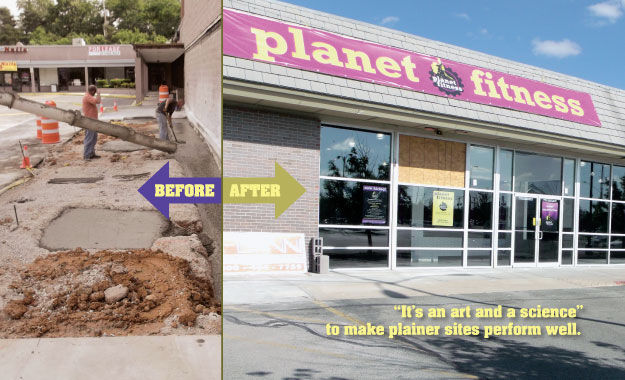
Class C space might be the neighborhood center that lost its anchor grocery store, with abandoned spaces and dilapidated or nonexistent signs. Many site developers avoid such space. But in some cases that type of site is just right for Planet Fitness, the New Hampshire-based chain that requires 25,000 to 30,000 square feet for its fitness clubs.
Brian Kunkel, director of real estate for Planet Fitness who opened 103 stores last year, said the chain doesn’t go searching for such sites. And it does go into power centers and other Class A sites often. But if they enter a market with a defunct center with possibilities, "we’ve been pretty good as a junior anchor in a center, to revive it. As far as those centers that are on the ropes that could go either way—they could be torn down or they could be built back up—we’re not opposed to that," he said.
He said the deals can be sweet—at one spot they got two years of free rent, which frees up maximum dollars for marketing. Planet Fitness is a low-cost gym, and they need to work hard to get 10,000 members in record time.
The build-out, however, can be more expensive. "You’re having to replace 100 percent of the HVAC," he said, referring to heating, ventilation and air conditioning. "A lot of times you have to do a new storefront. There’s definitely more upfront cost, but it tends to be a better deal overall," he said. Signage will probably be a mess, but that problem is sometimes offset by the fact that older centers are often exempt from laws limiting the size of signs.
Navin Nagrani, senior vice president at Hilco Real Estate, the Chicago area concern that liquidates consumer inventory, said, "We run the going-out-of-business sales for retailers. And then we deal with the real estate, getting rid of leases. Then we do work with the retailers looking to grow."
He cites key attractions of lower-class sites. "For B and C locations clearly landlords are willing to wheel and deal a little bit more. We’ve seen packages between $100,000 to $300,000 to allow operators to build out. That’s for great-credit operators. For lesser-quality credit, we’ve seen landlords provide free months of rent, anywhere from three months to nine months.
Legwork is important. "I try to get some sort of history on the prior operator, to understand why it didn’t work out. I like to see the history of the anchor tenant. I also just try to understand who else is in that center and how they’re doing. Sometimes it could be a B or C location for another operator, but because there’s no competition it could be an A. One person’s trash can be another person’s treasure," he said.
He recommends paying attention to more than lease rates and tenant improvements when negotiating. "If you are willing to take a risk and move into a B or C location, you want to structure something where you can have some flexibility if it doesn’t work out.
But beware. "There are definitely instances where a B or C site should not be touched," he said, like when customers just can’t access a site. "It’s not rocket science; it’s good old-fashioned real estate analysis."
Complicated sites
For N3 Real Estate in Southlake, Texas, sometimes site selection is science—but environmental, not rocket. The firm does about 10 to 15 percent of its business cleaning up sites for tenants, who do not want to shoulder that risk themselves.
"If they see a site that is too complicated or maybe too risky to take onto their balance sheet, that’s when they might work with a developer like us," said Brenna Wadleigh, president.
For example, N3 put an auto repair shop on top of a site that was once a brewery in Milwaukee. In California, they just broke ground on a site that once had a gas station on it in the ’50 and ‘60s. "It’s something that can be very scary to a tenant, a franchisee, but is actually pretty common out there in the world. With us having more skill and knowledge in that area, we make sure there isn’t an overly aggressive amount of risk."
Rents at such locations, after cleanup, may be higher than at a site without environmental hazards, she said. But that’s not necessarily the case—purchasing the land can be cheaper when hazards are used as a wedge. "The supply of people qualified and willing to take that risk is definitely lower, and so the sellers maybe have to be educated about the issues on their site. We do a lot of that too, and it’s a negotiating tool," she said.

