

Paying a percent of your sales is one way to get a break on your rent in a down market, without losing your shirt in the process.
Percentage rent is popping up more frequently in the down market. But is this form of rent payment a good deal for retail and restaurant tenants?
Fixed rental rates are by far the norm. Landlords, tenants and even lenders prefer the predictability of a set rate. Yet percentage rent is coming into play more frequently in situations where the landlord is struggling with high vacancies at a property. Landlords are offering percentage rent in lieu of base rent as a means to fill vacant centers. "We’re seeing it where desperation has kicked in and the landlord is tired of carrying the costs associated with vacant space," says Dick Grones, principal of Cambridge Commercial Realty, a real estate brokerage and consulting firm based in Minneapolis.
Common area maintenance (CAM) and taxes can range anywhere from $5 to $15 per square foot per year for neighborhood and community centers and $20 to $25 for regional malls. Those costs can quickly add up for landlords who have a large amount of empty space within a property. So landlords will try to get tenants to cover those CAM and taxes and also pay a percentage of their sales as rent.
Landlords will volunteer those deals on a short-term basis because they are hoping that either the market will recover, or they can eventually find a tenant who is willing to pay a base rent for the space.
In other situations, landlords are being required to shift to percentage rent due to high vacancies at a property. If occupancy levels at a shopping center dip below a certain level, usually between 50 and 75 percent, it may trigger a co-tenancy clause within a tenant’s lease.
Co-tenancy or occupancy clauses have proved to be an important protection in the current market with rising vacancies and massive store closings by "big box" tenants such as Linens ‘N Things and Circuit City. Tenants that are very dependent on a key anchor to drive traffic, such as a Wal-Mart or a grocery store, will seek a co-tenancy or occupancy guarantee within the lease to protect their business if that anchor were to close or relocate. Those co-tenancy provisions often give tenants the right to vacate their space without penalty or the right to shift to percentage rent only.
That switch to percentage rent in the case of a struggling shopping center can mean a substantial reduction in rent payment for tenants—by as much as 50 percent of the fixed rent in some cases. At face value, that discount can be advantageous for a tenant. But it also sends up a big red flag that a property is struggling. "The best advice is never compromise on the location, or you get what you pay for," says Grones. "If the landlord is totally upside down and needs you to get into a center so bad that they are willing to offer percentage rent, then chances are that it will be a very low volume or average store at best."

Win-win situation?
Although distressed real estate has brought percentage rent front and center for many tenants, the reality is that percentage rent can be a part of any ordinary lease negotiation. Some landlords will push for an additional percentage rate on top of the fixed rate. The percentage rent allows the landlords to share in the upside when a retail or restaurant tenant is performing well. In return, tenants are often able to negotiate a lower base rent.
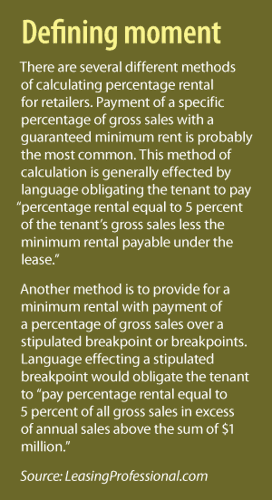
Typically, the percentage rent is set at a "natural break point", which usually falls between 3 and 6 percent depending on a store’s margins or profitability. For example, a tenant that is paying $45,000 per year in base rent is essentially paying 3 percent on the natural break point of $1.5 million in sales revenue. If that tenant also agrees to pay percentage rate if revenues exceed $1.5 million, then they will pay an additional 3% in rent for every dollar of revenue earned beyond that $1.5 million threshold.
"Percentage rent as a whole, if you don’t have a problem reporting sales, is a great tool provided that it is realistic," says Geno Coradini, managing director of Corporate Retail Solutions in Jones Lang LaSalle in Dallas. The key is that percentage rent be structured so that both sides can benefit. The individual franchisee needs to be comfortable in sharing that extra revenue with the landlord, and in return the landlord offers a lower fixed rent, he adds.
Lowering the base rent
One drawback of paying percentage rent is that it forces the tenant to report sales to the landlord, and many retailers do not want to disclose that information, notes Coradini. In addition, franchisees may be prohibited from paying percentage rent, because the franchisor may not allow reporting of revenues.
"We see percentage rent used mainly on the East Coast where the rents are a little bit higher," says Pete First, director of franchise development at Minneapolis-based Winmark Corp. The franchisor has more than 900 retail stores including brands such as Play It Again Sports, Music Go Round and Once Upon A Child.
In those situations, percentage rent can be an advantage because it allows franchisees to obtain a lower base rent. "Our goal is to get our franchisees into a property that they can afford, particularly in the first couple of years when they are ramping up the business," says First.
Winmark typically sees the level of percentage rent set at 3 to 4 percent. "If we have to set a percent rent, we want to make sure that we are setting a threshold that is going to be comfortable for the franchisee," says First. Because the system-wide sales average for its stores is about $800,000, the company prefers to set its threshold or natural break point above $1 million. "We would rather have that kick-in when our franchisees are meeting much higher sales numbers and can offset that expense," he adds.

