



Liam Dalgarno and Nin Atwal “worked flat out” for 20 years to develop Subway in the United Kingdom, starting in the northern Scotland city of Inverness in 2004 and eventually becoming the master franchisees with a system of more than 350 stores.
“We’ve always worked the really long hours, seven days a week, you know, maybe closing our stores one or two days a year, Christmas and New Year’s,” said Dalgarno. “We’ve kind of worked flat out, and we’ve had heads down as that was our goal, developing Subway.”
The prospect of growing a non-food franchise, however, was always of interest, with electronics reseller PayMore a frontrunner. The timing of Roark Capital’s acquisition of Subway in April proved fortuitous for the pair.
After the sale, Dalgarno explained, Subway sought to repurchase some master territories in international markets to run corporately, including in the U.K. “We agreed to negotiate our exit, and they bought us out just earlier on this year,” he said. Almost instantly, “we’re over in New York, training and signing the master franchise deal with PayMore.”
Dalgarno is still a Subway franchisee with 12 stores, and he and Atwal are now in site selection mode as they identify areas in and around London for their first PayMore. As master franchisees, they have a deal to open 60 units in the U.K. and Ireland through their own development and the signing of sub-franchisees. With a flagship store they run themselves, Dalgarno said the intent is to prove the concept before bringing other franchisees into the business.
PayMore CEO Stephen Preuss says international expansion is the next logical step for the brand after proving the concept in the United States.
“We’ve always had the ethos that franchisee profitability is the most important aspect of our business. It’s the number one thing that we have to look at. In all honesty, for many years we were behind our given development targets with Subway,” said Dalgarno. “We held our case strong that we would only open in the right locations; we would only open with the right franchisees.”
Dalgarno expects the PayMore model to prove viable in the U.K. for the same reason it has appeal in the United States: the sheer volume of unused smartphones, tablets, laptops, gaming consoles, digital cameras and other tech gadgets collecting dust in people’s homes. One main competitor in the U.K., Cex, has nearly 400 stores, and Dalgarno believes PayMore will stand out because of the wide variety of inventory it accepts, the ease of buying, selling and trading, and the ability of the brand to live up to its name by paying sellers more for their items.
Customers “trust that they’ll be looked after,” he said. “They’ll get the right price.” And there’s no haggling. With the brand’s proprietary software that calculates device demand and a top selling price, customers are presented with a fair trade-in value but not pressured into a sale.
As he and Atwal evaluate site options in an expensive real estate market such as London, Dalgarno noted another advantage of PayMore is the ability to consider secondary locations.
People are “not going to be carrying their game consoles or their old computers or laptops with them down the high street,” he said. If someone is looking to sell or trade in a device, they’ll search first on Google, making PayMore a destination retailer that doesn’t require prime visibility.
That real estate flexibility proved an attractive factor for Adam Corrin, who with brother Matthew Corrin is bringing PayMore to Canada after signing a 120-unit master franchise deal. Matthew Corrin is the founder and former CEO of health-focused fast-food chain Freshii, now owned by multi-brand Canadian franchisor Foodtastic.
Adam Corrin, who helped scale Freshii in franchise development and chief growth officer roles, was looking for an emerging U.S. brand to bring to his home country when a friend alerted him to PayMore. Corrin sought “simplicity,” a concept with “little to no direct Canadian competition,” a low labor model, “little commodity pressure” and something with omnichannel capabilities.
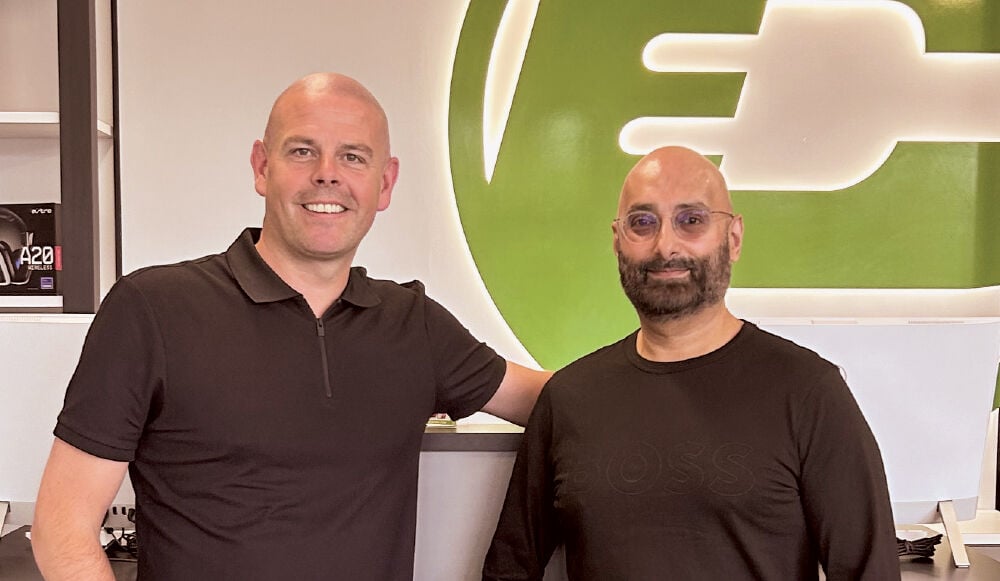
Liam Dalgarno, left, and Nin Atwal are the Scottish franchisees set to bring PayMore to the United Kingdom.
PayMore, he said, checked every box. “I visited the stores and realized how purposefully built” they are, he said. “It’s anything but a pawn shop.”
The brand has about 40 stores open in the U.S., and Corrin said he spoke to 90 percent of the franchisees in the system. The feedback was “overwhelmingly positive,” he said, and many owners are expanding on their original agreements. “That’s the healthiest of metrics,” he continued. “That gives us a lot of conviction.”
PayMore earlier this year signed a five-unit agreement for the Toronto market with Richard Price, and Corrin said they’re “working hip to hip” as both groups move ahead on development.
To PayMore co-founder and CEO Stephen Preuss, international expansion is the next “natural progression for us.”
“We’ve put our stores in every market: urban, suburban, rural, and they perform well,” he said.
Gross sales across eight franchise locations open at least 12 months ranged from $903,504 to $1,635,970 in 2023, the company reported in its franchise disclosure document.
Preuss and Erik Helgesen, the company’s president, opened the first PayMore in 2011 in Massapequa, New York. By elevating the experience and environment beyond a typical secondhand store or pawn shop, Preuss said they’ve been able to “give optionality to the masses” when it comes to buying, selling and trading electronics. Locations also safely recycle items, and any device sold or traded in is data wiped to remove personal information.
“The secondhand space is really having a moment right now,” said Preuss.