
Black Bear Diners
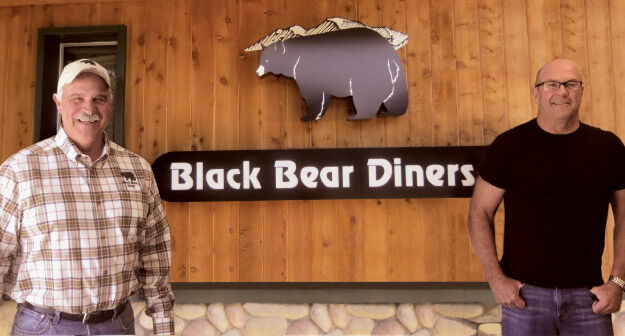
The motif for Black Bear Diners came to Bob Manley, left, in a dream, says the co-founder of the concept, with Bruce Dean.
Black Bear Diners, with a log-cabin look, is bucking a decline in family restaurants by showing increased same-store sales. Not bad for a chain where excess cash originally was found only in the jukebox.
Bob Manley and Bruce Dean were friends and business partners in Mount Shasta, California, in 1995 when Dean got an opportunity. A landlord friend of his was unhappy with the operator of a restaurant, and needed someone to come in and take over.
Dean had been a veteran of the restaurant industry, having worked at the old Sambo’s chain. He knew operations. He could cook and he could develop a menu. But he couldn’t come up with the concept. So he asked Manley to think of one.
Manley went home and dreamt about bears.
"Bears were a big part of my life," Manley said. This was Northern California, after all—Mount Shasta was at the base of a volcano, not far south from the Oregon border. "I was a wilderness guide with bears. My sports team in high school was The Bears. The team I coached was called The Bears. Everything was based on bears. I couldn’t avoid bears.
Black Bear Diners
"So I envisioned this restaurant with old-fashioned values, like the Cheers story, where everybody knows your name and you’re actually a person."
Manley called Dean the next day, and the Black Bear Diner was born. The two cobbled together $15,000 apiece and received a lot of help from suppliers and the landlord. Sysco gave them 60-day terms. "It takes forever to build cash," Dean said.
And they literally put everything into the business—except the jukebox money, that is. Early on, they put jukeboxes in the restaurant that used customers’ quarters. And then every Monday they’d empty the jukebox and split the coins. "We’re pretty high-powered businessmen, as you can see," Manley said.
The lack of cash didn’t keep the two from opening a second unit when the opportunity came. In the early days, customers of the restaurant kept telling the pair to open one near their town, and one day someone told them to open in Redding, a larger city south of Mount Shasta on I-5.
They got that opportunity when Harry’s Restaurant there closed at noon one day. "At 12, Harry’s closed," Manley said. "We reeled in a bunch of bears, we put pictures on the wall and were open at 5 o’clock the next morning. Total time and budget was five hours and 50 cents."
The pair gained a reputation in Northern California, for the friendly atmosphere Manley conceived and for the food that Dean prepared. "No way Bruce would put out a bad plate of food," Manley said. "We truly built our customer base one customer at a time. We still try to do that. Part of our training is to teach people to go beyond etiquette and form real relationships."
They continued to open units around Northern California, and five years later David Doty came across a Black Bear Diner and wanted in on the action.
Doty’s family owned a small California family chain named Jerry’s, one of the concepts that emerged when most of the Sambo’s chain rebranded. Jerry’s had grown to as many as 50 locations, but had been at the "tail end" of its life cycle. "We had a dying brand," Doty said.
Doty converted 15 of his restaurants into Black Bear Diners and became the chain’s vice president of marketing. Suddenly, this restaurant started with $30,000 in a small mountain village of 3,000 people had become a regional chain. Talk about a surprise. "You don’t go off with grandiose plans starting a brand in Mount Shasta," Doty said. The conversions took Black Bear to places like Sparks, Nevada, and Salina, California.
By 2002, Black Bear had basically run out of Jerry’s locations to convert, Dean said. So it started to franchise.
Today Black Bear has 58 locations. It’s on track to have 64 or 65 by the end of the year. And its sales have bucked the trend followed by most of its family-dining competitors: They’re going up. "Family dining, as you know, is a declining segment," Dean said. "We’re not. We’re growing." The company’s same-store sales rose 5 percent last year, and are up 3 percent so far this year.
The company calls itself the "anti-family-dining chain." Doty calls it a "hybrid Cracker Barrel," with a log cabin motif and a menu loaded with comfort food. The company’s price points are a bit higher than that of IHOP or Denny’s, but it also has a healthy dinner business uncommon in the family-dining space. "We seem to be hitting something fairly unique," Doty said.
"Somehow, we have resonated with customers," he added. "This restaurant wasn’t developed in an incubator in which you did a bunch of market research and analyzed the heck out of it. It was created, and everyone was like, ‘Wow, they really like us.’"
The chain’s early history—renovating old restaurant buildings—is coming in handy these days, as the company has embraced a strategy of moving into shuttered restaurant spaces. Of course, it will cost a franchisee a bit more than $30,000—$400,000 to $450,000. But that’s still relatively inexpensive for a family-dining concept, especially one that has average unit volumes exceeding $2 million. "The return on investment is significant," Doty said.
For his part, Doty believes the company’s lure is its "soul," that comes directly from Dean and Manley. The two have employed a customer-oriented focus from day one. They once stayed open on Christmas to accommodate their regular coffee-drinking customers who come in every day.
"There is a soul with what we have," Doty said. "We’re trying to be a community/family place. When we did some research on this, we did extensive interviews with customers. One of the biggest pieces was they came to Black Bear because it is their family. They feel they are part of this thing. This is ‘My diner.’"

