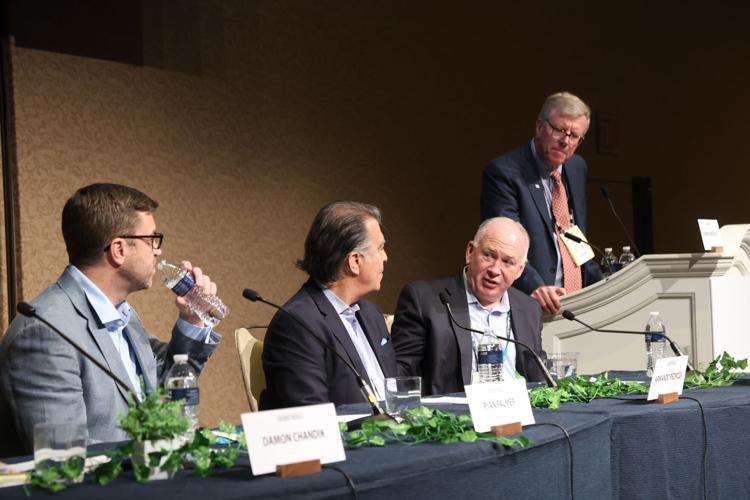


From left, Ryan Palmer of Lathrop GPM, Armando Pedroza of Citizens Bank, Ted Lynch of Bank of America and Franchise Times President John Hamburger discuss the state of capital markets during a session at the Restaurant Finance & Development Conference November 11.
Restaurant finance experts remain cautiously optimistic that lenders will continue to pump money into the industry in 2026 and beyond, even as operators face high interest rates and ongoing economic uncertainty.
Rising labor and food costs. Staffing shortages. Shifting consumer preferences. The adoption of new and expensive back-office technology.
As if things weren’t tough enough for restaurant franchises and their franchisees, they also need to find the capital to build new locations and remodel outdated ones in a high-cost environment. Interest rates for restaurants start around 6.7 percent and rise to as high as 11.7 percent in most cases for traditional bank loans. Private equity’s interest rates for restaurants and operators fluctuate but are often in the 10 percent to 15 percent range or higher.
Despite the many challenges restaurants face finding development capital, restaurant finance experts remain cautiously optimistic that lenders will continue to pump money into the industry in 2026 and beyond, with the commercial banks and private equity firms very much open to signing off on the right deals.
That was the overall sentiment from finance executives at the Restaurant Finance & Development Conference held in Las Vegas this week.
“It’s active but not energized, with a diverse group of lenders ranging from large to small,” said Ted Lynch, a managing director at Bank of America, when asked about the state of the lending space.
“I would call it active but selective, with a shift toward asset-light businesses with high multiples,” said Ryan Palmer, who specializes in franchise law at Lathrop GPM.
Lynch and Palmer were joined by Armando Pedroza, managing director of Citizens Franchise Finance department, and Damon Chandik, co-head of the consumer group and leader of restaurant investment banking at Piper Sandler, for a capital markets session moderated by Franchise Times President John Hamburger.
Pedroza, a veteran franchise banker who has been with Citizens for 34 years, pointed out that of the thousands of conference attendees, 560 of them were lenders. He compared that to the 477 lenders who attended the conference in 2019, the year before the COVID-19 pandemic.
He said those numbers are an indicator that restaurant lending remains active, with commercial banks and private equity firms looking for opportunities to partner with growing franchisors and experienced and well-capitalized franchisees.
“Banks are in good shape” and now you have a lot more private lenders involved in mergers and acquisitions, Pedroza said.
Panelists referred to some of the biggest deals of the past year, including RaceTrac buying Potbelly for $566 million. Hamburger pointed out the sale price was 18 to 19 times Potbelly’s EBITDA, or earnings before interest, taxes, depreciation and amortization, with a goal being to scale the sandwich chain to 2,000 units. Also mentioned was Jack in the Box’s sale of Del Taco to Yadav Enterprises for a $115 million, more than $400 million less than what it paid in 2021 as Jack in the Box looks to refocus on its core business.
Other major M&A restaurant deals finalized in the past two years were Roark Capital’s acquisition of Subway for more than $9 billion, Blackstone’s $8 billion buyout of Jersey Mike’s Subs and its purchase of Tropical Smoothie for an estimated $2 billion.
Related: Private Equity Firms Spent Billions On These Major Restaurant Deals
“I think we closed seven transactions in last 18 months, which is a good amount for us on the sell side,” Chandik said. “I think what has changed is the profile of the buyers with a lot of different private equity firms involved.
“If you go back 10 years, pre-COVID, there were lot of sponsors out there,” he said. “Now, everybody's kind of looking for the best deals in whatever best fast-casual version of various different food categories.”
The panelists also addressed the escalating cost of restaurant development and noted that more fast-casual brands are moving toward smaller protypes that emphasize drive-thru, pickup and third-party delivery.
Still, Palmer noted the bar for entry for first-time franchisees has risen dramatically because of inflation and other macro-economic conditions. He said the vast majority of new development agreements are now being signed by experienced multi-unit, multi-brand franchisees who have a track record of success operating restaurants.
Chandik said the speed with which development agreements are getting completed has slowed considerably.
“You're seeing a lot more sophisticated transactions now for franchisees, financial buyers with multiple levels of entities and operator structure and multi-brand portfolio companies. And those deals are going to get more scrutiny,” Chandik said. “You have to come through things like the guarantee and the non-competes and the non-disclosures and how that could apply.
“We are seeing just longer deal time and kind of more complicated structures on those deals, which does slow things down considerably,” he said.
Pedroza said when he thinks about the many challenges facing restaurant franchisors and their franchisees, including high interest rates for both loans and real estate leases, he always goes back to who is impacted.
“What's the most interesting about interest rates is what it's doing to consumers, what it's doing to the customers of those restaurant owners and those operators,” he said. “The capital is still available. Our customers are still borrowing from us. The larger ones continue to grow. But when I think about interest rates, I think about the consumer, whether it's student debt, whether it's auto loans, what the job market looks like for young people coming out and starting their careers.”