


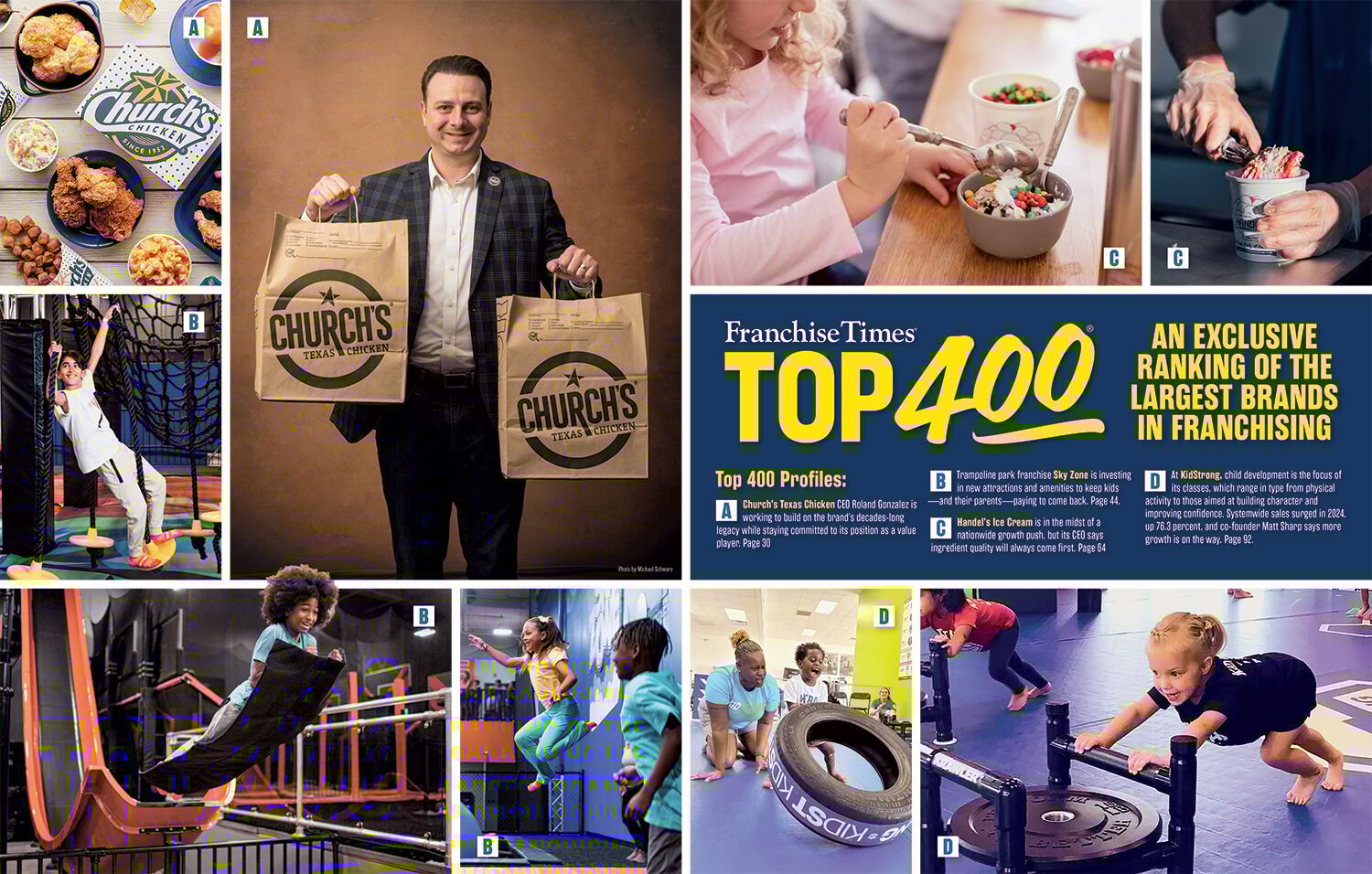
Franchise Times reveals its annual Top 400, an exclusive ranking of the biggest franchise brands by global systemwide sales. The five largest brands on the ranking—McDonald's, 7-Eleven, KFC, Burger King and Ace Hardware—combined for a massive $314.3 billion in sales. For McDonald's, even as growth slowed to 0.9%, it generated $130.7 billion of that total. Access the complete rankings database here.
Franchise brands across industries faced a varied economic landscape in 2024, and as expected, this led to wide-ranging financial results for those on the Franchise Times Top 400 ranking of largest companies by global systemwide sales.
Last year was marked by welcome decreases in two statistics. One was inflation, which began the year at 3.1 percent, but later fell to 2.4 percent, the lowest since March 2021. While it ticked back up later in the year, the rate remained below 3 percent, ending the year at 2.9 percent.
The other factor was the U.S. Federal Reserve lowering interest rates in the last third of the year. In August 2023, the Fed set its key overnight borrowing rate at 5.3 percent, where it stayed until September 2024, when the rate was lowered to 5.13 percent. Additional cuts would follow, with the rate set at 4.48 percent to close the year.
The more favorable economic conditions did result in stronger sales across hundreds of franchise systems. For many of the largest brands on the Franchise Times Top 400 ranking, global systemwide sales help tell the story.
Of the 10 highest ranked concepts on the Top 400, just two experienced sales declines. Subway finished 2024 with an estimated $17 billion in sales, down 1.4 percent from the prior year, and it fell in the ranking from No. 7 to No. 9. Unit closures continued to plague the company last year, and its total store count declined by 631 to finish the year at 36,502.
Convenience store brand Circle K, meanwhile, dropped from No. 9 to No. 10, as its $16.8 billion in sales was 4.9 percent lower than 2023.
A few other notable changes include Taco Bell’s move up two spots to No. 8 with $17.2 billion in sales, and Domino’s shift up to No. 7 with sales of $19.1 billion. Chick-fil-A’s 5.3 percent sales growth gave it a $1.2 billion boost last year, to an estimated $23.5 billion as it stayed at No. 6.
No. 1 McDonald’s, meanwhile, distanced itself just a little further from the pack as global systemwide sales ticked up only 0.9 percent, to $130.7 billion. That comes after nearly 10 percent growth in 2023 and the slowdown is also notable because McDonald’s increased its unit count by 1,655 to close 2024 with 43,477 stores.
Realities for restaurants
In the always competitive burger category, McDonald’s was one of three brands struggling to post positive revenue increases. No. 4 Burger King had a 2.6 percent increase in sales, to $27.7 billion, while No. 11 Wendy’s generated $14.5 billion, a 2.8 percent rise. The quick-service burger brands brought in a total of $202 billion last year, making it by far the largest segment.
Midsized QSR burger brands hit their stride. No. 33 Culver’s led the category with 12.1 percent growth to reach $3.7 billion. No. 28 Whataburger also had a strong showing, with sales growing by 9.4 percent, to $4.1 billion.
Whataburger also led the sector in unit growth percentage, up 8.8 percent by adding 88 net new locations, for a total of 1,085 to close out 2024. In the better burger space, No. 35 Five Guys was the only brand to post gains, with a 4.8 percent sales increase to $3.35 billion.
Behind burgers as the second-largest restaurant category was chicken and the $79.9 billion in total sales from these brands.
KFC is still the biggest global player, but its sales increased just 1.7 percent, to $34.4 billion. By sales and unit growth percentage, though, no brand did better than No. 123 Dave’s Hot Chicken.
The Nashville hot chicken concept ended 2024 with $636 million in sales, a 40.1 percent increase, making it the fourth-highest brand when ranked by percentage growth. In unit growth percentage, Dave’s Hot Chicken led all brands, increasing its count 76.5 percent to 259 restaurants.
The third-largest restaurant category, off-premises pizza, also posted an increase, though it was only a 0.9 percent rise, reaching $40 billion. Generating nearly half of the off-premises sales in the category was Domino’s, which finished 2024 with $19.1 billion, a 4.6 percent increase, pushing it from No. 8 to No. 7.
Health, personal care see sales gains
The category with the highest percentage jump in sales in the Top 400 was the health and medical sector, increasing 12.7 percent, from $11.2 billion to $12.7 billion.
The boost was powered by several senior care brands tapping into a growing demand for the elderly to age in their own homes as opposed to being moved into 24-hour senior care centers.
In all, 11 senior care brands posted double-digit growth in 2024, with HomeWell Senior Care and Senior Helpers setting the pace with respective 30-plus percent sales increases. No. 132 Senior Helpers did $600 million in sales, while No. 278 HomeWell reached $138.5 million.
Not all health and medical brands had positive years, though.
QC Kinetix—which has faced criticism for a number of issues raised by franchisees, including aggressive sales tactics, high costs and questionable effectiveness of the regenerative medicine treatments—saw sales decline 28.6 percent, to $112.2 million, while its unit count fell by 8.2 percent to 167.
Personal care and services, which includes franchises ranging from hair care to youth activities, continued a hot streak from 2023. In 2024, the category’s overall sales rose 8.8 percent, to $31.3 billion. Fitness brands alone accounted for a third of the sales, with $11.7 billion.
Leading the fitness concepts was No. 205 Burn Boot Camp, which grew sales by 33.4 percent, to $265 million. The North Carolina-based group fitness concept added 30 units overall to finish 2024 with 374 locations.
The highest-ranked brands in the category, No. 22 Planet Fitness and No. 44 Anytime Fitness, had 6.7 percent and 9.1 percent sales growth, respectively. Planet generated $4.8 billion in sales, while Anytime did $2.4 billion.
Education concepts also made strides, generating nearly $6.7 billion in sales. In the sector, more than half of the subcategory’s brands saw
double-digit percentage growth in sales last year, led by Celebree School’s 23.2 percent increase to $101 million.
Up and down at home
Total sales in the home services category rose 2.6 percent in 2024, to $12.4 billion. Five Star Bath Solutions was top grower at 49.9 percent as its sales jumped to $107 million. That’s thanks in large part to unit growth of 57 percent as the bathroom remodeler added 94 net new locations to end last year with 259.
Home improvement concepts led the subcategories in the sector, with $6.4 billion in sales, a 3.7 percent jump from 2023. Mister Sparky delivered a promising year in the electrical, HVAC and plumbing subcategory, with $188 million in sales, up 11.1 percent. Mister Sparky also added 46 locations, a 27.2 percent increase to 215.
On the franchised real estate front, 2024 was more difficult. The real estate category posted $26.1 billion in sales, but it was only 0.1 percent higher than 2023. Units also fell from 13,429 to 12,853.
The top brands in the category, No. 14 Re/Max and No. 15 Keller Williams, each had more than $10 billion in sales. It was new high mark for Keller Williams, which rose 1.4 percent from $9.9 billion to an estimated $10.03 billion. Re/Max, however, went in the opposite direction, declining 0.7 percent from $10.4 billion to $10.3 billion.
United Real Estate was the top grower in the category, with sales increasing 4.8 percent, from $627 million to an estimated $657 million. Unit growth for United Real Estate was similar, rising 4.9 percent, as the brand added eight locations to reach 170.

How we rank the Top 400 franchises
The Franchise Times Top 400 is an annual ranking of the largest franchise systems in the United States by global systemwide sales, based on the previous year’s performance.
In a five-month research process and building upon a database that began in 1999, our research team uses a combination of companies’ voluntary reports and publicly available data, including the franchises’ most recent franchise disclosure documents and Securities and Exchange Commission filings.
To qualify, a company must be a legal U.S. franchise. Franchisees must own at least 10 percent of the company’s total units. The company must also be based in the United States, or have at least 10 percent of its total units in the United States.
Systemwide sales is defined as the total sales for both franchise and company units. Those sales figures should represent sales to customers, and not corporate sales to franchisees or prospective franchisees, such as royalty revenue or franchise fees. Other revenue not directly related to franchising should not be included.
If two companies reported the same systemwide sales, the higher ranking is given to the company with the most units. Preference is also given to companies that voluntarily report their systemwide sales, rather than those companies for which we must estimate the sales figures.
Franchise Times’ estimated revenue for real estate companies is based on 2.5 percent of their reported sales volume. Real estate companies report sales based on total volume of homes sold. So, if a home is sold for $200,000, it would be listed as $200,000 in revenue. Franchise Times’ estimate would count $5,000 in revenue earned as a commission from the sale.
We estimate travel agencies based on 12.5 percent of their total sales volume. Like real estate companies, travel agencies report sales volume based on the value of the vacations sold, rather than their commissions.
Research begins for next year’s project in late April.
To submit your brand’s sales and unit numbers, or for more information, contact Franchise Times General Manager Matt Haskin, who leads the research effort for Top 400, at [email protected].