Franchisors offer shiny incentives in record numbers. Bankers roll out express loans with a quick decision guaranteed. As the push to sign veterans goes into overdrive, some caution the fit still has to be right.
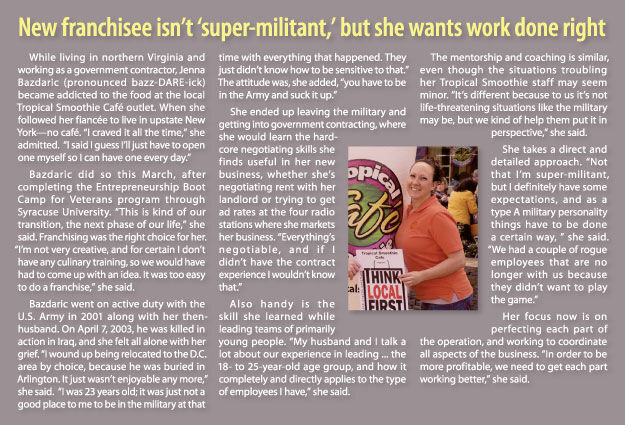
Holding a pair of giant scissors, Jenna Bazdaric beamed at the ribbon-cutting party this March at her Tropical Smoothie Café in upstate New York. At age 29, with a loan topping $400,000, she’s a first-time franchise owner facing all the usual risk.
Business has been OK this spring, but only when it’s sunny. Rents and taxes are high in the state, she said, although she did negotiate a competitive rate for her prime location in Poughkeepsie. Adding to the uncertainty, her husband, Jamie, is set to retire later this year from West Point, after a 20-year career with the U.S. Army.
But the couple decided to go for it, showing an attitude she gained through tragic circumstances. She was on active duty in Iraq with the U.S. Army in 2003 when her first husband, Jeff Kaylor, also a soldier with the Third Infantry Division, was killed in action during Operation Iraqi Freedom, she said.
"I just seize the moment because you never know when the moment is going to be over," she said. "That’s just how I’ve been since that time, because I don’t want to have any regrets."
Bazdaric’s story is unique, but as a military veteran who has just become a new franchise owner, she is also part of a monumental push. The centerpiece of the efforts is called Operation Enduring Opportunity, launched with a bang last November by the International Franchise Association in partnership with the White House-led Joining Forces Initiative.
The goal: to hire and recruit 75,000 veterans and their spouses and 5,000 wounded veterans as business owners and employees in franchises over the next five years. You could call the effort VetFran on steroids—and all the promotion is raising both hopes and worries.
Already ‘way past’ goal
The IFA has promoted veterans and franchising since 1991, when Don Dwyer Sr. and others led the push to start VetFran. After his death, his daughter Dina Dwyer-Owens of the Dwyer Group picked up the torch—and eventually named Marine Corps veteran Mary Kennedy Thompson as president of Mr. Rooter Plumbing, based in Waco, Texas, and one of the Dwyer companies. Thompson became chair of VetFran about a year and a half ago, and challenged members to up the ante.
"Our goal was to increase the membership of franchisors offering discounts to veterans by 15 percent—we’re way past that. We hit our goal in the first two weeks of this year," said Thompson. Her motivation was this statistic: 200,000 veterans are returning to civilian life each year, and she said that’s soon to jump to 300,000 each year with the drawdowns of the wars in Afghanistan and Iraq.
She believes franchising was key to her success in business—like many veterans, she had loads of leadership skills but little hard business background. "I didn’t know that P&L stood for profit and loss. I had to have someone sit down and say, this is how you run your business," she said.
More than 450 franchisors are now offering discounts to veterans through VetFran, she said, up from about 300 a year or so ago. Some 2,100 veterans have come into franchising since 2011, as employees and business owners, said the IFA’s Beth Solomon; 120 of those became business owners.
The offers and activities are dizzying: They include 30, 50 or even 100 percent off the franchise fee for veterans. Half off royalties for a year. Special loans, called Patriot Express, through the Small Business Administration. Heady photo opps for Thompson and other franchising bigwigs with First Lady Michelle Obama on the U.S.S. Intrepid.
("She’s extremely tall," Thompson said with a laugh, when asked what the First Lady was like. "I had on my highest shoes and I felt like a foot shorter. I really respect what she’s done working with veterans and the troops.")
Snap-on Tools has dedicated one individual full-time, retired Air Force Captain Jon Rucker, based in Atlanta, solely to the effort of signing on veterans as franchisees. Prior to 2010 they had signed three veterans, he said. In 2010, the year they committed to a "paradigm shift" to target veterans, they signed 43, and hit the same target last year. That’s about 10 percent of their new franchisees. This year they expect 12 percent of the franchisees they sign will be veterans.
The frenzy has created some concerns, too. All that discounting cuts into revenue; franchisors say they’re counting on high-quality franchisees to make money back in royalties. The sheer volume of offerings raises the question of whether all can successfully do so.
And many military veterans, just like their civilian counterparts, lack what it takes to run a successful business. Special loan programs for veterans are great, for example, said Mike Hainey, a Syracuse University professor who holds boot camps to help veterans prepare to run a business. "But I want to see them come with training that helps that veteran not get in trouble down the road."
Any fledgling business owner, veteran or not, lured by shiny discounts, saddled with large loans yet not equipped to run a business, "is absolutely a danger," Hainey said.
Three programs
With 450, and counting, franchisors participating, the number of offers is too large to list here. (See all the offers at www.vetfran.com. To be listed, Beth Solomon, IFA’s vice president of strategic initiatives and industry relations, notes, franchisors have to offer their best discount to veterans, and change their franchise disclosure document to spell out the details.) Just three of the notable participants follow.
This February at CiCi International in Coppell, Texas, they unrolled the CiCi’s Patriot Program, which waives the franchise fee for the first restaurant, plus 50 percent off the royalty for the first full year of operation. That’s a savings of between $55,000 and $60,000, said Forbes Anderson, chief financial officer and chief strategy officer.
They add another twist: "We ask the franchisee to employ another veteran in the management of their store," he said. "What we’re trying to do is give them an opportunity as they come out of the military. And if we’re willing to help them, we’re asking them to consider helping a fellow veteran coming out." He notes a $2,400 to $9,600 tax credit is available to employers who hire veterans.
CiCi’s has offered other incentives in previous years, although this is more generous. "What makes veterans successful in our brand, is they have been trained in the military to operate different systems. What we tell franchisees is you’re buying into a system, and if you execute the system you will be successful," Anderson said.
CiCi’s has 570 restaurants, and management knows many employees eventually become franchisees themselves, once they’re financially prepared. "It’s helping us grow our concept absolutely, but what we want to do is grow with quality people.
"There’s a large percentage of those returning military that are struggling to find quality jobs and opportunities. We recognized that they sacrificed for us and we want to give something back," he said.
"Franchising is entrepreneurial. It allows them to create an opportunity for themselves."
‘I was shaking’
At Instant Imprints, CEO Ralph Askar talked with Franchise Times in late April, the same day the space shuttle Enterprise arrived in New York City atop a specially modified 747 jet, on its way to retirement at Manhattan’s Intrepid Sea, Air and Space Museum. "I just heard it land," Askar said when reached by phone. "I was shaking while I was driving."
Askar’s family ran away from Iran in 1965, when it was called Persia, and ended up in Chicago. He has strong patriotic feelings today about the American military. "As far as the freedom we’ve created around the world, what’s happening today—it’s very momentous." That sentiment, plus headquarters in San Diego where there’s a huge military presence, motivated him to challenge Bryan Smith, senior vice president of franchise development and a veteran himself, for a stepped-up offering.
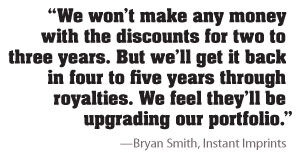
"We discounted our franchise fee by $10,000, and we are financing it for another $10,000, interest-free for 48 months," said Smith. "We won’t make any money with the discounts for two to three years. But we’ll get it back in four to five years through royalties. We feel they’ll be upgrading our portfolio" of franchisees.
Since he bought the company last June, Askar has added services to the concept, and introduced a "no-frills franchising" plan that reduces fees for all franchisees. He plans to make back the new discounts over time. "In the long term, once you reach critical mass, it’s the royalty stream that pays the base. Eighty to 85 percent of revenue comes from royalties, not fees," Askar said.
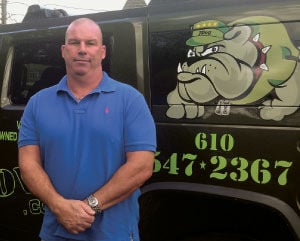
Jerry Flanagan says his is a simple business model so any veteran can run it: "If you have a hard work ethic you can be successful."
10 new franchisees
At UPS Stores, headquartered in Atlanta, they launched a promotion last November, offering to waive the franchise fee, nearly $30,000, for up to 10 qualified veterans who signed a letter of intent between January 1 and June 30 of this year. "We are well ahead. We hit that in early April," said Becca Andrews, marketing spokeswoman. Since 2004, she said, and including these 10 new people, "we’re at over $1 million in discounts that have been given."
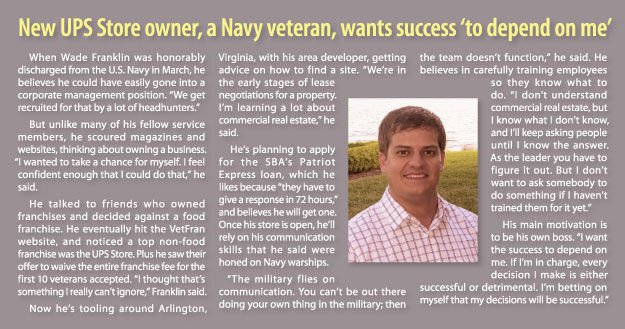
Wade Franklin is one of the 10, and this spring was busy selecting a site for his UPS Store in Arlington, Virginia, and is poised to apply for a $170,000 SBA Patriot Express loan. He said he’s getting great support from his area developer.
"As a person without much business experience, looking into franchising seemed like a pretty good idea. They had the business model set up already; all I had to do was go in and follow the plan," he said. "I know my limitations. I know if I was trying to open my own business I’d be completely lost."
Franklin, 29, served in the U.S. Navy as a surface warfare officer on two different warships, running a 25-person division at one point. "It was a faster, more complex, 24-hour operation" than his UPS Store will be, which he appreciates. "This is a change in lifestyle."
When his store opens, plans are for this October or November, he believes he’ll "embrace the simple lifestyle. I wanted to work for myself," Franklin said.
That sentiment—being their own boss—is nearly always the No. 1 reason veterans give for wanting to own a business, said Haynie, who runs the Institute for Veterans and Military Families at Syracuse University. He’s put more than 1,000 veterans through training programs preparing them for business ownership. "One of the things that attracts veterans is a way to regain autonomy over your life," Haynie said. Military veterans represent about 6 percent of the population, but they make up 14 percent of all business owners, Haynie said.
The No. 1 barrier, he said, is access to capital. Every new business owner faces the problem, but non-military people have probably worked in the industry where they’re now trying to start a business, he said, and industry experience is a key factor when bankers decide to make loans. "When that military person gets out they have great experience that applies to business in general, but they don’t have the industry experience."
Buying a franchise, of course, is just one of many routes to business ownership. Haynie says there are some clear draws for military people. "The thing that attracts them is the franchise model is similar to a military model. A franchise model provides a lot of that structure in a way that is similar to what someone who’s served in the military is used to. So there’s a level of comfort there," he said.
The most important predictor of success, he said, is passion. "In all of the things we do with veterans, what we hit really hard is thinking through what kind of business you’d like to pursue, and to really focus on something that has personal meaning to you," Haynie said.
"If you’re pursuing business ownership and it’s this 80-hour-a-week proposition, you’re only going to be willing to put in that kind of effort if it’s focused on something you care about."
For veterans only
Jerry Flanagan is one veteran who has found his passion—and just began franchising it in May. He has been driving around the Philadelphia area in his Hummer for the past year, testing his franchise concept called JDog Junk Removal. "I wanted to see what the reaction would be if I drove up in my Hummer. It’s a green Hummer, an H2 model. It’s an eye-catcher, and they’re noticing my website, and they’re noticing I’m a veteran. I’ve had a very good year," he said. Flanagan served in the Army from 1987 to 1989.
On May 10 he filed his FDD, or franchise disclosure document, offering franchises for military veterans only. He worked with an attorney, also a veteran, to check the legality of the arrangement and prepare the documents.
He believes his is the only franchise offered exclusively to veterans. Experts advised against the sole focus because the pool of prospects is too small. But he’s adamant. "I’d rather keep this sacred for the people that need it, because I think military veterans have a hard time getting an equal shot in the workplace anyway. We’re all brothers and sisters in this," he said.