
Strips of miso-marinated beef sizzling on an in-table grill lured me to the Gyu-Kaku booth at the Franchise Show, co-sponsored by Franchise Times and the National Restaurant Association at its annual convention in Chicago last month.
It’s a Japanese BBQ restaurant concept where customers cook their own food—and it was the fastest chain in Japan to reach 500 restaurants, said Aki Yamaguchi, vice president of franchising. Now he’s trying to sign franchisees in the United States, and was chatting with Ted Davenport, a Subway franchisee in Hawaii who’s stepped up to add Gyu-Kaku outlets there.
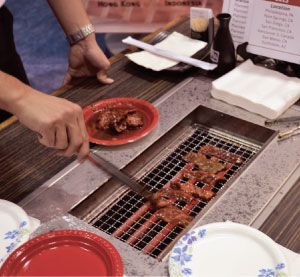
Every table at Gyu-Kaku has a built-in grill, which costs thousands. The trade-off for owners: Customers do their own cooking.
It was also one of many great stories—from the serious to the bizarre—I heard and saw during my first time at The Show, in Chicago May 5-8. Only there could these three true tales co-exist:
- A man wearing safety goggles shoved a five-foot, wooden rake handle in a blender, which chopped it to pieces in about 20 seconds. That was Tom Dickson, the inventor and maker of the Blendtec blender, whose method for testing his products (he’d stick 2X4s in them to see if they’d break) spawned the wildly popular "Will it Blend?" YouTube campaign.
- Jimmy John Liautaud—yes, the founder of Jimmy John’s—went on a full-scale rant against government regulation and waste in a panel discussion. When he paused for breath, fellow panelist Craig Culver, CEO of Culver’s, shouted: "Jimmy John for senator!" The crowd roared.
- A giant potato sat on the back of a semi-trailer truck, as part of a national tour to promote the Idaho Russet. (You can see that story on page 8.) When I found myself donning a straw hat and posing by said spud, I knew it was time to head home—but first I needed to snarf down succulent strips of beef.
Dubai to London to U.S.A.
At The Noodle House booth nearby, they were touting a big coup: the signing of a development deal in London, their first in the United Kingdom. Olivia Bilenkij, business development and franchising director for Jumeirah Restaurants, considers that base to be a launching pad for their next move into the United States.
The Noodle House started in Dubai, as part of the very posh Jumeirah resort and as a way to cater to the 10 million or so tourists who visit the city each year, many of them Asian. Jumeirah Restaurants was formed to begin franchising The Noodle House, and Phil Broad, who formerly led Starbucks in the United Kingdom and Ireland, is assembling a team packed with many Brits to tackle the task.
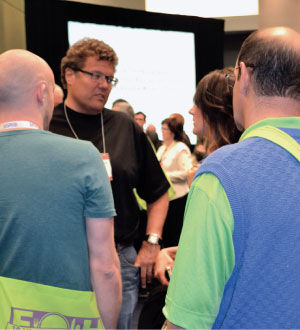
Jimmy John, plus fans, said he graduated high school second to last in his class: "I don’t have any education. I have to do what works."
‘A lot of tough love’
Jimmy John Liautaud attracted a crush of young acolytes after he held court on the President’s Panel, along with Craig Culver of Culver’s and Jim Greco of Sbarro. Franchise Times’ own Mary Jo Larson moderated. (Warning: Jimmy John swears a lot, so skip to the next part if you don’t like blue language.)
He recalled the early days of Jimmy John’s. "I didn’t know about leading by example. I worked a few days a week, then I smoked pot Friday, Saturday and Sunday," he said, causing his two employees to quit.
His father lent him money to open his first store, and said if it failed he’d have to join the Army. If it worked, his father would take 48 percent. The first year, he said, he posted $154,000 in sales and made $48,000. "I split it 48-52 with my father."
The second year, he made $188,000 in sales and $55,000 profit. "I split it 48-52," he said. "The third year I bought my father out." Jimmy John’s has 1,400 stores, with 2,300 in the pipeline. "We open a new restaurant every day," he said. To fuel that pace, he sold one-third of the company to a private equity group five years ago.
He said he learned the hard way to carefully screen franchisees. "It works well now, but my first criteria for franchisees were pulse and check." They started franchising in ’94. "I had 70 franchises and maybe 60 were not making money. Around 2003 we had those turned around, and by 2005 I put in stringent qualifications. It’s a lot of discipline, a lot of restraint, lining up the people with profits—free enterprise is very, very powerful.
"We give the franchisees a lot of tough love, like my parents gave me. My parents beat my ass when I screwed up."
Time to transfer
You don’t always see certified public accountants getting excited. But panelist Brad Saltz was telling business owners they have only until the end of this year for a "once-in-a-generation opportunity" to transfer wealth to heirs.

The crowd waited for an hour for their keynote speaker, above, while his plane circled in bad weather. Right, Tom Dickson answers his question, Will it blend? His company, Blendtec, has a new machine for convenience stores that allows customers to make their own smoothies, thus cutting labor costs.
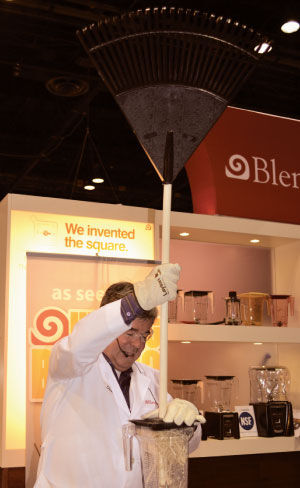
The crowd waited for an hour for their keynote speaker, above, while his plane circled in bad weather. Right, Tom Dickson answers his question, Will it blend? His company, Blendtec, has a new machine for convenience stores that allows customers to make their own smoothies, thus cutting labor costs.
In 2012, individuals can give $5.1 million to anyone, exempt from the gift tax; married couples can give $10.2 million. In 2013, that drops to $1 million per individual and $2 million per couple, said Saltz, a principal at SS&G in Cincinnati.
Also, in 2012 the top tax rate is 35 percent; in 2013 it goes up to 55 percent.
"It’s an opportunity I haven’t seen in my entire career, and it’s available this year only," he said.
Hail to the (former) chief
What does President Bill Clinton miss, now that he’s no longer president? The fact that no one plays a song when he enters the room, he said to the audience at the NRA show who waited an hour to hear him.
No one, that is, except for the orchestra that played him onto the stage for his keynote address. They’d been playing since 12:30—and playing, and playing, and playing, as bad weather caused Clinton’s plane to circle Chicago before it finally landed in Gary, Indiana, and he was driven up.
He likes being able to speak more freely now. "That’s a great thing about not being president. You can say whatever you want—unless your wife is secretary of state," said Clinton.
After his heart surgery in 2004, he said, he was asked to get involved with the obesity problem in America. He learned that children who have weight problems were getting 50 to 60 percent of their calories just from the drinks they were consuming in school—and he began contacting beverage suppliers and vending companies and restaurant people.
"Four years later," he said, "there’s an 88 percent reduction in the total calories in the drinks being shipped to our schools by people who found a legitimate business model.
"The world we live in has a lot of challenges that don’t have a simple solution and require cooperation. What works is creative cooperation," he said.
Longer than most marriages
Rahman Hashimi was another patriotic panelist. "I’m from a country with a lack of education," he said. "In 1979, Afghanistan was invaded by Russia. The same year my father died; he had a heart attack when he was 45 years old.
"I’m from a family of 12 kids, six girls and six boys. Things were getting bad so in 1988 we came to the U.S.," he said. He found a job in a restaurant, opened one of his own, then got into real estate—and failed spectacularly after 9/11. "When the market crashed I was out of a job for two years. I was bleeding bad," he said.
Now he has seven Popeyes and Dunkin’ Donuts restaurants in the New York area. "I appreciate the beauty of this country and the opportunity that it gave me," he said.
Cheryl Bachelder, president of Popeyes Louisiana Kitchen, said she learned the importance of collaboration between franchisors and franchisees when working for Tom Monaghan, the founder of Domino’s Pizza. "I’ve looked most for the mindset of the franchisee toward collaboration. These are 20-year contracts.That’s longer than most marriages in America today."

