

Mark Siebert
Editor’s note: In this second of two columns, franchise expert Mark Siebert touches on what competing concepts have found works in the past, and the ways your future franchise can succeed in the future. (The first article can be found at http://franchisetimes.com.)
Differentiation of the concept at the consumer level should, of course, be a competing franchisor’s top priority, as the concept must first and foremost compete for the consumer’s dollar. And from a strategic standpoint, winning positions need to be more than different. They need to be perceived as being best at something.
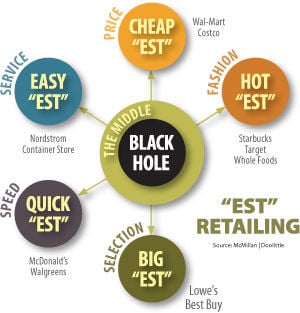
The importance of this position is reinforced by retail consultant McMillan|Doolittle (www.mcmillandoolittle.com), whose groundbreaking work on the "EST Model" is the basis for much of the strategic thinking in the American retail marketplace. The EST Model basically proposes that a retailer must be perceived as the best in at least one of five essential positions if they want to "win" in the marketplace:
• Biggest—a dominant assortment;
• Cheapest—lowest prices;
• Easiest—high-service orientation;
• Quickest—fast-service orientation;
• Hottest—fashion orientation.
EST Theory goes on to state that while a retailer can position itself to be best in two of these categories (biggest and cheapest, a la Wal-Mart), if they try to be more than two they will fall into the "black hole" of mediocrity—where retailers go to die. Trying to be everything to everybody leads to an undefined brand position and, ultimately, a position of mediocrity in the consumer’s mind.
When defining a brand’s position, bear in mind what your competitors will be saying—both about you and about themselves. If what they are saying about themselves sounds like what you want to say, you have failed to differentiate your brand and, in these cases, ultimately the larger player will generally win.
In positioning your concept, it is important to remember that position is relative. A small company that is the first to the market can strive to be the industry leader. That same concept in a crowded marketplace may need to become a niche player—or, alternatively, may need to redefine "the market" in which they are a player.
For example, a small player entering into a crowded national marketplace might have a difficult time getting traction, whereas that same player focusing on local or regional submarkets, may be in a position to take a more dominant position by tightly clustering all of their locations in a market in which their national competitors are spread thin. A franchisor who adopts this "fortress strategy," must concede markets out of their area in the process—a cost that some are not willing to incur—but in doing so, the franchisor can clearly stake out their "brand territory" as being the dominant brand in Poughkeepsie.
Beyond consumer positioning, many of these EST principles apply when positioning the franchisor versus its competitors. The savvy franchisor will begin its strategic planning process by deciding specifically how it will choose to compete in the franchise marketplace, how it will position the brand, and how it will craft a message that will convey its desired position.
Aside from positioning at the consumer level, there are dozens of ways franchisors can differentiate themselves in the franchise marketplace. Franchisors can differentiate their offer based on franchise structure, the size of the initial investment, strength of the management team, the availability of financing, the quality of services provided to franchisees, their earnings —if they choose to use a Finance Performance Representations (FPR), and, even based on price (lower royalties)—although being the "cheapest" in franchising is generally a losing strategy. Franchisors can even alter their position in the market based on the candidates they target to be their franchisees.
The savvy franchisor will thus examine every aspect of their franchise program in detail and ask, issue-by-issue, why they adopted that position.
The view only changes for the lead dog
With all the constant talk about leadership in the business press, why then do so many otherwise astute businesspeople choose to play follow-the-leader? For some, it is probably the fear of making a mistake. For others, it may be that they do not understand the process of how to systematically differentiate a concept or a franchise offering. And for others still, it is the simplest and most expeditious way to get to the market fast. But regardless of the rationale, follow-the-leader generally works as well for business as it does for lemmings.
If you do not stake out a unique position in the marketplace and clearly communicate that to your prospects, you can be sure of only one thing: Your competitors will do it for you. They will tell your prospects who you are and what you stand for. If you allow this to happen, rest assured the label they will choose for you will be different than the one you might have chosen for yourself.
Ultimately, to succeed in franchise marketing, one must identify the areas where you want to be best, develop a unique selling proposition around that position, and be willing to concede the areas in which you will allow your competitors to play unabated. This focus and this concentration of resources will allow you to succeed while your competitors will be touting their Orange Circles.
Mark Siebert is the Chief Executive Officer of the iFranchise Group (www.ifranchisegroup.com). His consultants have over 450 years of experience in franchising and have worked with 98 of the nation’s top 200 franchisors. He can be reached at 708-957-2300 or at [email protected].

