

Park Guell, Spain
The famous Park Guell in Barcelona, Spain, is just one reason to bring your brand here.
A new affinity group links the U.S. Commercial Service European offices together. So franchisors who want to expand in the European Union have the benefit of multiple resources in one package.
When Michele Fishman’s father told her it was time to take Denver-based The Alternative Board international, Fishman didn’t only move into the role of vice president of international, she also will move to Madrid, Spain—but only for seven weeks.
Fishman, whose father founded TAB, a franchise that forms an executive board of peers for growing companies, spent three years researching before deciding to start with Europe. She makes the move in September.

Michele Fishman
Why not be the boots on the ground? she ask rhetorically, especially since her only child is heading off to college in the fall.
"I have a list of 15 countries we had strategized would be good markets to research," she says. Since business consultants are TAB’s ideal franchisees, Fishman says she needs to get to know the competition and the business structure of the European Union countries.
Fishman isn’t the only one using Spain as a base. Angela Turrin, international trade specialist with the U.S. Commercial Service in Madrid, is the liaison for several other offices in Europe. She calls it "borderless behavior." By taking a regional, rather than nationalistic approach, an affinity group made up of Commercial Service officers in Europe works with franchisors to streamline the process. Anyone in government knows about doing more with less. "We lost Barcelona (office) and four people six years ago because it was considered a mature market," Turrin says. With the interest in the emerging markets in Asia and the Middle East, Turrin says she saw Europe getting less important. The regional approach is so they can become "quality oriented, not just number oriented."
Fewer resources also means more cleverness on how to use the resources they do have. "We’re creating synergies in all directions," she says. To demonstrate how this approach is working, Turrin gives a recent example of a restaurant chain management’s request. "They wanted something really hard," she says, "a list of the wealthy. They wanted to talk to the rich." Since no such list existed, Turrin says, the affinity group brainstormed and then put together an itinerary of luxury-item events, such as shows for yachts or helicopters. The chain now has a year’s worth of places to meet the investors they’re seeking.
Her approach is: "Let’s not say ‘no’ to the client. Let’s give it a thought."
For TAB’s Fishman, Turrin helped her work out strategies prior to traveling, while she’s in Europe and for when she returns home. In addition, Turrin organized a networking event to introduce Fishman to local business consultants in Spain. She also has similar events in the works for other countries. Moving to Spain "shows commitment," Turrin adds. "She represents the brand like no one else could."
From Brazil to Spain
Turrin may sound like a native Spaniard, but she was born in Brazil into an Italian family. She lived in the U.S. from age 11 to 14. Her mother, a research scientist who attended Yale at the time, couldn’t convince Turrin she would like living in the U.S., but MTV did. "That’s how she sold me on it," Turrin says, laughing. "I was hooked for two years."
She went back to Brazil for college and then moved to Spain. She’s married to a Spaniard, which allows her to be the local expert in the U.S. Commercial Service office in Madrid. She speaks Portuguese, Spanish, Italian and English.
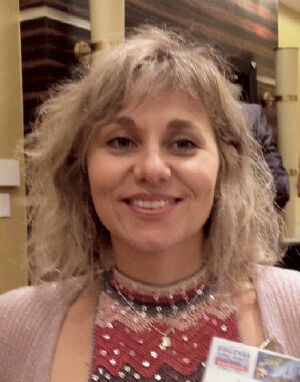
Angela Turrin
Turrin handles other industries, but her heart is in solving problems. "I go to work on Monday morning and I’m happy," she says. "When clients succeed, a spark in my horizon is brighter."
Getting that spark isn’t always easy. "Spain can be very conservative when it comes to business," she says. "They don’t like to share business plans or talk about failures." And unlike Turrin, English-speaking businesspeople aren’t the norm.
"We tell them (U.S. franchisors), don’t try to make money by tomorrow," she says. "Start with brand awareness." To be successful, a franchise has to offer something locals don’t have, but want. About 85 percent of franchise systems in Spain are European, while 15 percent are foreign.
Expect to slow down the process here, warns the business guide on doing business in 60 countries, "Kiss, Bow, or Shake Hands" by Terri Morrison and Wayne A. Conaway. Spaniards like to get to know the people they do business with on a personal level before sitting down for negotiations. But the authors warn: "Do not try to get too friendly too soon with your Spanish associates, and never underestimate a person based upon a job title."
Businesses here tend to be hierarchical and compartmentalized, as opposed to the trend in the U.S. to cross-train employees.
According to businessculture.org, a website detailing business etiquette, business dealings in Spain are more relaxed than other Western European countries, and deals can take time.
Another cultural difference is that Americans do business over lunch, but Spaniards like to go home for lunch, the book says. A two-hour window for lunch, when businesses close down, may also prove frustrating to the U.S. franchisor who likes to make use of every minute while overseas. "You have to shake hands," Turrin says. "It’s hard to work with someone you don’t bond with."

