
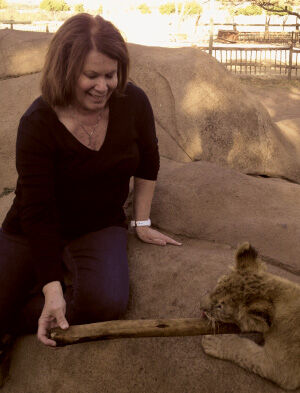
It’s not every day you meet a U.S. ambassador and pet a baby lion. Sometimes it takes two days. Saturday I pulled a two-minute shift in the lion nursery at a wild animal park outside Johannesburg; and the following Monday I met American Ambassador Robert Godec at a reception to honor the trade mission’s second stop in Nairobi, Kenya.
Godec is the not the first ambassador I’ve met—accompanying the franchise trade missions the last couple of years has introduced me to a whole new level of dignitaries—but Godec was the first one I had a chance to talk to for more than a brief handshake. (Although on the South American trade mission, I did have a chance to personally meet one ambassador’s dog and check out the books in the study. You can tell a lot about an ambassador by what he or she reads.)
I was touched by Godec’s speech at the reception for the trade mission delegates who had decided to make the trek to Kenya just days after the mass shooting at the Westgate Mall in Nairobi. He was still visibly shaken by the ordeal, and he addressed us from his heart, not from his notes.
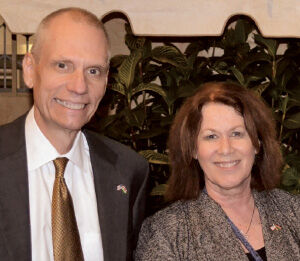
Trade mission, Nancy Weingartner
This trade mission to Sub-Saharan Africa was particularly hard on me because my computer refused to charge, thus becoming a casualty of the mission, along with my ability to write on the road. And my plug adapter refused to charge my flat iron, leaving me with hair that looked like I had stuck my finger in a 240-volt light socket. I’ve discovered I can only write stories when I have fingers on a keyboard. Pen and paper are no longer my muse. I also learned to get over my hair.
I originally intended to pass on going to Africa, because the timing was bad, but I am addicted to trade missions. It’s not just the international travel; the format provides a vantage point I would not get as a tourist. And to be quite honest, I would never think to vacation in Nigeria. It’s like being forced to read a book, because everyone in your book club is reading it.
Ironically, Nigeria is the reason I finally decided to go. A couple of years ago, after I had written the story on the India trade mission, Anayo Agu, a senior commercial specialist in Nigeria, cornered me at the International Franchise Expo and invited me to Nigeria. He wanted me to tell his country’s story in a way that would make it come alive for readers.
"The major problem we’re facing is that all they (Americans) know are the challenges," he told me two years later in the hotel’s conference room that overlooked the creek where the richest man in Nigeria’s $50 million yacht was moored next to its twin.
"This is a rich nation," Agu said. There’s a TV in every home; $100 generators are common; the average family has one vehicle; and people will be investing their own money in franchises, not loans. "We believe in family values, the first child takes care of the rest of the family," he pointed out.
One thing he said really struck me, because it’s my belief as well: "When people talk about their business, they talk about themselves, because their businesses are themselves."
I am afraid I’m going to disappoint Agu. All I saw of Nigeria in our two days there was out the windows of our wild ride to and from the airport. I didn’t see the nice areas of town, like some of our members who already had franchise partners in the country’s largest city, Lagos, but I do think I saw all 17 million Lagos residents walking on the streets.
As someone in our group commented, Lagos is where VW Vanagons go to die. Among all the battered, bright-yellow ones, I think I spotted the one I traded in 20 years ago that was so trashed by my three kids who ate all their meals in the car and a driver who had a blindspot when backing up that the dealer immediately sent it south.
I owe the drivers in Cairo an apology for thinking they are crazy. By Lagos’ standards, they are old ladies. Nigerians drive way too fast for the pothole-filled roads and five lanes of traffic trying to fit into three. And they all honk their horns in a bizarre kind of Marco-Polo game.
Executive Editor Nancy can be reached at 612-767-3200 or at [email protected]. Follow her on Twitter at http://twitter.com/nanweingartner

Editor-at-Large Reach Nancy at 612-767-3207 or [email protected]. Follow her on Twitter at http://twitter.com/nanweingartner
In an expanse of makeshift stalls for a local food market, I spotted several cages with large dogs in them. At first I thought it was an SPA-sponsored adoption center, like PetSmart has in its stores. But the more I thought about it, the more I became convinced those were not pets. And then I decided not to think about it anymore.
In South Africa, we had a free Sunday, so we did have a chance to see some sights. We visited a wild animal park-light, where we fed giraffes, "petted" lion cubs and then drove around looking at the cubs’ parents out the windows of our van. When the lionesses started gnawing on our tires, the fun went out of it for me. As I’ve said before, I do not run like a Kenyan.
On the mall tour, we passed a large building that housed the Virgin Active Club. I was instantly intrigued. Clive Robinson, the South African master for Curves, joined us in Nairobi, and I wanted to ask him how this club was doing, because I knew women liked exercising in women-only clubs, but I had never heard of virgins wanting to exercise only with other virgins. I didn’t ask Clive, however, because he said he was a member. I could be wrong, because nonvirgins fly on airplanes named Virgin, too.
I’m sure someone else has said it, and said it better, but no one leaves Africa untouched. It wants to succeed so badly, you can’t help but root for it.

