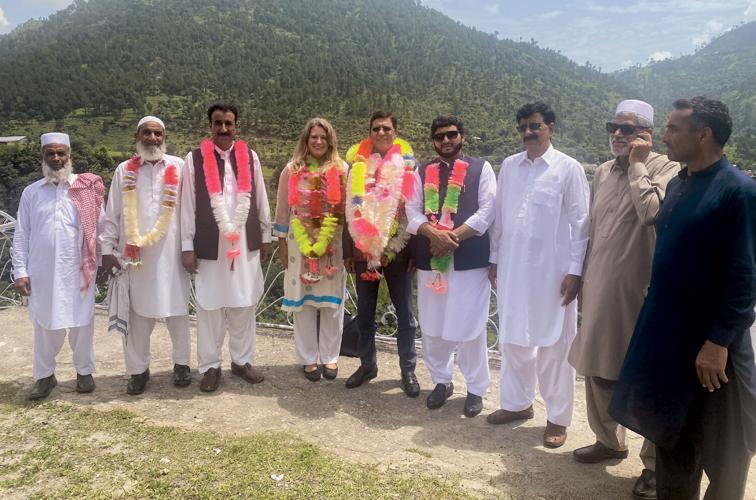


Falcon Holdings CEO Aslam Khan, fifth from left, stands with residents of Fatehabad, Pakistan, his hometown. Jill Filipiak, Falcon vice president of finance, joined him on the trip (fourth from the left).
Aslam Khan considers himself “blessed.” Maybe it’s because he’s the CEO of Falcon Holdings, a 175-unit franchisee and operator of Church’s Chicken, Carl’s Jr., Hardee’s, Piccadilly, K&W Cafeteria and Fatz Café. Or, maybe it’s because of the numerous awards he’s won over the years that have led him to sit on the board of the International Franchise Association.
Or it could be because he survived a major health ordeal. Or, maybe he’s blessed because, above all, he can help.
Even before a near-death experience changed his priorities, Khan made a pledge to assist the people in his hometown village of Fatehabad, in the Punjab province of Pakistan.
Khan grew up poor before emigrating to the United States at age 14, and today the village and surrounding area still struggle with poverty. Before his death years ago, Khan’s father told him if there was one thing the younger Khan could do to help, it was to make it easier for women and children there to get help in a health emergency.
As Khan reports, girls marry early there, and if they get pregnant, there is no assistance. “Sometimes the mother dies, sometimes the baby dies. Sometimes they both die. And they fear for their life. Fear creates complexity, and complexity bars you from achieving your life’s purpose,” he says.

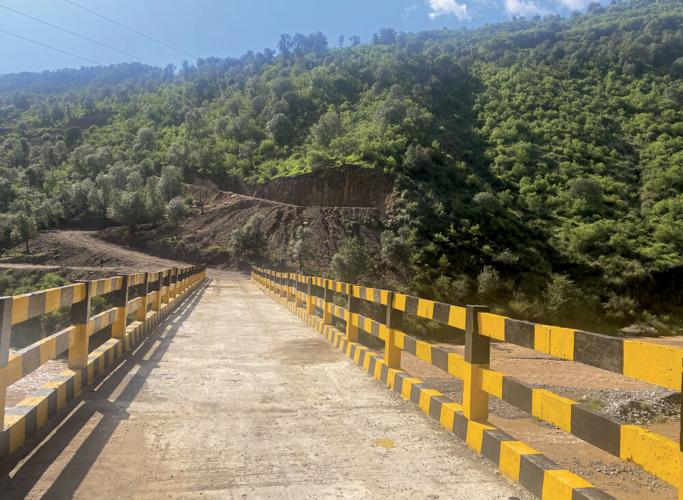
Aslam Khan used his own funds to build this bridge, which allows residents of Fatehabad and other nearby villages to travel to area health clinics.
The women will ride in the back of a cart to get to the hospital in Islamabad, Pakistan’s capital, but it “takes hours and hours” to get there, he says. And then when they arrive, they often wait hours to be seen.
Years ago, Khan decided he would build health clinics in remote villages to meet the basic needs of the residents there. First, they needed a road, which was built and financed by Khan. Then, the first clinic was built in the area, again with funds he provided.
The road, however, was a precarious route for the villagers as it could be washed out by a riverbed if it rained. For Khan, the answer was clear: Build a bridge. So, in 2019, the work started.
Finally, last August, Khan and Jill Filipiak, his vice president of finance who was there representing the company, traveled to Fatehabad to see the completed bridge and take part in a dedication. More than 1,200 people turned out for the celebration. YouTube videos documenting the day show villagers draping flower necklaces around Khan and Filipiak’s necks as they walked closer to the event.
Khan says when he addressed the gathering, he spoke in his native language, with a little English mixed in. “I may have forgotten some of the language, but I’ve never forgotten you,” he told the crowd.
It was emotional. “When Jill and I walked up to the village” that day, “everyone was crying and grateful,” Khan remembers. “I kept my heart protected.”
But the next morning, by himself and reflecting on the previous day, “I wanted to cry,” and he did. “You are human and you can only take so much.”
An arduous journey
Apparently, Khan can take a lot, because he survived a near-death illness in 2021.
It started out in 2012 as “just a cough. I would chew gum so I wouldn’t cough,” he says. But the cough worsened, and Khan visited doctors—a lot of them. He went to Baylor University, the Mayo Clinic, doctors in Chicago, to no avail.
Time marched on, the cough continued, and Khan grew more tired. In March 2021, he was in rough shape. His lungs weren’t operating at full capacity and at one point, he fainted. He was taken to UT Southwestern Medical Center near his home in Dallas.
“There just wasn’t enough oxygen in his body, and he was hospitalized as a fall risk,” says Filipiak. “That’s when it came to light he had idiopathic pulmonary fibrosis.” IPF is a chronic disease that affects tissue around the air sacs in the lungs.
There’s no cure for IPF, and the progression of Khan’s disease meant he was immediately referred to the lung transplant team. He was also told he had only 90 days to live.
Khan’s wife, Hilda, and Filipiak formed their own team that would take care of him and lead the journey to finding a lung transplant. The process was arduous, Filipiak reports, because the rest of Khan’s body had to be in shape to take on the new lung.
“They told us, ‘We want you to start the process. Head to toe,’” she says. “Everyone had to sign off on it: the kidney specialists, heart specialists. Every single doctor.” It wasn’t easy. Initially, Khan failed some of the physical tests, although later passed them as the team worked with him and he received therapy.
Filipiak reports his case then went on to a committee of seven doctors who would approve him for the list. After much prayer and waiting, the committee signed off.
Khan says even given the 90-day life expectancy and being so sick, he never asked, “Why me?” “I didn’t fear death,” he says.
Filipiak agrees he stayed positive. “He’s very strong minded and kept marching forward.”
The race was on
To make matters more complicated, Khan says he has a unique blood type, AB positive, which is present in only 4 percent of the world’s population. His team was calling everywhere, getting his name on as many transplant lists as possible.
By this time, it was July and Khan was in desperate need of the lung. At one point, Hilda called Filipiak, frantic that Khan couldn’t catch his breath. It was a horrible choice they had to make: whether to take him to hospital.
“But if she took him to the hospital, he would have been pulled off the transplant list,” Filipiak explains. Hilda kept him home.
Luckily for Khan, the call came soon after that. In the middle of the night on July 10, he received word a lung was available, and at 3 a.m. on July 11, he was in surgery. The transplant was a success.
It took a full year to get back to health, but Khan was determined and worked hard through therapy and other measures. Today, he says, he feels better than ever, and he’s back to leading the business he started and grew for 30 years.
Hitting home
While Khan was recovering from his lung transplant surgery, he learned his brother, Banaras Khan, was also diagnosed with IPF. Khan theorizes that because the two of them grew up in a home that didn’t have a kerosene lamp and fires were burned indoors for cooking and light, it damaged their lungs. “That probably damaged a lot of people,” he says.
Khan sent his oxygenators to Banaras in Pakistan, and Khan and his team helped get him on transplant lists.
“We wanted to get him to India so he could get the transplant, but during the whole process, he passed away,” Filipiak says. If there had been a local hospital in Pakistan, he would have survived, she says. He was 61.
Building a hospital in his native country had always been on Khan’s list of to-dos, and now the aim is for it to be able to handle procedures such as transplants. Twelve health clinics total are in the plan, as well as funding for an ambulance and another bridge. In January, Khan and Filipiak attended the dedication of the site for the second clinic.
Khan’s goal is to eventually step away as president and CEO of Falcon Holdings and concentrate on his work in Pakistan. He is forming a foundation Filipiak will lead. She is working through the approval process with the Pakistani government. Once that happens, they will begin fundraising.
Khan has built a restaurant empire, been celebrated on the cover of business magazines, received awards and sat on prestigious boards. But he says his most important work may be yet to come.
“I don’t want to take my money with me,” he says. “There is no use for it in the grave. God has blessed me.”