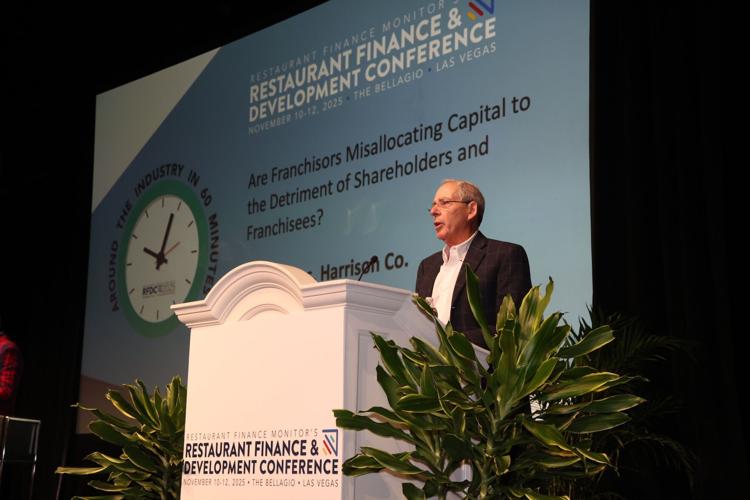

For more than 30 years, John Weiss has provided research on publicly owned restaurant companies to major investors. During the Restaurant Finance & Development Conference, he shared what he considered troubling errors by franchisors, and how brands should course correct.
John Weiss didn’t mince words.
The senior adviser at Harrison Co. railed against recent monetary decisions by franchisors, namely public companies opting to invest more in repurchasing shares than financially supporting franchisees.
“When franchisors focus on the long-term strength of the brand and optimize the operations, sales and, importantly, profitability of the franchisees, that franchisee, that profitability leads to more franchise restaurants and greater profits for the franchisor,” Weiss said during his turn on stage Tuesday at the Restaurant Finance & Development Conference in Las Vegas. “That, in turn, produces a better return for the franchisor’s shareholders.”
Influence from Wall Street, though, resulted in franchisors taking several missteps, such as selling a majority of company-owned stores to new and existing franchisees, and using the sale proceeds, as well as cash flow, to repurchase shares. The strategy of doing so to boost stock prices, though, hasn’t worked, Weiss said.
“How does the use of free cash flow, refranchising and repurchasing of shares work out?” Weiss said. “Not so well. Eight of the 10 largest publicly traded franchisors reduced their shares outstanding by 20 percent to 50 percent over the last 10 years.”
Just three of those companies, Domino’s, McDonald’s and Wingstop, outperformed the overall stock market over that 10-year period.
“Wingstop has repurchased very few shares,” Weiss added. “It was too busy driving sales and franchisee probability to listen to Wall Street.”
On the opposite side of the spectrum, Weiss cited Dine Brands, parent company of Applebee’s, IHOP and Fuzzy’s Taco Shop. Over the last decade, he said Dine Brands reduced its shares by 19 percent, and its stock declined 67 percent. Denny’s, meanwhile, reduced its shares by 38 percent, with a stock price drop of 40 percent over the same period.
Regarding Denny’s, Weiss also noted how the brand announced an agreement to sell itself to TriArtisan Capital for $620 million, which he said was 73 percent below its all-time-high valuation.
“Some of these companies even threw away more money by acquiring new concepts,” Weiss said. “I would suggest that the shareholders of these franchisors would have been much better off if, instead of repurchasing their stock and making poor acquisitions, just gave the funds to franchisees.”
In this section, Weiss highlighted Jack in the Box, a brand that had repurchased 51 percent of the shares while also buying Mexican chain Del Taco for $575 million in 2021. Earlier this month, Jack in the Box announced it was selling the concept for just $115 million to Yadav Enterprises.
“Some franchisors are finally realizing that in order to strengthen the concepts on a longer-term basis, they need to spend their own money, and not chase royalties with schemes that generate incremental royalties, but hurt franchisees’ profitability,” Weiss said.
Weiss said one example is Wendy’s allowing some franchisees to discontinue breakfast, which he said had been a challenging daypart at the concept. He also shared how McDonald’s was making moves to use corporate funds to subsidize value offerings by franchisees and to increase advertising support.
Weiss, who’s researched the restaurant industry for 30 years, said these types of actions are steps in the right direction. What needs to follow, he added, is more consistency at the top instead of what he called excessive turnover. At the 10 largest public franchise brands, Weiss said the average tenure for a CEO is less than three years.
Of those 10 companies, eight of them had three or four CEOs leading the brands over the last decade. With each new CEO, Weiss said a new strategy is brought in, meaning confusion for employees and consumers. The solution, Weiss said, is more regularity in leadership and a greater dedication to operational funding.
“We believe it’s imperative, and will become more common, for franchisors to use their own dollars to gain share and enhance the long-term profitability of their franchisees,” Weiss said. “Options include the strategic targeting of competitors, supporting value strategies implemented by franchisees, reducing margins on food sales to franchisees and sharing a greater portion of vendor rebates with franchisees. If done properly, the franchisors’ shareholders and the franchisees will both benefit.”
The Restaurant Finance & Development Conference, presented by the Restaurant Finance Monitor, Franchise Times and Food On Demand, runs through November 12 at the Bellagio in Las Vegas.