
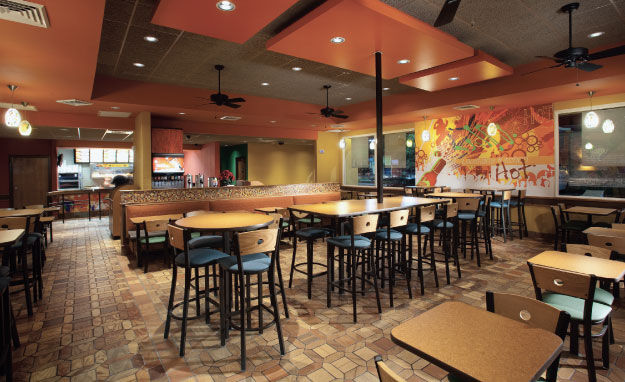
| Above, Popeyes’ spiced-up interior. Below, CEO Cheryl Bachelder. |
Economic stability remains a matter of serious concern for quick-service operators despite January’s good news about job growth. "The economic climate is not improving very much," declares AFC Enterprises CEO Cheryl Bachelder, who oversees Popeyes Louisiana Kitchen. "For a lot of restaurant companies, this year will remain a dogfight (for) market share."
No surprise, as consumers are likely to carefully dole out disposable income. A recent survey from Pew Research showed a majority of Americans (61 percent) rated their personal finances as "poor to fair," while merely 28 percent expected the economy to improve in 2012. Worse, the NPD Group forecasts a paltry 1 percent increase in restaurant visits for the entire year. To be sure, higher-ticket, casual-dining will suffer the brunt of such uncertainty; yet the quick-service segment will feel the blow and react accordingly, or so says operators and consultants.
Take Popeyes, which last year rolled out boneless chicken products that helped same-store sales inch up 1.7 percent in AFC’s third quarter. Bachelder, who acknowledges that competition "remains intense," won’t say how the 1,800-unit chain will steal market share. But it’s clear Popeyes, and its rivals in the $16.3 billion chicken segment, will continue to balance new products with effective pricing.
"We have got to be very smart about engineering offerings for both value and margin," Bachelder says.Same for Cinnabon, which will continue to roll-out innovative products, particularly beverages, says President Kat Cole, referring to its "Chillattas." Cinnabon is a unit of Atlanta-based Focus Brands, which owns the international franchise rights to Seattle’s Best Coffee. This past summer the mall-based chain hopped on the health bandwagon by promoting a limited-time "super-fruits" Chillatta made with blueberries, pomegranate, acai berries and blackberries. This year, Cinnabon plans to improve its coffee.
The recession has prompted QSRs to get even more creative than usual, especially around "value."
Unemployment, the housing crisis and a tight credit market have contributed to an inability to grow revenues through new franchise units. That situation is slowly changing, claims the International Franchise Association. The trade group, citing improved credit standards, predicts the overall number of "franchise establishments" will climb by 1.9 percent in 2012, an increase of 13,928 outlets. New QSR franchises are expected to outpace the figure, rising 2.6 percent this year.
Franchise consultant Michael Seid of MSA Worldwide believes there could indeed be a big outbreak in franchising in an election year. Demand for franchise businesses, he argues, has been stymied not only by a weak economy, but by a fear of rising labor costs brought about by state-level minimum wage hikes and federal healthcare legislation. "(Potential franchisees) have backed off because they can’t fit the labor model into their budgets," he says.
Seid says 2012’s national elections may have a salutary impact. "If we go into summer with (President) Obama 20 points behind in the polls, and if it looks like the Republicans will hold the House and control the Senate, then I expect an explosion of franchising," he says.
Then again, maybe not. Bachelder, for instance, doesn’t believe a franchisee who’s willing to spend $1.2 million to open a Popeyes restaurant would base a bet on early polling data. Policies toward business, she insists, are more important this year than Republican or Democratic candidates."The million-dollar question is: ‘Are we going to get fewer regulations and imposed costs, like healthcare legislation, that are taking the life out of our entrepreneurs?’" she counters.
Franchisees, nonetheless, can expect a better financial picture from a franchisor’s Franchise Disclosure Document, says attorney Marisa Faunce, an FDD specialist with Plave Koch. This is partly due to recent banking regulations, which require lenders to seek more data before making loans.
"We’ve gone through economic downturn and financing is difficult to come by, so franchisors have been more willing to put in this level of detail (in FDDs) so franchisees can take this information to lenders," she explains.
Another reason, she adds, is that desirable area developers, who can open multiple units quickly, demand substantial financial information for budgeting purposes.
For example, Go Roma, which operates six fast-casual eateries, recently filed an FDD with a relatively detailed Item 19 (financial performance representation) in an effort to attract a "better franchisee," says Senior Vice President of Development P.J. Evans. The section includes average annual sales volumes, operating expenses and earnings before interest, taxes, depreciation, amortization, and rent (EBITDAR) for four suburban units.
When it comes to digging, QSR franchisors will hardly need to lift a shovel in 2012 to uncover suitable unit sites, particularly conversions. "That is actually a sweet spot right now," says Bachelder, cautioning that real estate costs and varying market availability. "We are not having any trouble finding restaurants to convert, company or franchise. That’s what’s widely available."
Plain pieces of dirt, however, remain pricey and in demand. Nonetheless, Popeyes and its franchisees still intend to build on them this year. "We are getting new dirt and we are doing nice conversions, and both are providing good returns to investors. That’s an unusual story in our sector," she claims.
Smashburger CEO David Prokupek agrees there is plenty of availability in 10-to-15 new markets the upscale burger chain and its franchisees will enter in 2012. Plans call for opening 65-to-70 restaurants, versus 52 in 2011. He estimates a third of those will be in a new space. "A lot of what I will be getting ready for this year is growth in 2013," he says.
Smashburger, Popeyes, and Cinnabon are also boosting international presence in 2012. In January Smashburger announced an 18-store deal with fast-food veteran Richard Eisenberg, who’s expected to open units in Central America and sub-franchise the brand elsewhere in the Caribbean. Cinnabon, Cole says, is focusing on Russia this year, a two-year-old territory where it already franchises 29 units. Last year, new Cinnabon units popped up for the first time in Kazakhstan, Trinidad, Latvia, Malta, Israel, Lebanon, Syria and Poland.
Bachelder boasts Popeyes has "lots of runway to grow" internationally, citing South Korea, Malaysia, Central America, Canada, and the Middle East. She nonetheless expects the battle for market share to swell globally this year. "(There’s) a second wave of competitors expanding around the globe and countries are innovating themselves," she says.

