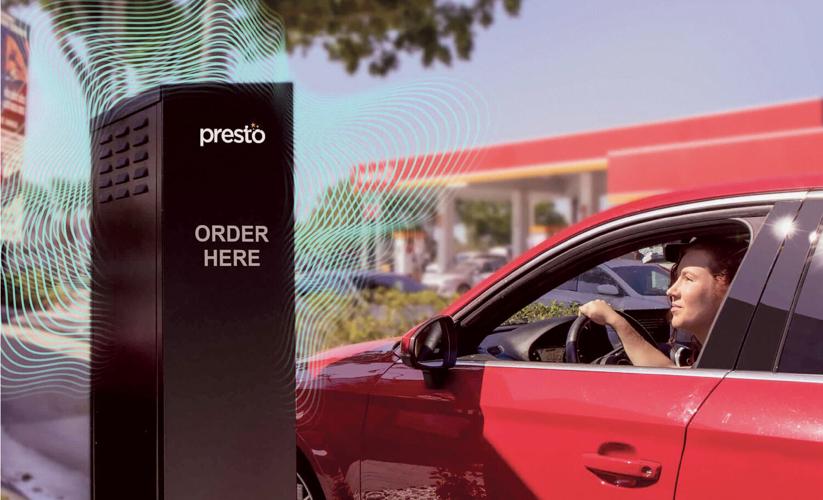
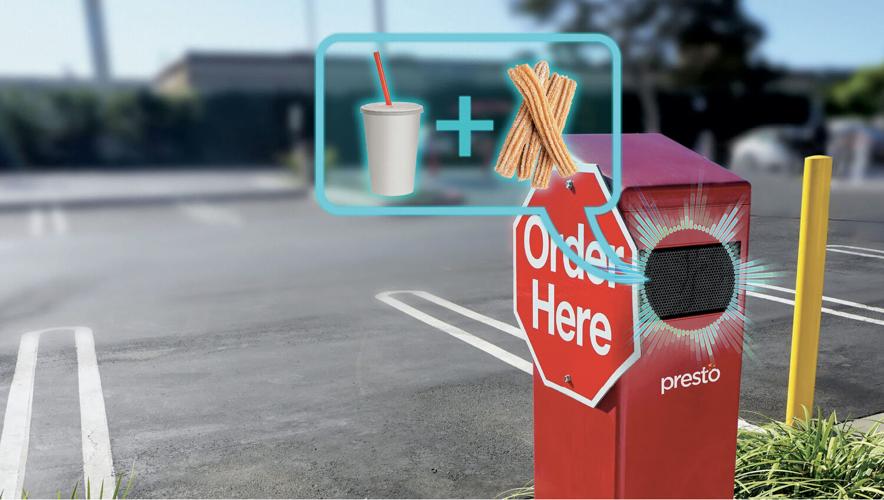




Presto, which began in 2008 by developing restaurant payment tablets, has moved into the drive-thru space with AI technology that can take orders.
Artificial intelligence is everywhere, including restaurant drive-thrus. As brands are trying to improve order efficiency and lower labor costs, they’re turning to AI—and even adding an entertainment factor.
Lee’s Famous Recipe Chicken launched AI technology with Delaware-based Hi Auto and is using it in its drive-thrus. In December, Hi Auto announced the addition of its voice-cloning feature to the partnership.
Hi Auto is taking the voice of former NFL player, sports broadcaster and radio host Keith Byars and adding it to the drive-thrus at Lee’s locations in Ohio; Byars played football at Ohio State University and holds sports celebrity status in the market. The new technology will allow brands to use fully customized voice options at drive-thrus, as the cloning can create a digital voice that’s practically identical to the original speaker.
AI is emerging in drive-thru and over-the-phone ordering channels at other brands, too. One company pushing order automation is Presto, which began in 2008 and put focus on drive-thrus after previously developing a pay-at-the-table tablet. Presto’s technology has since evolved to include ordering and gaming, with its tablets now in restaurants such as Chili’s, Applebee’s and Red Lobster.
It was during the pandemic, though, that QSR drive-thru lanes caught Presto’s attention. The heavy use of drive-thrus at the time inspired the company to develop an AI voice system to take orders and look to improve operational efficiencies.
Presto CEO Xavier Casanova said the brand is working with several chains, including Hardee’s, Carl’s Jr. and Checkers & Rally’s. The company finished the year with its voice AI technology implemented at more than 400 locations and is expected to be deployed at 1,270 units by the end of 2024.
“We’re seeing an acceleration in our deployments, especially as operators are looking for solutions to keep operations low,” Casanova said. “It helps restaurants save on labor. It’s not something where a restaurant needs one less person, but a person that was originally dedicated to a drive-thru can now be dedicated to other tasks.”

With the aim of helping restaurants improve operational efficiency, Presto began developing voice AI technology during the COVID-19 pandemic.
Casanova said voice AI can also increase order consistency and upsell items to guests.
“That drives additional revenue up for the operators,” Casanova said. “At a basic level, you don’t have the different personalities anymore—the interactions are all much more consistent and normalized across locations.”
Feedback on the technology has been positive so far, Casanova said. The success rate, measured by order accuracy, on average is 85 percent and, in some cases, up to 95 percent. Upon adding the service, Casanova said the operator accesses a subscription program to use the AI.
“Our technicians come in and install a box that hooks up to the operator network, audio system and POS,” Casanova said. “There’s an initial installation fee, and then there’s a monthly fee that’s a couple thousand dollars that essentially keeps the service up and running and provides upgrades. We’re always working to improve the product.”
Checkers, which has 787 units, has 350 restaurants with AI services installed. Minh Le, Checkers & Rally’s chief information officer, said the company began considering investing in robotics and AI to boost efficiencies right before the pandemic hit.
“When it started, we were ready to pilot, which was good for us as labor shortages became an issue,” Le said. “The majority of our employees love the technology. It makes their job so much easier. Cashiers at drive-thrus are taking your order, reviewing the next order, and it can be frustrating. Our AI system, though, eliminates the need for that cashier to manage the order, so they’re freed up to take care of the customer at the window and hand food out.”
In a test conducted by the brand, Le said locations with AI were 7 percent faster and 6 percent more accurate than units without the tech.
Digitizing phone ordering
Another AI developer entering the drive-thru space is ConverseNow. Vinay Shukla and Rahul Aggarwal created the company in 2018 to work with restaurants on ordering over the phone and at drive-thrus, after finding a lack of digitization with both.
“We saw an opportunity because both were heavily human-centric,” Shukla said. “That created, in our minds, a lot of issues for their operators. We found team members who would be fatigued and frustrated because of different people who’re ordering. By making digital channels, you can improve the guest experience and give a better day-to-day experience to those team members who’re at the store. Plus, there’s more data these brands can analyze.”

Minh Le is the chief information officer at Checkers & Rally’s.
At the start, the brand focused on phone ordering, as it was easier to implement versus the more complicated drive-thru functions. One brand taking advantage of ConverseNow’s phone technology is Domino’s.
“If you call a Domino’s, the experience is personalized with the technology as your order is taken,” Shukla said. “It doesn’t require you to have to ask for anything in a specific way and it can automatically apply coupons if they’re available. It also upsells you and answers questions you might have.”
ConverseNow works with seven brands. When a company implements ConverseNow, the onboarding process usually takes four to 12 weeks, depending on menu complexity and existing POS technology. Once one store is live, setup for additional units takes just a few hours.
As the AI is implemented, Shukla said it’s able to learn different dialects and the ways people ask questions in different regions of the country. Meanwhile, it frees up time for employees to tackle other tasks and quickly fulfill orders.
Because of how AI has evolved, Shukla said the company was comfortable with beginning drive-thru operations in early 2023, and has been piloting it with a few brands, such as the Italian concept Fazoli’s, which has 210 stores. With the advancements in AI, Shukla said the drive-thru systems are able to have natural and fluid conversations with guests.

Veronica Luna is Jollibee’s senior director of digital engagement.
For brands that partner with ConverseNow, pricing options include a fixed rate per order or a fixed rate per month based on volume.
Advancements in AI also allow orders to be met with more precision. This is the case for Smashburger, as parent company The Jollibee Group partnered with Curbit to better track kitchen times and relay the information to those who placed the order.
“We’ve been able to synchronize our online promised order times with actual kitchen capacity,” said Veronica Luna, Jollibee’s senior director of digital engagement. “That’s become important as we’ve grown our off-premise volumes. Curbit is able to take the kitchen data and adjust our promised times through continued real-time analysis of kitchen operations to make sure they’re as accurate as possible.”
The promised time, Luna said, is a quote time Smashburger provides for customers to pick up their order. In the past, it was purely an estimate.
“What we didn’t know and what we were challenged on was the actual capacity at that moment,” Luna said. “If there were already five to 10 orders at the kitchen, we wouldn’t know and just assume an order might take 15 minutes and we’d provide that time. In many cases, it wouldn’t be accurate and the guest would have to wait. Providing a more accurate promise time and keeping guests updated on their order status is a game changer for us.”

