"Green" was once shorthand for saying a business was hip and socially conscious. But has the natural and organic movement retained its luster among franchised brands?
A few years ago, green was the golden ticket. Anything organic, natural, environmentally friendly or local was a hot commodity, and restaurant chains couldn’t chase the bandwagon any faster. But many such trends are followed by a backlash. Is green still as red-hot as it used to be?
A National Restaurant Association (NRA) survey of restaurant chefs reported locally grown produce is expected to be the most popular restaurant trend of 2010. Sustainability came in third on the list, and organic produce was 12th (it was No. 3 on last year’s list). An NRA survey from last year indicated that organic items were the second most popular trend on quick-service menus. NRA research shows that 60 percent of adults say they are more likely to visit a restaurant that offers food grown in an organic or environmentally friendly manner.
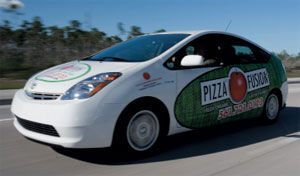
In addition to using organic ingredients in their products, Pizza Fusion has a fleet of hybrid delivery cars.
Pizza Fusion, one of the more visible franchises to use organic or natural ingredients, reports the practice has been beneficial. President and Cofounder Vaughan Lazar said chain-wide sales were up at the end of 2009 compared to the end of 2008. Pizza Fusion heavily advertises its 75-percent-organic menu, but it’s not just the veggies that are green—many aspects of the business are environmentally friendly, from the recycled church pews they use as furniture to utensils made from potato starch, plus hybrid delivery vehicles. And the Holiday Inn Northwest in San Antonio, Texas offers recycled paper products and linens, as well as locally sourced menus.
Said Pizza Fusion’s Lazar, "By omitting harmful chemicals in the production process, like pesticides, hormones, fertilizers and more, organic food is healthier than conventional foods. Thousands of man-made chemicals are added to America’s food supply. Ensuring these chemicals don’t make their way into our customers’ bodies or the environment is very important to us and to them." He said consumer interest in the organic/natural movement "only validates the adoption of natural foods in the restaurant and franchising sectors."
Daniel Fabricant of the Natural Products Association (NPA) said consumers have voted with their dollars and demonstrated that they’re willing to pay more for natural or organic products. Though the natural/organic movement is often linked to the idea of small, independent, local business, Fabricant said that if large, franchised companies are able to establish a local buying and distribution system, cut down on other costs like shipping and establish credibility with a third party (for example, earning certification as Fair Trade or USDA Organic), it is possible for them to embrace the ideals of the movement. "It may cost more at the beginning, but we’re seeing that it pays dividends rather quickly," he said.
Frozen yogurt and smoothie chains were quick to jump on the all-natural bandwagon: FreshBerry, Red Mango and Jamba Juice all claim their ingredients are all-natural. And Virginia-based Elevation Burger, serving organic, free-range, grass-fed beef and fries cooked in olive oil, is growing, with a New York City location opening this spring.
Ryan Combe, founder of Spoon Me, a frozen yogurt franchise that uses natural ingredients, pointed out that the proliferation of the label "all natural" could dilute its meaning and cause a backlash among consumers. "So many ingredients that are tagged ‘all natural’ are things the consumer doesn’t recognize," Combe said. "How many people know what guar gum is? Or potassium citrate? These are ingredients that may technically be ‘all natural.’ But who really knows what they are? There are a lot of things that are ‘all natural’ that I wouldn’t eat."

The Holiday Inn Northwest has preferential parking for hybrid cars; part of its green efforts.
Combe raises an important point about the health claims many chains are making about their "natural" menus. According to Dr. Janet Brill, who runs the nutritional program at Fitness Together, "if you look at the compared nutrients, it’s apples to apples between organic and conventional—they pretty much have the same. With organics, it’s not so much about what you’re eating as what you’re not eating (like pesticides, hormones and antibiotics)."
And there’s some rain falling on the organic parade. Wade Hanson of food industry research firm Technomic said the use of organic and natural ingredients has become less widespread over the last 12 to 18 months due to consumers dining out less and looking for value when they do. He explains that quick-service restaurants, which seldom use natural or organic ingredients, are doing much better than upscale dining spots—where organic/natural foods traditionally perform well.
"One area of backlash ties to some of the world’s largest food suppliers entering the organic and natural space," Hanson said. "Many of the more educated or devoted consumers consider this to be a ‘violation of the spirit’ of organic and natural. This group likes purchasing local, family, or small-producer products. But as more major manufacturers have entered the space, some consumers have felt that the high prices being charged are more about profits and less about care being shown during the processing of items."
Certain consumers who are devoted to using organic or natural products will continue to pay a premium for them, Hanson pointed out. "However, moderate and trial users, while they may prefer these items, have not shown the same willingness. The devoted users have a strong understanding of the advantages of organic and natural products and don’t need to be educated. But less-informed consumers are more likely to be swayed by marketing campaigns that break organic and natural down into the simplest terms, like ‘good for you’ or ‘healthy,’" he said.
Pizza Fusion’s Lazar believes his restaurant’s "devoted users" will stick by their brand through good times and bad, however. "Organic consumers are very loyal to their values and the businesses that cater to them," he said. "They don’t give up their values and opt for chemically laden food during challenging times."

