

Layne's Chicken Fingers has 34 locations in nine states, with 22 restaurants in Texas. CEO Garrett Reed said Layne’s has 14 restaurants under construction and six more openings slated for this year.
Eli Cohen’s agreement with the chicken fingers brand commits him to developing 44 restaurants in Texas. Earlier this year, he took over six top-performing Fazoli’s in West Texas and signed a four-unit deal with Smalls Sliders.
Eli Cohen makes it clear he is not a restaurant guy. In fact, he’s never worked in one.
What Cohen knows, however, is real estate. He has a long track record of finding good commercial and residential opportunities. He also has a knack for aligning himself with successful restaurant operators and managers.
Using that business playbook, Cohen has moved fast to build his quick-service restaurant portfolio. He acquired six top-performing Fazoli’s locations in West Texas and signed a four-unit agreement with emerging cheeseburger and shake brand Smalls Sliders earlier this year.

Multi-unit, multi-brand restaurant franchisee Eli Cohen is a managing partner with C5 Restaurants in Lubbock, Texas.
With Layne’s Chicken Fingers, Cohen signed his largest restaurant agreement to date: a 44-unit deal to develop the concept in West Texas, San Antonio and Corpus Christi. It also marks the largest multi-unit signing for the brand.
Cohen expects to open his first two stores, likely a restaurant conversion and an acquisition, in Lubbock, Texas, starting next spring. At this time, he doesn’t expect any of his Layne’s to be new builds.
“I was never really a restaurant guy, but I am a numbers guy and I love to break down P&Ls”—profit and loss statements— “and learn why certain brands do better than others,” said Cohen, a managing partner with C5 Restaurants in Lubbock, Texas. He’s also co-founder of Cohen Rojas Capital Partners, a private real estate investment firm in Sacramento, California, that specializes in value-add residential and mixed-use properties.
Cohen’s real estate firm managed more than $600 million in multifamily properties in several states before pivoting to what he calls his “second act” in the restaurant business.
“There is clear momentum in chicken as a category and everything I found out about Layne’s, from the people who run the company to the trajectory” of its average unit volumes and unit growth “told me that this was the right brand to partner with and grow with in Texas,” he said.
Cohen said he’s excited to join a successful brand in the growing chicken tender space that offers a relatively simple but popular menu focused on core items such as chicken finger meals, sandwiches and shakes. “Having a menu that is streamlined and not too complicated allows for easier operational efficiencies and consistencies,” he said.
Related: Demand for Chicken Continues, Top 400 Data Shows
Like Cohen’s newly established restaurant business, Layne’s is experiencing rapid growth. The company founded by Mike Layne in 1994 and franchising since 2017 has 34 locations in nine states, with 22 restaurants in Texas. CEO Garrett Reed said Layne’s has 14 restaurants under construction and six more openings slated for this year.
The AUV for traditional Layne’s restaurants is $1.98 million and the total investment range is $451,500 to $1.1 million, according to the franchise disclosure document.
“We’re anticipating 100 percent growth for the second year in a row and ending the year with 40 locations. We’re also on track to get to get to 80 to 85 locations next year,” Reed said.

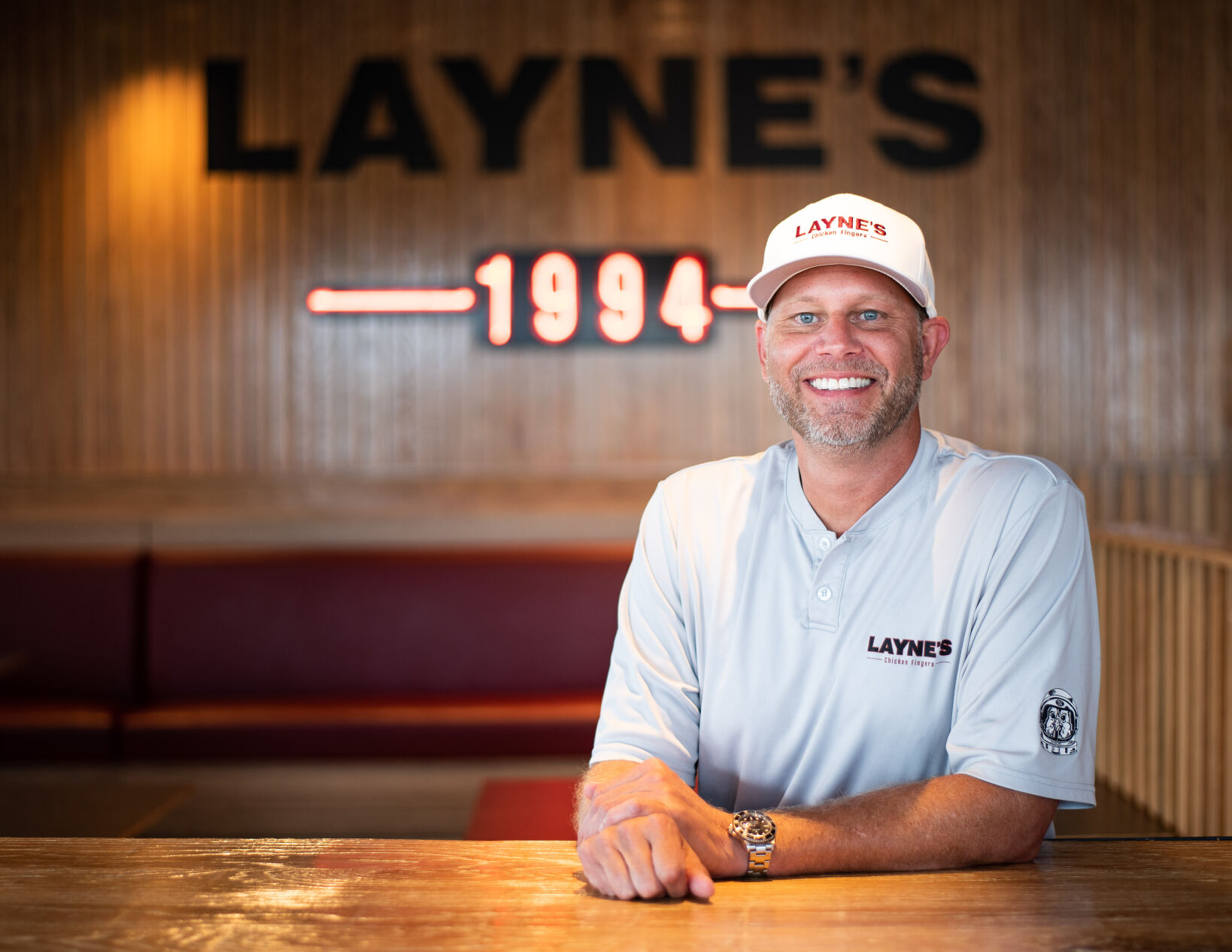
Garrett Reed is the CEO of Layne's Chicken Fingers.
“Having well-capitalized multi-unit operators like Eli signing big development deals has really helped us develop fairly quickly,” he said
Reed pointed out that Cohen’s is the latest in a series of large multi-unit agreements. He talked about a 25-unit deal signed by Whataburger franchisee Taylor Thomas in 2024, a 15-unit deal with Scott Davis in Utah and a 13-unit addition to an existing multi-unit agreement with the Bergeson family in Wisconsin. There was also a 12-unit deal with experienced Wendy’s operator Ricki Oberoi for the Rio Grande Valley in Texas and an eight-unit deal for the “Big Country” area in Texas, which refers to a 22-county area in the west-central part of the state.
Layne’s also attracted a longtime Arby’s franchisee, Doug McGuire, who signed a 22-unit deal for Ohio.
Cohen said he was fortunate to grab the last big territory available in Texas for his Layne’s development.
Meanwhile, he said three of his six Fazoli’s also located in West Texas rank in the top five for sales for the brand; five of the six are in the top 12 of the system, with the average unit volume for the brand coming in around $1.1 million.
Fazoli’s, a fast-casual Italian-American chain owned by FAT Brands, is No. 204 on the Franchise Times Top 400 ranking of the largest brands. It did $266 million in systemwide sales last year, down 7.5 percent.
He said it is too early to predict how his Smalls Sliders will do in his territory of Lubbock, Amarillo, Abilene and San Angelo, Texas, since he hasn’t opened any yet. But he’s optimistic.
“West Texas is a great market and we are doing more than 50 percent above the AUV with our Fazoli’s there. But I really can’t take the credit for it since I bought the Fazoli’s business. It’s not a business that I developed,“ Cohen said. “I came into a well-oiled machine that’s doing great with Mark Crayne running the show for us in West Texas in Amarillo, Lubbock, Abilene, Midland and Odessa and with two great district managers and four of our six general managers being in the business for 15 or so years.”
“I found this diamond in the rough with Fazoli’s and now I’m hoping we can now get the same kind of success with our other two QSR brands.”