
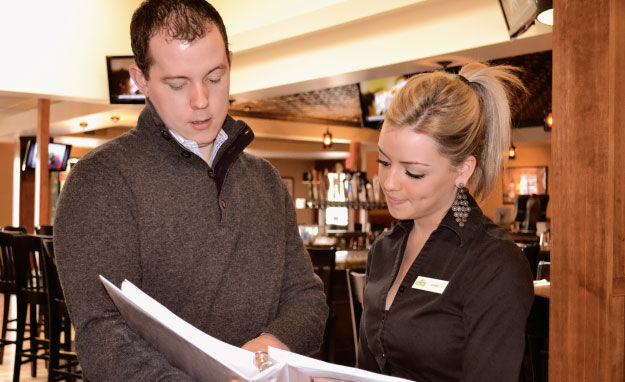
| Tim Kreiser, director of operations for Green Mill Restaurants, and server Sarah Carter review the new manual. |
A year-old training program for servers at Green Mill Restaurants emphasizes the basics of communication: how to smile, how to listen, how to talk with the guests.
Such things may come naturally to older workers, but Green Mill’s CEO Paul Dzubnar noticed they weren’t always to teenagers and 20-somethings hired to serve at the St. Paul, Minnesota-based company’s 28 stores.
"I think technology has got kids talking less and interacting less face to face," he said. "And the face-to-face personal contact isn’t what it used to be. It’s more of a stretch for kids. They do a great job in a lot of areas but it’s a stretch for some of them to do that."
Dzubnar is not the first to note differences among generations in the workplace. Books, articles, consulting contracts and entire companies are aimed at bridging the gaps—especially between baby-boomer bosses and the 18- to 29-year-old "millennials" who work for them. "The differences between the baby boomers and the millennials is night and day," said Gregory Smith of Chart Your Course International, a training and development company in Atlanta. "Employers have to spend more time training these people on things that the other generations knew when they got a job."
Green Mill’s five-day training program for servers addresses the differences directly—and it’s getting results.
Fully in place since June of last year, the program includes working through scenarios: If the customer says this, what might the server say? Certified trainers teach new hires to look at their customers, focus on what they’re saying, repeat exactly what they want and get a nod before moving on. "The key to restaurant success—you have to drive top-line sales, check averages and customer counts," Dzubnar said. "People are going out for the experience, so the service has to be great. You have to be sure you’re very perceptive and intently analyzing the guests to make sure their needs are being met."
Customer complaints are down about 8 percent across the Green Mill system, which has 20 franchise units, Dzubnar said, and scores are up from the two secret shopper visits each store receives each month. The training is taught by at least one certified trainer in each department. It’s a big investment. "From a dollar standpoint, it’s four hours a day times five days, so it’s 20 hours, and a server’s wage in Minnesota is $7.25. Plus we’re paying the certified trainer $10 an hour," Dzubnar said, adding: "Not to be cliché, but you’re going to get out of it what you put into it."
Green Mill also reduced each server’s section from six tables to four to allow more time with each guest. Doesn’t that increase labor costs? "It does, but we turn our tables faster," plus servers have more time to describe such delicious things as the best tequila for a margarita—Patron, which costs $3 more than the regular stuff. "Our sales are up and our net income is up," Dzubnar said. "I’m not attributing it directly to service, but it’s not hurting."

Before, above, and after Green Mill server Sarah Carter went through "smile" training. We asked her to demonstrate both looks and she was a good sport to play along.
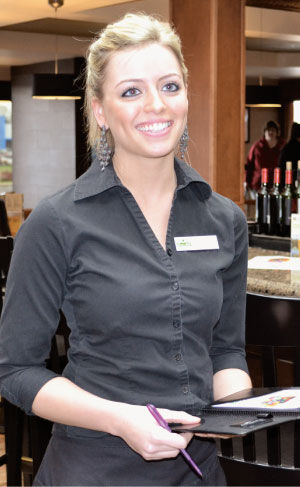
Before, above, and after Green Mill server Sarah Carter went through "smile" training. We asked her to demonstrate both looks and she was a good sport to play along.
Different styles
Training-consultant Smith believes employers of all kinds must clearly state what they want.
"Businesses need to establish what is acceptable behavior when someone walks in the door or places an order," he said. Expectations will differ from employer to employer, but the key for all is to break them down and spell them out. "For example, for one of our clients we said, ‘You will look the customer in the eye and stand up straight and say, Hello, may I help you?’"
He praised Zappos, the online shoes and clothing retailer that has outlined 10 values that can be translated to behaviors when employees deal with people. "One of them is to create a ‘wow’ experience. How do you inculcate a behavior like that? No. 1, you have to do a better job of hiring people, and finding out is that behavior going to be part of that person’s DNA." Smith said a practice at another company, which he wouldn’t name to preserve their cover, sends an employee to pick up job candidates at the airport. "What the candidate doesn’t know is that’s part of the interview," he said.
"You find out what this person is like."
Young people aren’t the only employees who need specific customer-service training, but he says some of the biggest clashes arise between baby boomers, born after World War II through 1963, and millennials, also called everything from Generation C (for "content," because they’re heavy users of social media) to Y (following Gen X) to the iPod Generation.
Bosses tend to be baby boomers, and some routinely dismiss millennials as slackers with an overdeveloped sense of entitlement. Millennials, meanwhile, are sick of their rigid, obsolete bosses hogging all the good jobs that rightfully belong to the tech-savvy youthful set. "No. 1 is communication skills and work ethics," Smith said about the greatest source of conflict between the two. "I’m certainly not saying anything bad about either generation, because we’re all different. But the young people today do have a different work ethic, a different way of communicating."
"If you come from a digital age where you do nothing but text people—OMG and all that—and then now you have to engage people in a conversation, it’s challenging for them," Smith said. A poll by Workplace Options last November showed the extent of the image problem: 77 percent of workers believe millennials have a different attitude toward workplace responsibility than workers of other age groups, and 68 percent said they’re less motivated to produce quality work.
Michael Phillips owns PC Training Experts in Irvine, California, and he’s been training people of all ages to use technology since 1993. He has noted a distinct difference in his younger students that emerged about the same time as the iPhone, five or six years ago. "There’s much less of a respect and understanding for the knowledge of the teacher, because knowledge tends to be something they can get with a flick of a button," he said. "They turn off very quickly. You really have to keep them interested, and the big wows don’t happen like they used to."
Younger students are also quick to whip out their phones during the training if they already get it—and in mixed-age groups younger students almost always understand everything tech first. "At first I took it wrong. How could they do that?" Phillips said about those phones. "But finally I realized, they’re just not the same as students used to be. If they’re not being entertained at every moment, they just go into their own world." Phillips posted an article on the subject on his company website, cleverly called "Generation Y: I think, therefore iPad."
‘We’re not robots’
At least one expert in the training field isn’t buying the idea that the youngest group of employees needs special training because they’re so different. "It makes a good book title, doesn’t it?" said Richard Fletcher with a laugh. He’s director of learning and organizational performance for Zaxby’s restaurant chain in Athens, Georgia. He’s found that variations among people have little to do with when they were born, but rather what type of learning style they have. "The way we approach it here is a learner is a learner, and we don’t talk about age. Everybody’s different. We’re not robots."
Zaxby’s, which has 550 franchised units, rolled out a new training program five years ago, focused primarily on educating owners and training managers how to train better. "We have this paper book that’s called Zaxby’s 101. Some people love it. But then there are others that would rather be shown by a coach. And then there are others that like to go online," he said, and the preferred medium can’t be predicted by age. "You have to have three approaches to satisfy all of your learners."
Now they’re getting ready to build a new learning management system, and are planning some changes. The courses need to be shorter than ever, and employees need to be able to quickly access the step they need to recall, not wade through a long checklist. Employees of all ages also like true interactivity—not just watching a video. "Interactivity means you have to think before you click, so it engages," Fletcher said. They’ll be figuring out how to go mobile, too. "Clearly we’re going to need to be able to launch our material on tablets, because of the proliferation of 50 million iPads," he said.
If they do go mobile with their training materials, they won’t lose bored students to their phones like PC Training Experts does. Zaxby’s bans employees from using cell phones in most of their stores.

