The kiosk shows up to work every day, increases the number of add-on sales and combos, shortens lines and never asks for a raise. But does it eliminate jobs?
Imagine an employee who never has to punch out, rarely calls in sick, doesn't ask for time off and upsells like a car salesman on steroids.
Bolstered by the success of self-service kiosks in airport check-in lines and at retail outlets like Wal-Mart, QSR franchisees increasingly are using technology to speed transactions and free up employees to serve as hosts or help out elsewhere.
Boddie-Noell Enterprises (BNE), the nation's largest Hardee's franchisee, has started using self-serve kiosks in three of its stores, two in Richmond, Virginia, and another in its Rocky Mount, North Carolina, home town. The kiosks were made by EMN8, a leading kiosk developer that focuses on the quick-service and fast-casual dining industries.
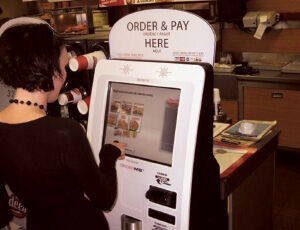
A customer uses a self-service kiosk to order a fast-food meal. In restaurants the kiosk doesn't eliminate personnel, it just reassigns them.
The pilot began in late February and is scheduled to last from three to six months before any decision on whether the technology will find a home in other Boddie-Noell restaurants.
Research from Sandelman & Associates Inc.'s Quick-Track showed that restaurants in the DMAs where Boddie-Noell operates could improve on speed of service and order accuracy metrics. Before deploying the EMN8 solution, Hardee's Food Systems conducted a pre-test study and was scheduled to start a post-test study in April.
Self-service checkouts have moved from curiosity to convenience in many industries, including the airline, hotel and grocery sectors. IHL Consulting Group expects self-service transactions to top $450 billion by the end of 2008.
"The kiosk shows up to work every day, increases the number of add-ons and combos, shortens lines and allows us greater control," Allsbrook says.
Although kiosks in airports do save on labor, that's generally not the case in restaurant deployments, says Peter J. Boylan III, vice president of San Diego-based EMN8, which currently has kiosks in 200 restaurants such as Jack in the Box, Carl's Jr., Burger King, Arby's and at Walt Disney World. The company has an additional 200 kiosk orders from Wienerschnitzel, KFC, Panda Express and Taco Bell.
"The labor savings is kind of a misnomer," Boylan says. "The market is so tight, it becomes a question of how to maintain a level of service and satisfaction."
Restaurant operators pay between $600-$700 a month for each kiosk, a fee that includes menu development, 24/7 system support, integration with a restaurant's existing POS system and necessary upgrades. Advantages include a $1 average increase per transaction, improved cash management, speed of service improvements, a better restaurant experience and lower food costs because of order accuracy improvements.
Boylan reports uptime exceeding 98 percent with its K4000 kiosk. When a kiosk does require attention, it's usually a jam in either the printer or the bill acceptor—both of which are easily remedied while the kiosk continues to operate normally.
Employees who were operating registers usually are moved elsewhere. One becomes a host for the front end to meet and greet customers, direct them to kiosks, answer questions and become the "face" of the dining experience. The other employee moves to either the kitchen or the drive-thru area to help handle the extra orders a kiosk can generate.
"We recommend that the restaurant maintain one or two manual registers depending on the amount of business they do," Boylan says. "The most typical configuration we see today is one manual register and two kiosks. In cases where there is no drive-thru and/or the restaurant does more than $30,000 per week, the configuration is two manual registers and two kiosks."
Taking EMN8's advice, Boddie-Noell placed a hostess in front and moved a second person to the drive-thru. When the test began, a hostess and officials from the kiosk manufacturer greeted people and helped them use the kiosk. It takes the typical customer three tries to feel comfortable with the system, Allsbrook notes.
After the break-in period, says Jerry Allsbrook, chief marketing officer for Boddie-Noell, reports widespread use among people 18 to 24, who are accustomed to technology and are more frequent QSR customers. But he also reports good use among older patrons, especially during breakfast hours.
ATMs have been around for decades, but the self-service banking technology took many years to gain any significant traction. Kiosks in the fast-food industry are quickly becoming the standard as operators seek greater efficiencies.
According to a 2007 survey commissioned by NCR Corp., 77 percent of consumers in the United States and Canada said they'd be more likely to conduct business with companies that offer self-service options. That figure climbs to 92 percent when mobile devices are combined with kiosks, the Internet or ATMs to enhance the customer experience.

