There’s no clear beginning to franchising. Some say the ancient Romans came up with the idea, others maintain it was a product of the 20th century. Regardless of when franchising came on the scene, it’s always carried a certain amount of conflict, and that fact—unlike franchise litigation—won’t change with the times.
In the beginning (the second half of the 20th century, for our purposes, after the business model really began to catch on), franchising resembled something closer to the Wild West than the somewhat regulated world we know today. David Kaufmann, a franchisor attorney with Kaufmann Gildin Robbins & Oppenheim who authored the New York Franchise Act, said of the time: "Franchising exploded on the scene, and the criminal community—including organized crime—jumped in, using slick brochures and outright fraud to sell nonexistent franchises to hapless victims. In New York alone during that period, 14,000 New Yorkers lost upwards of $40 million through franchise fraud and organized crime in franchising." As a result of such issues, franchising gained an unsavory reputation among the general public.

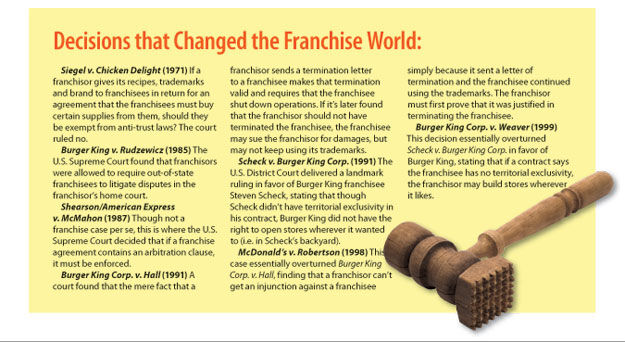
For some reason, burger chains are involved in many landmark cases.
From his experiences working with the New York Attorney General during franchising’s violent expansion, Kaufmann can relate numerous horror stories from organized crime’s involvement in franchising, from bagel truck bombings to kidnapped children. "I can’t overemphasize how filthy-dirty some of the players in franchising were back then," Kaufmann said, "or how the legitimate community of franchisors were behind laws to clean up what had become a filthy marketplace." Those laws started on the state level, with 1971’s California Franchise Investment Law, which notably ordered franchisors to register with the state and distribute a disclosure document to prospective franchisees. Fourteen other states would also enact franchise laws, and in 1979, the Federal Trade Commission’s Franchise Rule governing pre-sale disclosure took effect.
Setting precedent
Part of the reason franchising was so dirty in its early days is because there was no legal precedent to work from. "In the beginning, there were very few guideposts telling lawyers and their clients ‘what is the law in this area,’" Kaufmann said. "Well, the answer was ‘there was no law in this area, or very little.’" Because many of franchising’s disputes were cases of first impression—issues that had never been decided by any judge or court—no one knew what the rules were. Franchise lawyers (who were few and far between at the time) had to argue their way through the facts of their specific cases rather than relying on precedent to point them in the right direction. "You were actually making law with every new decision that came out," said Robert Zarco of Zarco Einhorn Salkowski & Brito, a franchisee lawyer with 22 years of experience in franchise law. And as Kaufmann explains it, our legal system works on precedent—the idea that if something’s been decided before, we’ll follow that decision if the same issue comes up again. When Kaufmann first started practicing franchise law 33 years ago, he said, "you didn’t really know who was going to win and who was going to lose because the rules weren’t yet written, so everybody was going to court. Now, cases of first impression are few and far between. The decisions coming down today don’t shake the earth the way they used to because the earth was already shaken, the rules are in place, and most of the important issues have been settled. Disputes now are more confined to individual franchisor/franchisee spats as opposed to much larger principles of franchising, which were crafted by the courts in the ‘70s, ‘80s and even the ‘90s."
Legal Darwinism
As franchising grew, franchise attorneys grew more savvy and developed techniques to shift the balance of power toward their clients. Some franchisee attorneys took clients on a contingency fee basis to combat franchisors who used a scorched-earth policy to run franchisees into the ground with lawyers’ fees, Zarco said. And Robert Purvin, chairman and CEO of the American Association of Franchisees and Dealers, said that when business-format franchises like McDonald’s became mainstream, franchisor attorneys started using previous lawsuits to their advantage and rewriting franchise agreements to get around whatever decisions had just been passed. "If a franchisee won the right to choose their own cash registers because it wasn’t in their franchise agreement, the next issue of the franchise agreement says ‘we (the franchisor) get to tell you which cash register to use,’" Purvin said. "Every lawsuit instructs the bar how to fix it and they draft around it. It still happens today—rewriting agreements is a natural progression. If you lose the lawsuit because your contract didn’t protect you, you say to your attorney, ‘You idiot, why didn’t you write the right language in?’ and he fixes it. That’s the way things evolve."
Kaufmann takes a more charitable approach to the evolution of franchise law: "As franchising, franchisors and franchisees grew, they all matured," he said, "and something remarkable happened: The conflict that was so prevalent between franchisors and franchisees throughout the 1970s and ‘80s began to subside in the 1990s and has continued to subside in the first decade of the 21st century. ...And folks are thinking ‘if we can work it out together, if we can be fair with each other and carve up the pie so that each side is getting an equitable slice, it’s a far more productive way of doing business than constantly doing battle with each other.’"
Of course, not everyone would agree. Which is why arbitration and mediation, along with litigation, are the tools in lawyers’ briefcases.