



DoorDash reported that one third of consumers ordered delivery more in 2024 compared to 2023.
It’s dinner time, the dishes aren’t done and the leftovers in the fridge are questionable at best. Or maybe getting off the couch isn’t an option on a Saturday afternoon. Perhaps there’s a day of sports ahead and it’s just not the same without pizza and wings.
No matter the reasoning, third-party delivery apps have become an essential part of many consumers’ lives by offering convenience—and those customers aren’t willing to give that up.
The National Restaurant Association’s 2024 State of the Restaurant Industry report found that more than half of consumers said ordering delivery “is an essential part of their lifestyle.”
According to DoorDash’s report on restaurant online ordering trends last summer, 33 percent of consumers surveyed ordered delivery more in 2024 than in 2023 and about 31 percent said they prefer doing so via third-party apps.
For consumers, these apps are time savers and convenient, despite the associated fees. For restaurants, third-party delivery is a “necessary evil,” as Craveworthy Brands CEO Gregg Majewski called it. Craveworthy’s portfolio includes Genghis Grill, Wing It On and Dirty Dough, plus a collection of virtual brands.

Craveworthy Brands CEO Gregg Majewski is mindful of menu price increases on delivery platforms.
The markups necessary to cover advertising costs on third-party apps can be as much as 20 to 25 percent, said Majewski. To mitigate those upcharges for consumers, Craveworthy eats the cost of marketing.
“I can’t deliver the product for the cost that they charge me. That’s 6 percent or 7 percent above advertising. I can’t deliver that,” Majewski said at the Restaurant Finance & Development Conference in November. “Being a delivery expert in my past, it’s impossible to deliver the product at 6 percent of sales. So, we no longer pass that cost on to our consumer. We just cover the cost of the marketing that we’re spending or the marketing dollars that the third parties have put on us.”
Inflation rates are high across the board, to say the least. Majewski said consumers are more conscious of their spending habits as a result.
“I don’t know a way that we can go ahead and charge 20-to-25 percent markups, like some restaurants do, to our customer and think they’re going to come back,” he said.
By increasing third-party menu prices by just 12 percent instead, Majewski said the increase in off-premises sales more than makes up for the loss in markups. Consumers will find his restaurants as the “cheaper” option because of the lower increase in price than competitors, he said.

Dan Cardamone is guiding digital efforts at Culver’s.
Pent-up demand for Culver’s
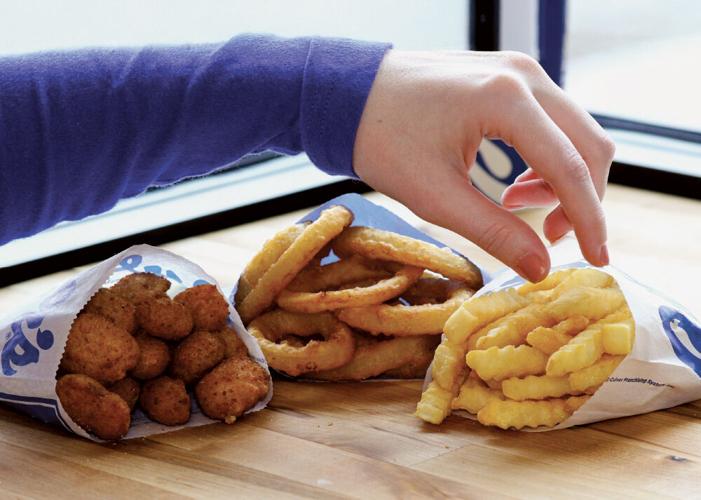
Saying that Culver’s was late to the game when it comes to third-party delivery would be an understatement; the brand rolled out delivery systemwide in 2024.
The franchise known for butterburgers and frozen custard tested DoorDash and Uber Eats in about 60 restaurants at the end of 2023 before introducing the marketplaces across the board last year.
“We spent the majority of our time on operational procedures and quality control and then marketing levers,” said Dan Cardamone, Culver’s director of digital experience. “We had some hypotheses on the best way to do this, given the uniqueness of our restaurants and our made-to-order food, that really allowed us to iron out the details and come up with what we were feeling certain about in terms of operating procedures for the whole system.”
The sales performance, Cardamone said, was strong given the pent-up demand from customers. Other brands had years to figure out the ins and outs of third-party delivery, but for Culver’s there was a learning curve at first to make it “feel more native and intuitive” for employees and franchisees, he said. Where some brands may have plateaued in delivery sales, Culver’s has yet to do so given the late rollout.

Culver’s waited until 2024 to roll out third-party delivery systemwide, but that delay drove sales because of the pent-up demand from consumers, said Dan Cardamone, Culver’s director of digital experience.
“We got a burst from that, where we were potentially behind, but have quickly made up for it,” Cardamone said.
It’s not mandatory for franchisees to be on the apps. Some locations are in rural areas where Uber Eats and DoorDash don’t operate or it otherwise doesn’t make sense for the location. But the majority of Culver’s restaurants have opted in to the new sales channel, Cardamone said.
Quality is at the forefront of Culver’s—and maintaining that quality from the restaurant to the delivery driver to the customer’s house was a concern. Customers expect their burgers to be served hot and their frozen custard to stay, well, frozen. But there’s some wiggle room in those expectations.
“We learned through a lot of research and talking to other brands and guests as well that they lower their bar to some degree and give us the benefit of the doubt” in regards to keeping food cold or hot during delivery, Cardamone said. “We went in eyes wide open. We’re going to watch our ratings and reviews really close, that’s how we’ll determine if we’re still maintaining our high standards.”
Delivery app users will often see that the cost of their favorite item is higher than it would be at the restaurant. While Culver’s doesn’t dictate prices for franchisees, it provides data-driven guidance to operators. In the case of third-party delivery, recommended pricing isn’t “egregiously higher,” Cardamone said, but to sustain profit margins those increases are often necessary.
The franchise will spend 2025 tinkering with marketing on Uber Eats and DoorDash. “2024 was a lot of change, and 2025 is really optimizing, fine tuning,” Cardamone said. “We’re really excited and optimistic about what this can continue to provide us and also our guests.”

