Since taking over the company his mother, Rajul Gala, founded in 1983, Anand Gala has grown it from 10 restaurants to $87 million in revenues last year. He’s building three brands—Del Taco, Applebee’s and Famous Dave’s—with the idea that making a profit is an honorable goal.
Rajul Gala was ahead of her time—which is why she hit the glass ceiling.
In 1967 she left her university post teaching literature in Bombay (now Mumbai) to emigrate to the land of opportunity. "America is the beacon of success," says her son Anand. This was in the late ‘60s, early ‘70s, when the U.S. opened its borders to educated people around the world to expand its "brain trust," Anand Gala points out.
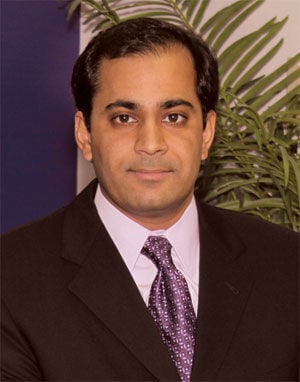
Anand Gala learned the value of hard work early. He had the advantages of being born in the U.S., but he’s never forgotten his roots.
His mother came from an entrepreneurial family, but no one else had advanced degrees. Rajul Gala was an example and an exception in a Hindu family where the girls were routinely ushered into arranged marriages when they reached adulthood. "At that time in history, it was the sons who had the opportunities, Gala says. But his mother, who was the youngest of four sisters, stood out. "Her parents saw a unique quality in her," he says. And because of her spirit and progressive viewpoint, they allowed her to come to the United States by herself.
She joined a small community of Indian emigrants in New York, where she met her future husband. The two married and began climbing the corporate ladder. Rajul worked at Fortune 500 companies, but in the early ‘80s the beacon of success began to dim for her—due to the reflection off the glass ceiling.
A neighbor was a successful McDonald’s franchisee, Gala says, and so his mother started investigating both McDonald’s and Burger King. The two behemoths were in high demand at the time and could dictate where the stores were located, which would have involved the Gala family having to move—plus the chains were expensive.
But another burger chain, Jack in the Box, had just agreed to a buyout and new management was looking to refranchise some of its restaurants, including the ones in the Galas’ area. "Geographically we could stay where we were," Gala says. "She took the risk."
His father remained at IBM. The two were a remarkable combination of role models for him, Gala says. They taught him that "education was the only way up; the only thing that can’t be taken away," he says.
Gala began working in the business when he was around 8 or 9, mopping floors and making salads. "They taught me how hard people work," he says. Being raised in the U.S.—first New York and then California—he never experienced the poverty his parents did growing up in villages with no running water or electricity.
After opening that first Jack in the Box in 1983, Rajul grew her company to 10 locations in the Los Angeles area by 1994. "I’m a goal-oriented person," she says. "I’m always trying to accomplish more."
In time, she handed the business off to her son, who is president and CEO, and limits her involvement to a director seat on the board and a couple of days a week in the office working on accounts payable and payroll. This enables her to concentrate on her passions—philanthropy, travel and Ayurvedic yoga.
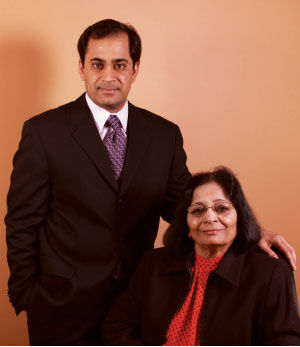
Rajul Gala turned to franchising after hitting the glass ceiling in the 1980s. She grew the company to 10 units, before her son, Anand, took over the day-to-day operations.
Values from the homeland permeate Gala Corp.’s business activities to this day. The company’s mission statement is replete with value-laden prescriptions (loosely based on Hinduism) for business success. But the company’s philosophy is no different from any American company: "An emphasis on family and people…and profit’s not a dirty word."
One edict is: "To help our people reach their full potential" is not just talk. Gala tells the story of someone who fled from the Ayatollah’s Iran and rose from fry cook to general manager of a Gala unit in a matter of months. When he expressed a desire to go to medical school and become a doctor, the company rearranged his work schedule to make it happen. "It’s the care and interest you take in your people, encouraging their success, which leads to your own," Gala says. "Because of the accommodations we made for him, he doubly committed his efforts and treated the business as if it was his own."
The values have propelled Gala Corp. to new heights. After Gala joined the operation full-time, the company opened its first Applebee’s in 1998, first Del Taco location in 2000, and first Famous Dave’s BBQ smokehouse in 2006. Revenue rose from $30 million to $35 million in 2006 to $87 million last year. A record 2009 is expected. The company, which exited from Jack in the Box by 2007, now has some 3,200 employees spread across headquarters and 27 restaurants: 19 Applebee’s, five Famous Dave’s (with another one in development), and three Del Taco’s. Gala operates primarily in Southern California but has several locations in Phoenix. In 2003, Gala Corp. was recognized by Restaurant Finance Monitor as one of the 200 largest restaurant franchisees in America.
"Anand is a true leader, in addition to being a really nice individual," says Jim Murphy, vice president of franchise operations for Famous Dave’s. Gala chairs Famous Dave’s franchisee advisory board and contributes to the concept’s marketing advisory committee. "He’s a great operator, as well," Murphy says. "He has two of the highest-volume units in the entire system."
Philip Crimmins, senior vice president of development for Applebee’s Services, echoes Murphy’s sentiments. "We are very happy to be doing business with Anand Gala," Crimmins says. "He has been an acquirer of his neighbors and has a high degree of sophistication. California is probably one of the most distressed areas of the country right now for all of casual dining. Even in that environment, he’s working on expansion plans with us."
People who still think of franchisees as single-unit operators have the wrong picture. A 2007 research report attributed much of the recent growth in franchising to multi-unit operators, which now account for almost half of all franchised units. Multi-unit operations can grow to tremendous size and complexity. Gala Corp. reflects these trends, with a sophisticated corporate structure: a district manager for every five units, a director or vice president of operations for each brand, and a CFO-controller, as well as accounting, payroll, IT, marketing, and human resources departments.
The company’s multi-concept structure is a source of strength, Gala says. While the company may be concentrated geographically, it is diversified among three franchise concepts that are in different segments that have different momentums at different times (fast food versus casual dining), as well as different price points, growth trajectories (Famous Dave’s is new and underpenetrated in California), and demographic sweet-spots. "All of these things provide diversification and insulation to the unpredictable macro-environment," Gala says.
Dealing with multiple concepts does add complexity, however. Each brand is different, Gala says. Positions, individuals, and resources cannot always be leveraged to the most efficient level. Marketing, for example, is brand-specific. Also, like HMSHost, which operates more than 300 brands, Gala Corp. must employ a focused head of operations for each brand.
Gala is pitched by new franchise food concepts on a weekly basis and is clear on how he sifts through the opportunities. "Rule No. 1," he says, "if you’re going to be in the restaurant business, the food better be good." Second, restaurants entail tremendous risk and he entered his three current concepts because they offered the most compelling returns. "The second filter is you look for the best economic returns you can get," he says.
Financing growth
Gala Corp. plans to add 10 restaurants in next five to seven years using a combination of leverage and internal financing. Gala finds 50 to 60 percent debt to be the optimal level of overall leverage and is careful to put at least 30 percent equity into every deal so that no single part of the company is over-levered. He prizes cash flow and will sacrifice points of return to get it. He would rather earn $15 as a 50-percent return on a deal than $1 that represents a 100 percent return elsewhere. The greater cash flow translates to greater operational flexibility, which is the name of the game in these tough times, he says.
In contrast to recent trends in U.S. culture, there’s no shame about profits at Gala Corp., only pride that the business and profits are still growing in a tough environment—present-day Los Angeles is saddled with recession, state budget woes and a regulatory environment some outside the state consider onerous. One way Gala succeeds is by becoming intimately involved with the community, making the effort to engage local schools, nonprofits, and municipal governments. Gala Corp. participates in fund-raising drives for the schools. It also donates its old computers to schools or uses volume discounts from suppliers like Dell and Hewlett Packard to obtain new computers for schools at essentially no cost. The reward for these investments? Local mayors take Gala’s phone calls, plus "whenever we do grand openings, the mayor will come out, because we’ve been such an important part of their communities," he says.
Gala Corp.’s business activities are not limited to franchising. Monetizing core competencies is another part of the business. The company sells real estate development services to third parties, helping to develop small shopping centers in order to get a pad site, for example. Gala Corp. also participates in joint ventures in land acquisition where a Gala concept will be the restaurant for a new hotel. All the third-party business has had a restaurant hook so far, but Gala expects to branch out in the future.
Gala Corp. also leverages its investment prowess, backing the import and distribution of packaged foods, for example. In addition, Gala is an angel investor for tech start-ups. Some of the deal flow comes from introductions made at The Indus Entrepreneurs (TiE), a business networking group for South Asians with a chapter in Southern California. TiE is a "labor of love" for Gala who has mentored other businesspeople of Indian descent through the organization. Gala is also active in the Young Presidents’ Organization (YPO), a select group with 8,000 members world-wide where, he says, he has learned a lot about being a restaurant CEO from chairing an annual conference and helping to administer YPO’s 1,000-strong food industry network.
Right now, Gala doesn’t know how big he wants to grow the company. "When it’s big enough, it’ll just feel right. I couldn’t tell you today," he says. As for restaurants versus monetizing core competencies, "opportunities and return on investment will determine what direction we go," he says.
Right now, he feels he’s in a "great place" with his franchisors and wants others in the franchisor community to know how he got there: "Based on my very positive experiences with the franchisors I have, the one thing I would like to say is you gain more success through mutual respect and partnership with your franchisees than any other method." Values—first, last, and always.

