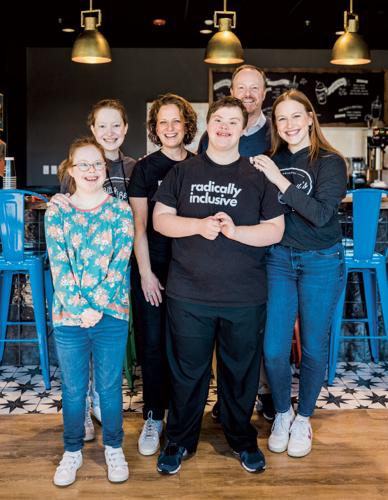


The Wright family named Bitty & Beau’s Coffee for their two children with Down syndrome and have grown the concept to 18 locations, both company-owned and franchised.
What started out as a business where Ben and Amy Wright’s children could eventually work has evolved into a franchise providing employment opportunities to people with intellectual and developmental disabilities.
“My wife and I saw that 80 percent of people with intellectual and developmental disabilities didn’t have jobs in their own communities,” said Ben Wright, who with his wife co-founded Bitty & Beau’s Coffee in Wilmington, North Carolina. “We have two children born with Down syndrome, and we knew our kids would be in that boat. We just weren’t having it.”
Knowing the future held many challenges for Beau and Bitty, they began to connect with others in the IDD—intellectual and development disability—community. The family became involved in advocacy in order to bring awareness to the broader population.
They began to notice, however, that no matter where they went, they saw the same faces.
“It was just kind of an echo chamber,” said Wright. “The people who would come to such things were already sympathetic to people with IDD and their plight in the world.”
Amy Wright got to thinking about how to reach out beyond the somewhat insular community. In a “shower thought” moment, she came up with what would eventually become Bitty & Beau’s Coffee.
Bitty & Beau’s employs people with forms of IDD. The employees get the chance to interact with the public and socialize, and on the flip side, customers get experience with the IDD community in an informal environment. As Ben Wright put it, “Everyone knows what to do in a coffee shop.”
The first Bitty & Beau’s opened in January 2016, only about three months after they conceived the idea. Eighteen locations are now open across a dozen states, including 11 franchise stores, combining to employ more than 400 people with disabilities.
“We realized that there was a lot more at stake here,” said Wright. “Not only was there a need for jobs for people with IDD, but the reason there weren’t jobs for them is because those of us who don’t have disabilities don’t know how to interact with people who have them.”
What started out as an idea to benefit their children turned into much more than a way to provide employment opportunities, with the stores also creating an avenue for more community outreach. “The mission of the business is for people without disabilities to come into the shop and see people with disabilities doing jobs that they could do,” said Wright.
The Wrights started out by scaling through company stores before launching a franchise program in 2020. While they want to bring their model everywhere, choosing franchisees is a careful process, especially since they’re stepping into uncharted territory.
“We’ve not found anybody who’s franchised or scaled like we’re trying,” said Wright. “That’s a blessing and curse in a way.”
Making sure prospective franchisees understand the Bitty & Beau’s model and mission is essential for the Wrights. While stores do look to hire people with IDD, a key goal is also to show people without a disability that those with IDD can work and contribute. Wright referred to this as “social reconditioning.”
The cost to open a Bitty & Beau’s Coffee ranges from $461,750 to $858,050; the average unit volume is $620,572.
As for what the brand’s namesakes think of the business, they have opposite loves. Bitty, 13, loves to serve customers, though Wright clarified Bitty doesn’t work at the store just yet. Beau, 18, on the other hand, would prefer to be a customer, Wright said, and in general loves being in the stores.
“When we go to grand openings for the coffee shops, they love it,” said Wright. “Everybody likes to feel like they matter, and having a coffee shop with their names up there is pretty powerful for them.”