

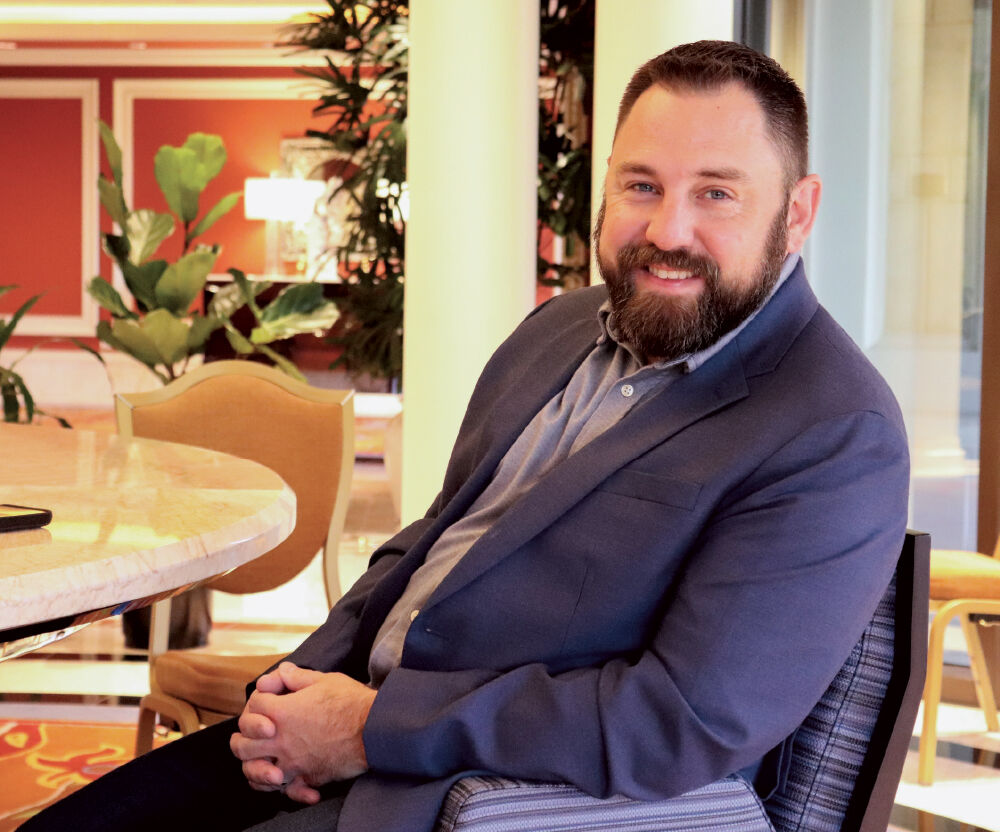
Digitally monitored beer kegs help reduce waste, says Tapville CEO Joseph Tota, giving another example of how his company puts technology to work.
Since founding food and beverage company Tapville, CEO Joseph Tota has wanted to make the restaurant industry faster and more efficient, and his tool of choice is technology.
The Chicago-area native began his career in retail as a management consultant, where he worked with food and beverage operators—and their technology. Tota said during that time he came to realize there were a lot of challenges in the hospitality sector, and believed technology could solve some of those problems.
The next step for Tota was starting the Red Arrow Tap Room in 2016, which became Tapville. Today, there are 20 Tapville restaurants, and each includes digital options that give the customers more control over their service.
In addition to digital ordering at the table, customers can also pour their own beer, cider, cocktails or wine, with nearly 50 taps to choose from at a typical location.
“When a guest walks into Tapville, we issue them a core pass,” Tota said. “It’s a card that’s synced with their credit card, and they can use that card to pour their own beverages or order their food. They still have servers, but it makes the process more efficient.”
When a customer is ready to leave, they leave their card at a checkout box. Tota said the practice has eliminated paper checks and menus, while also allowing servers to cover a larger section of the restaurant.
In addition to easing the ordering process, Tota said Tapville gives customers the ability to experiment with craft beer, which is an industry that has grown tremendously in the last decade. Across their locations, Tota said some of the best beers come from independent craft brewers, and that the brand makes an effort to get regional brews.
“We really localize our selection,” Tota said. “Our concept gives the operators of those breweries a chance for people to test their beer and even visit their brewery as well. We see it as a really great partnership. The ability to sample by the ounce is a really good proposition for the guest, too. Instead of buying a pint of beer you may not like, you can build your own flight.”
The Brewers Association reports the number of breweries in the U.S. has increased from 1,813 in 2010 to a whopping 9,247 in 2021. Tapping into the popularity of craft beers with self-pouring isn’t the only way Tota is implementing technology.
“Because of our loyalty program, we know exactly what our customers pour on their visit, how long they stay for and what they like,” Tota said. “We can then really target our marketing for a customer. If a guest comes in who drinks a lot of IPA, we can send them marketing all about our IPAs. The data insights are phenomenal.”
The technology at Tapville has come into play with operations, too, which has cut down on waste for the brand.
“A lot of our options come through kegs and those are all monitored digitally,” Tota said. “When a keg gets close to empty, the staff is alerted, so we know exactly what’s in every keg. Because of the monitoring, the waste in draft beer is only about 3 percent. The industry waste for draft beer is about 23 percent, so we’ve reduced waste almost 20 points on draft beer alone.”
As Tapville allows customers to experiment with their drinks, the brand itself is experimenting with new ways to expand. In addition to its traditional brick-and-mortar locations, Tapville has two other concepts franchisees can select.
One is the recently launched Tapville Mobile Taproom. A taproom in a trailer, an operator can take the mobile unit to events with 16 taps to offer. The other is a kiosk concept, which can be implemented in malls, airports, entertainment venues and other locations.
The cost to open a full Tapville location is between $672,250 and $1 million. For a mobile taproom it’s $159,750 to $198,900 and for a kiosk it’s $134,750 to $291,500.
As the company grows, Tota plans for a mixed ratio of company-owned units and franchised locations. He added the decision to franchise wasn’t quickly made.
“We thought franchising might be the right route, but I think it took us a few years to really fine-tune the concept before we published” a franchise disclosure document Tota said. “But now, with the system we have in place, the technology we have and the training, it’s easy now for an operator to get started with our concept.”
The company is looking to expand the brand in California, Colorado, Connecticut, Florida, Indiana, Nevada, Pennsylvania and Texas. “The big thing is, we’re a brand that solves problems in the hospitality industry, so I think you’ll be seeing more of us in the future,” Tota said.