

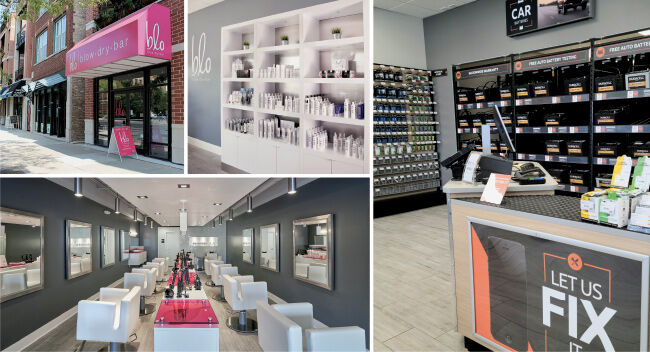
Interiors and exteriors at Blo Blow Dry Bar, left, whose VP of development says rents are nuanced and market-specific. Above, an interior at Batteries Plus, where franchisees are encouraged to renew early in exchange for landlord perks.
Last August Bill Lenehan, CEO of Four Corners Property Trust, surveyed the sea of restaurant closures amid pandemic lockdowns and had an idea: raise a new fund specifically to buy vacant rather than leased properties. With Lubert-Adler Real Estate Funds in Philadelphia, a private equity firm, putting in $130 million and Four Corners adding $20 million, they launched Vacant Venture last fall.
“We’ve now spent six months looking for vacant properties. We’ve looked at 3,000; we’ve formally underwritten over 1,500,” he said, adding checking out all those sites means worn-out shoe leather. “For us, it’s turning over a lot of rocks.”
Vacant Venture is just one example of new moves in real estate during a year and counting of COVID-19 disruption. We asked investors and landlords on the one hand, and tenants on the other (see sidebar), to describe their pivots in the past and plans for the future.
Four Corners Property Trust is a five-year-old REIT, or real estate investment trust, with 805 buildings in its portfolio, 95 percent of those restaurants. “We basically don’t have any that are empty,” he said, adding Four Corners was collecting “99.8 percent of our rents” by late summer last year.
With the new fund, Lenehan seeks to buy vacant properties at a lower price than leased, and then set the rent lower as well. It’s not necessarily easy. “People are not being terribly realistic on what the new value of their property is, if the tenant is no longer capable of paying rent,” he said.
He believes restaurant tenants that are still growing—and there are plenty—will win with the model.
‘Hard calls to take’
Matt Laatsch, COO at U.S. Restaurant Properties, said his firm cut lease rates for tenants last year, although he would not disclose the percentage. “We started with April and May, and some people that’s all it took,” he said, noting other landlords took other paths.
“We decided to go the discount/abatement route. There wasn’t one right way or one wrong way to skin the cat. One, there was a human element. We’re all in this together, and it wasn’t good,” he said.
“Sometimes those phone calls were really difficult. Those are hard calls to take, when people say, ‘I can’t afford to do anything this month,’ and they aren’t kidding.”
U.S. Restaurant Properties owns roughly 100 properties, a vast majority of them quick-service restaurants with drive-thrus. Other holdings are convenience stores, quick-lube and other auto service, and more recently Dollar Store.
“The single-tenant folks really bounced back quickly. Obviously drive-thru bounced back quickly. The convenience stores, it was amazing how quickly they pivoted to hot food items in the store, given the lines at the grocery store.”
About 20 percent of their properties are multi-tenant, mostly centers that are restaurant-centric and many with drive-thrus. “We knew they would be OK, but there were concerns about the mom and pop, service-oriented tenants. We have a couple of dry cleaners. What does a dry cleaner do when there’s no need to wear 15 buttoned-up dress shirts and slacks anymore?” he said.
He said the plan they put into action “worked out very well for us. Since August of 2020, we’ve collected in excess of 98 percent of our rents, every month moving forward.”
A long-term view
“We’re in pretty good shape to be honest with you,” said Josh Lewis, senior vice president of acquisitions for National Retail Properties, which owns 3,100 properties in 48 states “Last year obviously was a bit of a whirlwind,” with the end of the first quarter and all of second quarter consumed by rent relief.
“We’re long-term investors, so our goal was to try and be cooperative and provide rent relief to those tenants that could demonstrate a need,” he said.
National Retail Properties opted for short-term rental deferral agreements, one to three months, generally with a six- to 10-month period of deferral. “This was not a time to jab a sharp stick in their eye when they’re down,” he said about tenants.
As of December 31, National Retail Properties had collected 90 percent of contractual rent owed in 2020; by March this year that had risen to about 95 percent.
In some parts of their portfolio, tenants have “issues,” he said, “whether it’s driven by capacity or otherwise. We own some movie theaters, we own a little bit of fitness, we own a few sit-down restaurants, casual dining, family dining. We own a little bit of experiential retail. We have a bunch of Chuck E. Cheeses,” which filed for bankruptcy protection last June and emerged in December.
National Retail Properties typically buys about $700 million in properties each year; last year that number was only $200 million. “We turned off the acquisition engine at this time last year, and we turned that back on in Q4,” he said. This year he expects about $400- to $500 million in acquisitions.

Venture X, the co-working franchise with “an incredibly huge uptick of landlords” reaching out, Matt Cozza says.
What the tenants say about real estate
1. It’s a great time to get space. “There are so many spaces open now,” said Kirtis Hill, VP of market and business development at Batteries Plus, which plans to open 30 stores this year and is actively negotiating 15 leases now. That’s true for both relocations and new space. “We have seen landlords being more open, as far as lease rates or terms.” Matt Cozza at Venture X, the co-working franchise with 40 locations, echoed the point: “At the turn of the new year there’s been an incredibly huge uptick of landlords that are reaching out to us.”
2. Ditto for ‘perks,’ as they used to be known. Like many retailers, Batteries Plus rolled out curbside pickup in the early days of the pandemic and it’s here to stay, with 95 percent of its online customers buying online and picking up at the store. That means what used to be a perk has now become essential. “Having dedicated spaces for our stores, they’ve been open to us,” Hill said about landlords, offering two or three parking spots in recent lease deals.
3. Renew early, make a deal? If franchisees are within 18 months to two years of lease renewal time, Hill is urging them to “re-engage with landlords right now, see if there’s something available, in tenant approval or better signage, if you renew early.” At a corporate store, Batteries Plus renewed two years early in exchange for splitting the remodeling cost. “We got over $25,000 of improvement money from the landlord, and we contributed an equal amount, and it looks like a brand new store now.”
4. But don’t get cocky. “The narrative from the C suite” is there’s a glut of vacant space, “so there must be good deals to be had,” said Patrick Pantano, VP of franchise development for Blo Blow Dry Bar. “While there’s still availability, I think it’s very market-based,” with rents going down in New York City, for example, while in South Florida, where he’s based “rents have not changed; we’ve seen increases. We’re still not seeing landlords just giving away space. We’ve seen very comparable rents to 2019.”
5. Or, be your own landlord. That’s what Greg Goodman would advise. He’s the first franchisee of Turbo Tint and formerly owned three Alta Mere auto accessories stores. He used to lease his stores, but in 2002 did his first build-to-suit and now swears by it. “I have seen what owning that real estate has done for me and being able to leverage and having equity and cash,” he said, which came in handy especially during the pandemic. His next Turbo Tint will open in March 2022, in Oklahoma City, Oklahoma, on the site of a car wash that had a “leftover” parcel.