

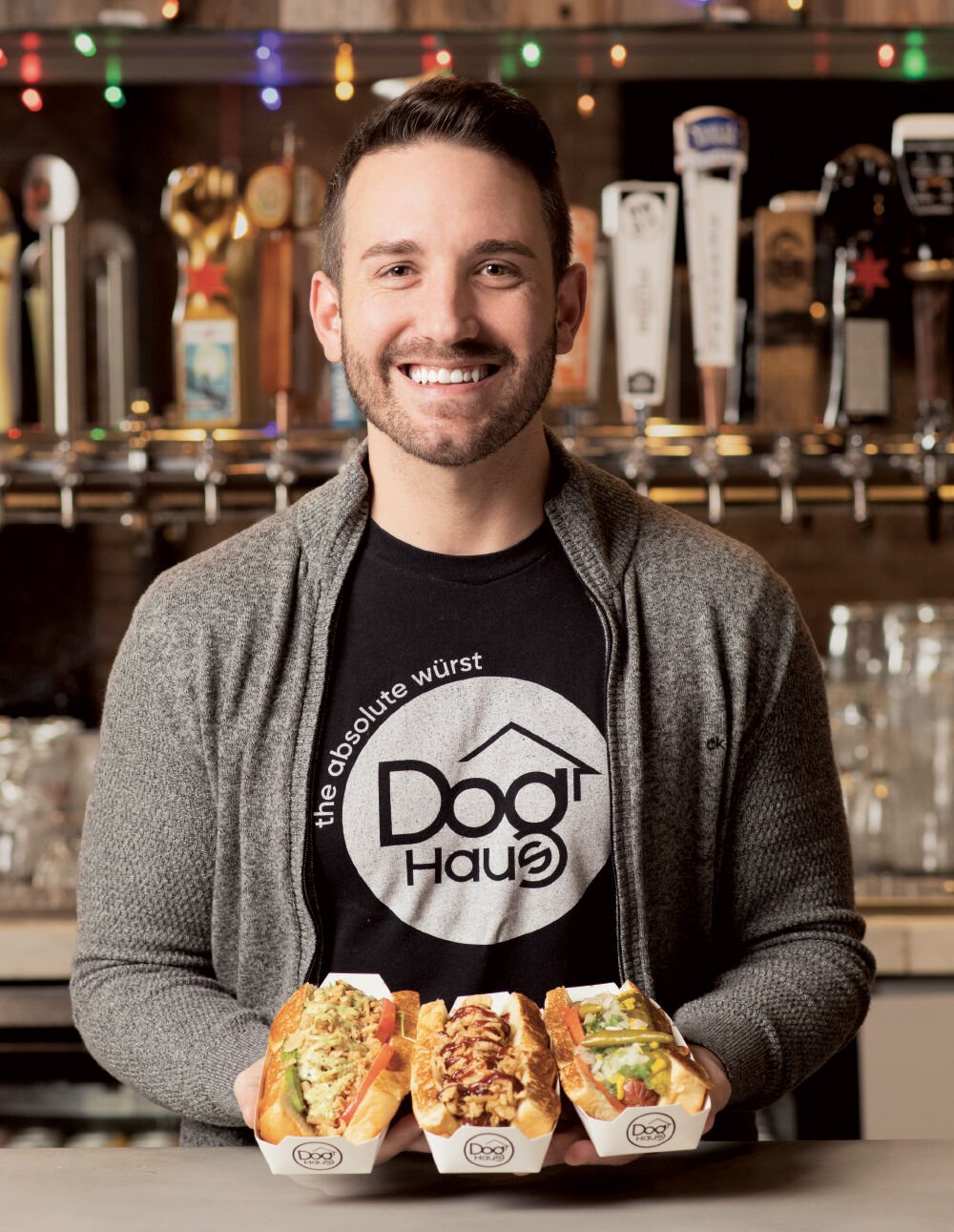
Multi-unit Chicago operator Jesse Koontz was the first in the Dog Haus system to try out a delivery-only ghost kitchen in 2019.
Winner: Dog Haus
Finalists: Happy Joe’s Pizza and Ice Cream and Kolache Factory
Military discounts first attracted Marine Corps veteran Jesse Koontz to franchising, but he chose an up-and-coming brand without those incentives because he liked the food and concept so much. Initially drawn to pizza brands Little Caesars and Papa John’s, Koontz started digging into territories, which “were very saturated,” he said.
“I wanted to find a concept at the beginning stages and get in early,” he said, “so I was looking for something really good but smaller, maybe a little more unknown but something I could see lots of potential in.”
Koontz visited the Dog Haus location in Burbank, California, in 2015 and “fell in love” when he walked in. “It was tiny, maybe 1,500 or 1,400 square feet,” Koontz recalled. “They were playing ‘80s music, had a modern industrial build with reclaimed wood, concrete floors, hard steel—it was so awesome. I was reading all their little sayings on cups and walls, humor on the border of what’s socially acceptable and what’s not, which really resonated with me. A lot of stuff that’s tongue-in-cheek,” like the “We love wieners” sign that now hangs in his Dog Haus Biergarten in the Lincoln Park neighborhood of Chicago.
He flew out Super Bowl weekend of 2016 to a discovery day, where he met founders André Vener, Quasim Riaz and Hagop Giragossian. “I always describe them kind of blue collar, not afraid to roll up their sleeves and do work if there’s a problem,” Koontz said. “That’s the overwhelming feeling I got, and it’s remained true to this day. Any time if there’s an issue or pressure point, they’re always open.”
Dog Haus also isn’t afraid to innovate, and was one of the first franchise restaurant brands to try delivery-only ghost kitchens when it partnered with Kitchen United in 2019. And Koontz was the first Dog Haus franchisee to open a virtual kitchen facility in Chicago’s River North neighborhood, which he admitted was “really tough. I didn’t have a great go of it” because delivery adoption wasn’t as widespread.
But then 2020 came, and the pandemic along with it, and his sales grew nearly 200 percent from 2019. Sales grew another 33 percent in 2021, and delivery now comprises about 80 percent of his total sales. Plus, Dog Haus launched more virtual brands utilizing existing ingredients in new ways, such as Bad Mutha Clucka, Plant B, Bad-Ass Breakfast Burritos, Jailbird and Big Belly Burgers, all under the restaurant group name Absolute Brands.
“I definitely recommend franchisees be heavily involved with the operations,” Koontz said. “Up front, it’s a huge time commitment. When I opened in Lincoln Park, I was there every day for the first year and a half to really understand the business and make sure it was a well-oiled machine.”
In addition to his brick-and-mortar location ranked No. 3 in the system in 2021, Koontz has two ghost kitchen sites in Chicago and a location inside Live Nation’s entertainment venue, Huntington Bank Pavilion. He’s in the construction phase for another Biergarten in central Illinois and has plans to open another in downtown Chicago. He recently signed a development deal in Florida covering Clearwater, St. Petersburg, Sarasota and Fort Myers.
“If you’re going to make a decision to invest in a concept, it’s more than just numbers. What’s really important is you’re passionate about the concept and the food,” Koontz added. “If you don’t believe in what you’re doing, you’re not going to be successful. There’s not a single thing on the menu I don’t like.”
Dog Haus franchisee Faizan Khan, however, cautioned against picking a concept based on feelings or passion and instead focused on the data. With a 25-year background in the technology industry, Khan advised prospective franchisees to do a detailed analysis of a potential location including demographics research, population densities, income levels, even walking scores, to gauge the financial model.
“Does the investment make sense?” said Khan, who opened his first location in April 2018. “Due diligence around that is super important, and corporate helps with that as well, but sometimes franchisees just go off a good gut feeling. Don’t do that. Go with data and make sure the site you’re selecting is a good site.”
Khan pointed to the differentiated Dog Haus concept, which touts gourmet hot dogs, burgers, fried chicken sandwiches and even vegan options crafted by Michelin-star chefs for non-gourmet prices, as a reason to invest. His average ticket is about $25 across his three Dog Haus locations in Washington, D.C., Maryland and Virginia, and he said the full bar complements the food and “sets up a franchisee for success.”
“It’s not like this very narrow, one type of food selling that might be a niche or a flash in the pan,” Khan continued. “It’s sustainable in the perspective of, this food is comfort, it’s familiar, it’s great, and everyone and anybody’s family is going to be able to find something to eat at Dog Haus.”
Khan is in lease negotiations for two additional locations in the D.C. area and hopes to open three to four more in 2022. The investment for a Dog Haus franchise ranges from $215,525 to $543,900.
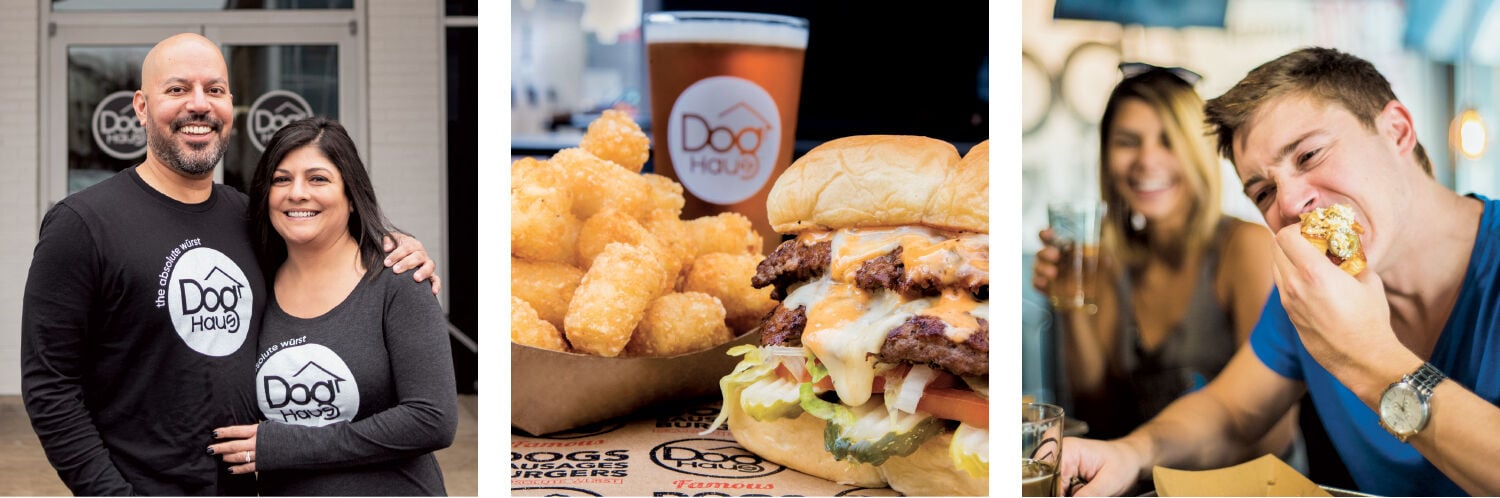
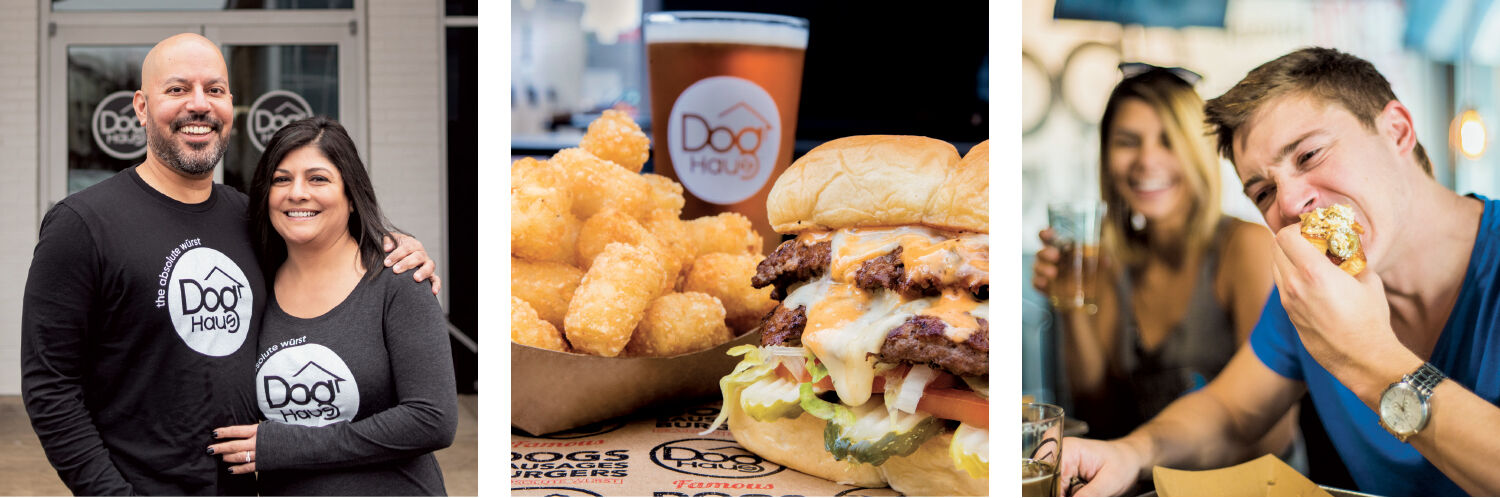
From left, husband-and-wife duo Faizan and Adila Khan own three Dog Haus locations in Washington, D.C., Maryland and Virginia. Faizan noted the brand’s wide menu variety, including burgers, tots and sausages, is a plus.
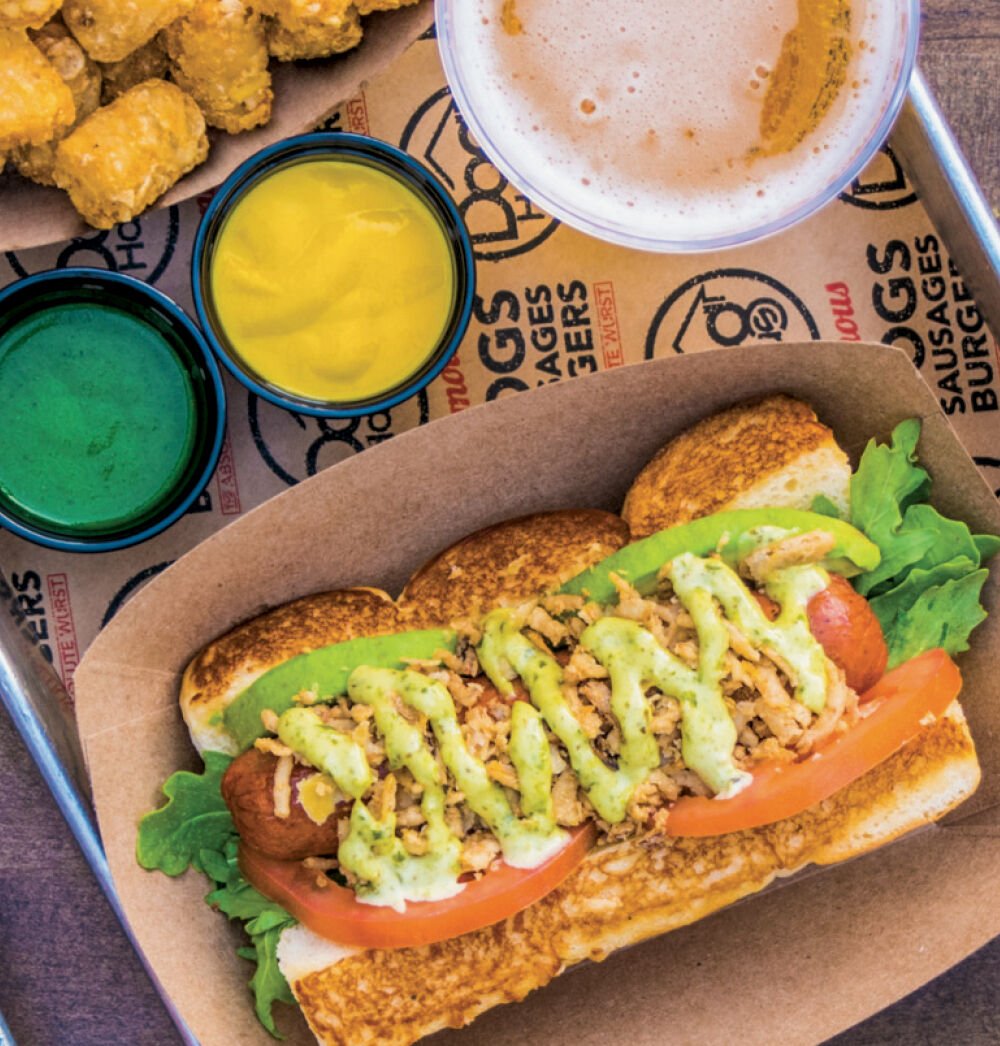
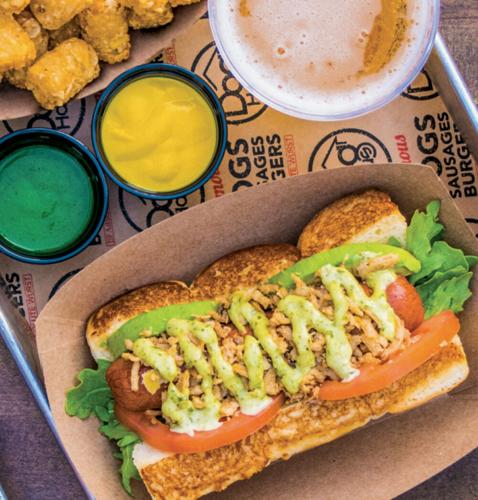
Dog Haus touts its gourmet hot dogs and even has vegan options.
Dog Haus
Positives
- Multiple revenue streams from ghost kitchen and virtual concepts that can be toggled on and off depending on the traffic at brick-and-mortar locations.
- The brand is an early adopter of new technologies and a pioneer in the off-premises space (it partnered with Kitchen United in 2019).
Use Caution
- Tongue-in-cheek humor used in store signage, such as “We love wieners,” may not be to everyone’s taste.
Launched in 2010 by three friends in California, Dog Haus offers specialty hot dogs and sausages at restaurants and craft beer at “biergarten” locations. It grew sales 18.6 percent in 2020 with 43 total units in the U.S.
Franchise Times | Full Speed Ahead Big Haul Affordable Entry On the Move | Early Risers Fixer Upper Upstart Adventure |