


Research by Matt Haskin and Jacob Scheinost
Rising inflation was a major economic factor in 2022, but while consumers bemoaned climbing costs, they largely kept buying and franchise businesses saw it reflected in their sales.
The U.S. Bureau of Labor Statistics reported consumer prices rose by 6.5 percent in 2022, with food prices in particular increasing 10.4 percent. According to the bureau, the cost of food away from home rose 8.3 percent, and many franchises likewise took price as they sought to protect profit margins.
Only three key categories covered by the Top 400 saw overall sales declines: real estate, health and medical, and off-premises pizza. Some segments had clear winners, while others were more of a mixed bag as the shakeout continues and coronavirus pandemic recovery remains uneven. Franchise brands also continue to grapple with shifting consumer habits, the ever-evolving technology landscape and development hurdles created by rising interest rates and tight commercial real estate markets.
Still on top
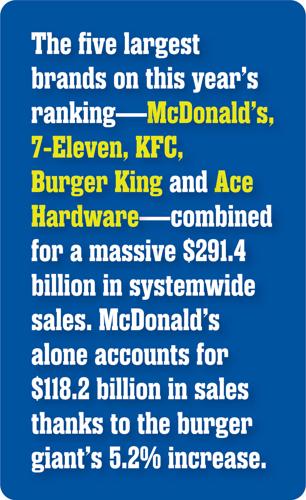
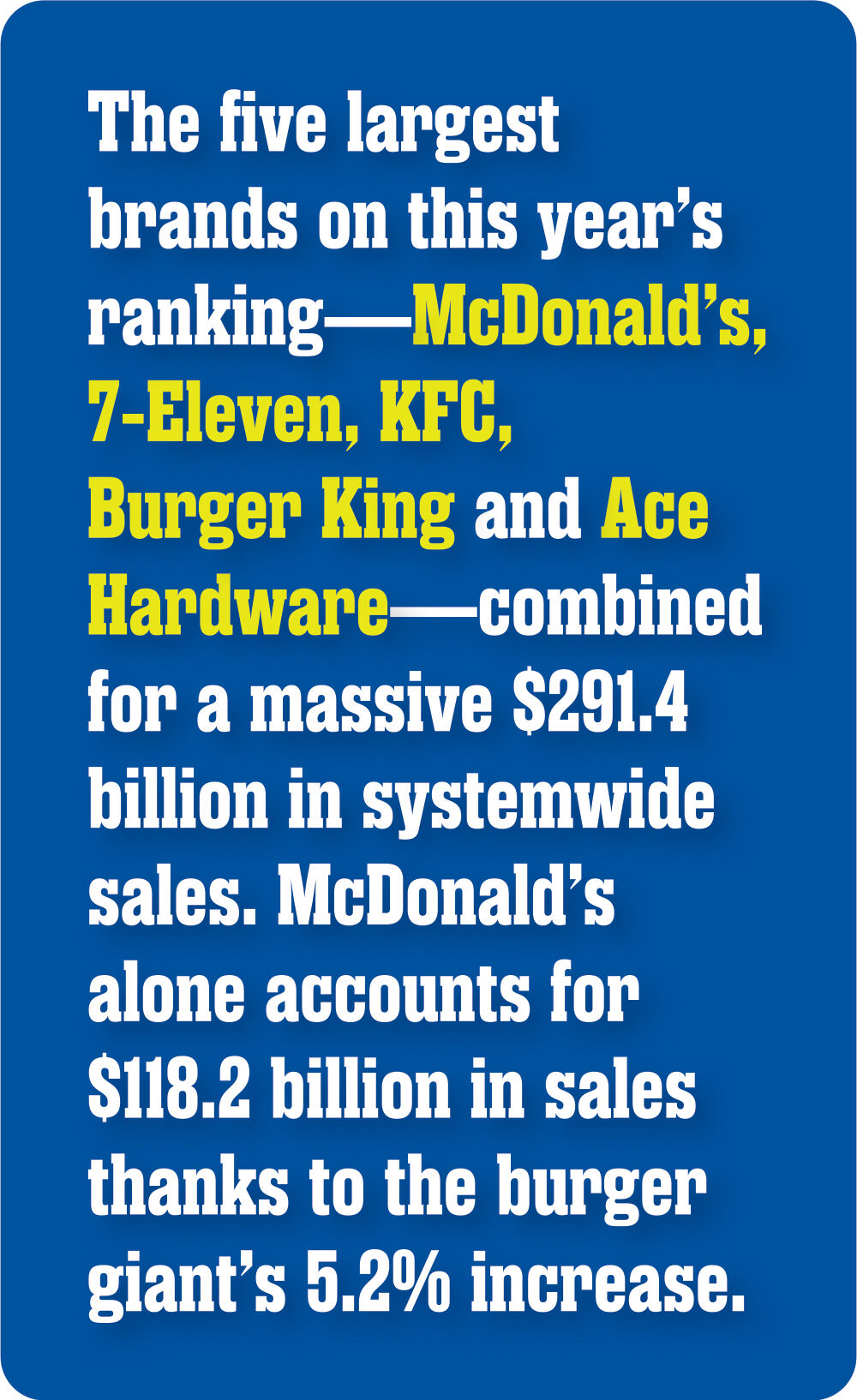
Brands at the top of this year’s list remained mostly the same. In fact, the top five companies went unchanged, with McDonald’s staying at No. 1. The global burger juggernaut grew systemwide sales 5.1 percent in 2022, to $118.2 billion. 7-Eleven, even with its 1.7 percent sales decline, remains at No. 2 as its 84,061 units pulled in sales of $93.5 billion. KFC likewise saw sales slip, down 0.8 percent, but held on to the No. 3 spot with $31.1 billion in global sales. Burger King and Ace Hardware are again No. 4 and No. 5
The rest of the top 10 had a few shifts. Chick-fil-A’s estimated $19.3 billion in sales pushed it up to No. 6, swapping positions with now No. 8 Domino’s, which was down 1.3 percent, to $17.5 billion. Subway remains at No. 7 with its estimated $19.1 billion in sales, while Circle K and Taco Bell round out the top 10. For Taco Bell, the bump to No. 10 comes as the Yum Brands subsidiary grew sales 10.3 percent, to $14.6 billion.
The top 10 overall had $378.9 billion in sales in 2022, a 2.8 percent increase from the $368.5 billion from the previous year. These 10 brands also grew their number of units, increasing the amount of worldwide locations from 249,030 to 257,301.
While not in the top 10, another brand with a top-tier performance in the rankings was Crumbl Cookies, with an estimated sales increase of 174 percent, to $685 million. Crumbl also led in unit growth percentage at 110.7 percent, reaching 689 locations.
Looking at the larger picture, the top 200 brands in the rankings had worldwide sales of $680.1 billion in 2022, a 3.1 percent increase from the $659.6 billion in 2021. The number of worldwide units also grew, increasing from 522,868 in 2021 to 539,062 in 2022.
While units grew worldwide, though, franchised locations in the U.S. did see a small reduction, from 256,276 in 2021 to 253,541 in 2022.
Mainly gains for restaurants
The QSR burger category in general experienced a solid 2022, with the segment up 5.1 percent to $185 billion. Another indicator of the category’s success was No. 4 Burger King, with sales up 8.7 percent, to $25.5 billion. The better burger segment was successful, too, up 7.8 percent to $3.4 billion.
Other restaurant categories up in 2022 were sandwich chains and Mexican brands, both with increases of nearly 10 percent. Along with Taco Bell, other large players in the Mexican restaurant segment turned in strong showings, with systemwide sales for No. 76 El Pollo Loco up 6.8 percent, to cross $1 billion. Qdoba Mexican Eats also pushed past the $1 billion mark, with sales up 8.8 percent.
In the sandwich/sub category, No. 39 Jersey Mike’s was a notable top performer as it reached $2.7 billion in sales, a 22 percent increase, and added 298 units.
At the traditional casual dining level, the segment had 7 percent sales growth, to $11.4 billion. Applebee’s, the largest in the group, finished with an estimated $4.6 billion in sales, followed by Chili’s at $4.1 billion and Red Robin with an estimated $1.5 billion.
Most of the brands in casual dining did have unit count declines, though, with only Chili’s adding units. Applebee’s was down two restaurants while Red Robin’s net unit count dropped by 20 last year.
Declines were also taking place in the delivery pizza category, snapping a streak of success for the segment. The category had been strong during the pandemic and hasn’t had an overall sales dip in at least six years. That changed in 2022, with off-premises pizza sales declining $116 million, or 0.3 percent, to $43.3 billion.
The declines were reflected in the numbers from three of the largest brands in the segment. Pizza Hut was down 0.8 percent; Domino’s had a decrease of 1.3 percent and sales for Papa Murphy’s declined 9.1 percent. Other large brands Papa Johns and Little Caesars did have modest sales growth of 1.3 percent and 2 percent, respectively.
Other than the pizza pullback, restaurant categories remained fruitful in 2022. The casual breakfast segment had 5.8 percent sales growth, with standouts being Eggs Up Grill and Elmer’s, both with sales increases of more than 29 percent.
Chicken chains, meanwhile, had a 5.6 percent sales increase overall, with the segment totaling $67.6 billion. The largest brand in the chicken segment, KFC, did have that 0.8 percent decline, but still brought in $31.1 billion.
Mixed results for home, business services
Away from restaurants and on the home front, shifts in the housing industry led to a roller coaster of a year for real estate. Homebuying went from frenzy to near-standstill as buyers were pushed out of the market because of increasing mortgage rates. As a result, overall sales for real estate brands fell 9.2 percent, from $38.6 billion in 2021 to $35.1 billion in 2022.
Home services, though, had a solid 2022, with overall sales coming to $13 billion, a 10.3 percent increase. Subcategories leading the segment were property management, increasing by 27.2 percent, lawn care, up 19 percent, and tree services, up 14.7 percent. The brand with the highest sales growth percentage in the segment was Superior Fence & Rail at 61 percent.
Cleaning brands, whether they were serving homes or businesses, also had consistent growth in 2022 with $12.8 billion in sales, marking a 10.6 percent rise. For commercial cleaning in particular, the subcategory had a 10.8 percent increase in sales, to $4.6 billion.
When it came to other business services, brands across several segments such as staffing, security and information technology had respectable sales growth. When combined, all business service brands had 7.9 percent sales growth, to $8.4 billion.
Companies with notable increases in sales growth were Dale Carnegie Training, up 52.9 percent, Signal Security, up 30.4 percent, and Nexstaff, up 29.2 percent. IT brands also had strong years, with TeamLogic IT and CMIT Solutions reporting sales growth of 27.2 percent and 20.7 percent, respectively.
Personal services powers ahead
A category that includes fitness, hair care, education and wellness franchises in its lineup, personal services made major gains in 2022, with overall sales of $24.6 billion, up 19.1 percent.
No. 29 Planet Fitness, the largest brand in the Top 400 fitness segment, showed there’s growing demand for low-cost gyms, with systemwide sales up 14.7 percent, to $3.9 billion. Its total unit count swelled by 156, to 2,410 locations. No. 67 Orangetheory Fitness, which in 2021 was the lone gym decliner and down 12.5 percent, began its rebound last year, increasing sales to $1.25 billion. Though that’s notable 25 percent growth, the brand is still behind its 2019 sales of $1.36 billion.
Massage, hair care and beauty brands continued adding to their top lines, with Hand & Stone up 14.8 percent and The Lash Lounge seeing a 42.9 percent sales boost. No. 59 Great Clips, the biggest hair care brand on the list, hit $1.5 billion in sales, up 12.9 percent.
It’s no surprise that pet care franchises, meanwhile, saw sales surge in 2022 as pet ownership skyrocketed during the pandemic and the trend of people spending more on their pets continued. Retailer Pet Supplies Plus was up 16.5 percent, with systemwide sales of $1.7 billion, and dog daycare provider Dogtopia was up 44.6 percent, to $166 million. Dogtopia also added 40 locations.
How we rank the Top 400 franchises
The Franchise Times Top 400 is an annual ranking of the largest franchise systems in the United States by global systemwide sales, based on the previous year’s performance.
In a five-month research process and building upon a database that began in 1999, our research team uses a combination of companies’ voluntary reports and publicly available data, including the franchises’ most recent franchise disclosure documents and Securities and Exchange Commission filings.
To qualify, a company must be a legal U.S. franchise. Franchisees must own at least 10 percent of the company’s total units. The company must also be based in the United States, or have at least 10 percent of its total units in the United States.
Systemwide sales is defined as the total sales for both franchise and company units. Those sales figures should represent sales to customers, and not corporate sales to franchisees or prospective franchisees, such as royalty revenue or franchise fees. Other revenue not directly related to franchising should not be included.
If two companies reported the same systemwide sales, the higher ranking is given to the company with the most units. Preference is also given to companies that voluntarily report their systemwide sales, rather than those companies for which we must estimate the sales figures.
Franchise Times’ estimated revenue for real estate companies is based on 2.5 percent of their reported sales volume. Real estate companies report sales based on total volume of homes sold. So, if a home is sold for $200,000, it would be listed as $200,000 in revenue. The Franchise Times estimate would count $5,000 in revenue earned as a commission from the sale.
We estimate travel agencies based on 12.5 percent of their total sales volume. Like real estate companies, travel agencies report sales volume based on the value of the vacations sold, rather than their commissions.
Research begins for next year’s project in late April.
To submit your brand’s numbers or for more information on the project, contact Franchise Times General Manager Matt Haskin, who leads the research effort for the Top 400: [email protected].